
By Wil Haygood '76 I am haunted by my March madness. It ended some years ago, but still, at this time of year, when college hoops are the rage, it seems to come back. I hear the commentators talking about hard-luck players, about unheard-of juco (junior college) transfers now dazzling on TV; about so many players envisioning a dreamt-of moment: A lovely jump shot slicing through the net with no time on the clock to send their team to the next round, and now Momma has to get to the game, drive all night if she must, borrow somebody's car if she must. But she must. We watch and wonder and hear the hopes and predictions of those talking about the game as if suddenly it has some kind of life-or-death angle to it. The fateful moments are a thrill to watch. But so many of them are lived away from the glare of TV, moments any proud ballplayer will come to store up in a suitcase as time goes on. How unlikely, how strange, my own basketball odyssey. I played at a Division I school. My name stenciled right there on my very own locker. And here I was a kid cut from the junior high basketball team. Cut from the high school basketball team. I was the walk-on who refused to walk on by. Here's what drove me mad: The simple pure bounce of a basketball on a playground. It could be 40 degrees or it could be 90 degrees. I played alone and I played with nine others. I played in rickety gyms and well-attended suburban gyms. I played in gyms lit by sunlight and in the gym at the mental hospital on the Ohio State University campus. My cousin, Toodie, was the janitor and opened the doors wide some weekend mornings and I scooted in, just after dawn. The place seemed to be asleep, save for me and my bouncing ball. It started at Indianola Junior High in Columbus, Ohio. I was cut from the eighth-grade team. Didn't see my name on the list posted outside the gym door. I had barely slept the night before. I had brought my gym bag to school that day like any other player hoping to make the team, believing in his destiny. I looked at the list, stood there, didn't see my name, tried to make it appear, squinted my eyes. Then I felt my eyes water up. A knot of kids had gathered round, snickering at those of us there who had slipped from the pier - off the team. School bullies without any ballplaying talent were especially harsh: ha ha ha ha. A brittle nastiness to their laughter. Some mean girls giggled themselves away. After school that very day, when it was time to practice, I too went to the locker room. I sat at a distance from those who had made the team; I dressed in silence. I couldn't not be there. I loped out onto the court. The coach spotted me, hoped he hadn't spotted me, didn't have the nerve to tell me to get the hell outta the gym. He called the team together to go over that day's practice. I blurted my passions out: “Coach, please, give me another chance. One more practice. Please.” He shot me a cold look, but as long as I didn't see his arm fling toward the door, toward the exit, telling me to get, I didn't mind the shame that Tutu and Skip White and Jim Hardesty and others who had made the team looked at me with. The next day turned into the next day into the next week into the next month. I dressed for every game, and got into several. I never scored a point the whole season. But it felt heavenly, being there, on that team, the March winds whipping around us as we walked home along the B&O Railroad tracks. Skip to the 10th grade, East High School junior varsity. I made the first cut; the last cut was now upon us. There'd be 12 players picked. Again, the night before the final selections, I fretted, listened to an ABA game (the defunct American Basketball Association) on my hand-held transistor radio, scrubbed my practice clothes on my mother's washboard in our apartment. I slept with my pretty white high-top Converse All-Stars under the bed and dreamed. Next morning my name was not on the list. I squinted, hard, harder. I roamed the halls and cursed. The end-ofschool bell rang out that day and I took my gym bag and marched off to the locker room. I got dressed for practice. I marched out onto the court. Coach Scott Guiler saw me, stared at me, probably wondered if I had noticed the list of those who had made the team. I walked over to him before he had a chance to throw me out of the gym. Another chance, coach, please; I begged in front of other players, players who had made the team. I didn't care about the strange looks on their faces, their hands on their hips, proud to have made the team, shaking their heads and rolling their eyes at me. Guiler said nothing, absolutely nothing. Then he blew the whistle to begin layups. I stood frozen. “Get in line. Everybody!” he bellowed, staring right at me.
Next year, my 11th-grade year, the varsity coach, Bob Hart, expressed serious doubts I'd make the team. I had begun haranguing him first day of school, weeks before the beginning of practice. We went down the list of comparable players, with me demanding how he rated their skills alongside mine. I remember this happened outside his office; the sun was shining through the large gym windows. He said something about my weight, being too skinny, getting pushed around on the court. That previous summer I had worn ankle weights, ran in them up the football stadium steps, hoping to build endurance. The coach didn't budge in his assessment: He doubted I'd make the team. He wore bifocals; I could hardly see the outlines of his eyes. He couldn't imagine the desperation beating in my heart. Just like that, a snap of the fingers, I left East and enrolled in West High School. I figured I had a better chance to make the team there. I made the first cut, not the second. The varsity coach, gray-haired, tweedy, severe-looking, would have none of my ghostlike reappearance on the court, which I tried, whereby his arms remained folded and he said, simply, “Thanks for trying out, son.” I transferred yet again, Franklin Heights High School. It took two city buses to get there. My mom, who worked nights as a waitress, slept mostly during the day, thought I was still at East High. I used my lunch money for bus fare and wrapped sandwiches in the morning darkness at home. I made the first cut, not the second. I knew nothing to do save show up for practice again, which I did. Bob Cawley, the coach, pulled me to the side. There were words exchanged. I told him I had to make the team; from the fright inside me I somehow felt light as a bird - and yet strong as a bull with determination. He relented. I wore number 30 at home, 31 at away games. The 10th game of the season, our team having scored 99 points in a blowout, Haygood happened to be at the foul line. We hadn't broken the century mark all year long. My shots swished through the net. After the game I was lifted on shoulders - I remember the high school wrestlers, tight as a gang, had rushed the court and hoisted me - and got my picture in the local newspaper for having scored the 100th and 101st points. It was March. My senior year Coach Cawley cut me. Told me there were sophomores whom he needed to play; I would be taking up space. I showed up in his office first practice and said, Coach, please, you've made a mistake, I can play; I need to play.
Coach Cawley allowed me to stay on the team. Varsity practice wasn't until 7 in the evening. I never had bus fare to get all the way home to the eastside after school and then come back, so I waltzed along the edges of corn fields, threw stones, walked and walked until four hours had passed and it was time for practice. I scored 12 points against Dublin High. My first time in double figures. Ever. I walked through the hallways the following Monday proud as a king who had conquered a foreign foe. That senior year in high school I dreamed of playing for some big-time college program. I had my sights set on Marquette; I'd settle for less. They didn't write me, but I wrote them, bragging up my meager stats. They wrote back - form letters, the noncommittal kind that they must have sent to thousands of other hopeful high schoolers - which I proudly displayed on the dresser in my bedroom.
At Miami, I got cut from the junior varsity. I walked back out onto the court the next day. Coach Jerry Peirson looked at me as if I were nuts. This wasn't fantasy land; this was college, and scholarship players. I begged, pleaded; Coach said I could practice until he decided what to do with me. He seemed stunned at my intransigence. It was a reprieve, but the trek to remain on the team would be harder. Before the season began, halfway through a grueling practice, I saw Coach Peirson whispering in the ear of another coach. I was called over. I was told my ACT scores didn't meet NCAA requirements. I wouldn't be on the team after all. The coach seemed forlorn. I toiled through a season of intramural basketball on campus. I told myself it was my redshirt year. I hung out some days after class, basketball season over, with Warren Dorsey, a scholarship player, and we talked about the New York Knicks, we talked about the Los Angeles Lakers. We talked, in earnest, about the teams we'd someday play for. We weren't joking either. That summer, back in Columbus, I ran hills, ran sprints on my own in the park near my grandparents' house until the sun descended, then grabbed my ball and walked up to the Ohio State campus, where there were games illuminated by lamplights allowing us to play till midnight, and beyond. The next year, my sophomore year - my name stenciled on my locker like all the other players, the uniform hanging beautifully on game days - I got in plenty of games. It was only junior varsity, but JV in Division I is big-time ball still. (Besides, we sometimes practiced with the varsity, and on varsity that year was Phil Lumpkin, drafted his senior year by the pros; he played for the Portland Trailblazers. My buddy Phil.) Anyway, I torched Kent State with three long jumpers; torched Ball State with two sweet shots from the top of the key. Tammy, a girl I coveted, a girl I never kissed, saw those shots drop with her own eyes. I saw where she was sitting during warm-ups. We traveled to Rupp Arena to play fabled Kentucky. That place seemed scary, loud, with muscled players coming toward me as if windblown they were so quick. I didn't score a point. I loved being on the court, the lights and noise in my face. Toward the end of the season I hurt my knee against Western Michigan. Had to have surgery. Otherwise, it would have been on to a pro career. My madness knew no end. Editor's note: This essay ran in The Washington Post's Style Plus section March 28, 2005. (c) 2005, The Washington Post. Reprinted with Permission.
|
 I stayed on the team the whole year. For the next-tolast
game of the season, I was named to start at point
guard. We played South High. I didn't have a family
member in the stands. No matter. I felt upon the world's
stage. I didn't score a point. I floated home. It was March.
I stayed on the team the whole year. For the next-tolast
game of the season, I was named to start at point
guard. We played South High. I didn't have a family
member in the stands. No matter. I felt upon the world's
stage. I didn't score a point. I floated home. It was March.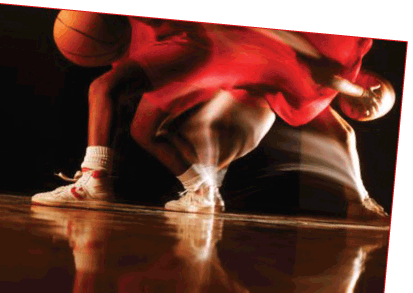 Who knows why men do such things. The pure
bounce of the basketball.
Who knows why men do such things. The pure
bounce of the basketball.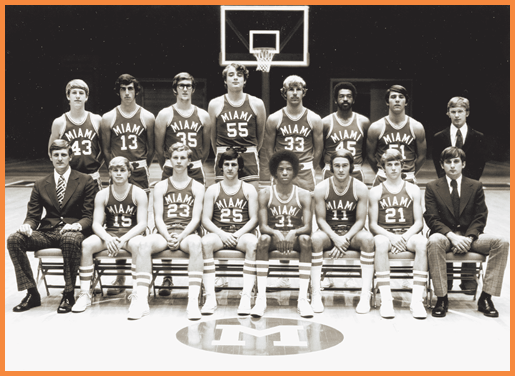 The author, number 31 in the front row, claiming his hard-earned spot on the
  Back to the Miamian Magazine Spring 2007 Web page