
Renate Crawford
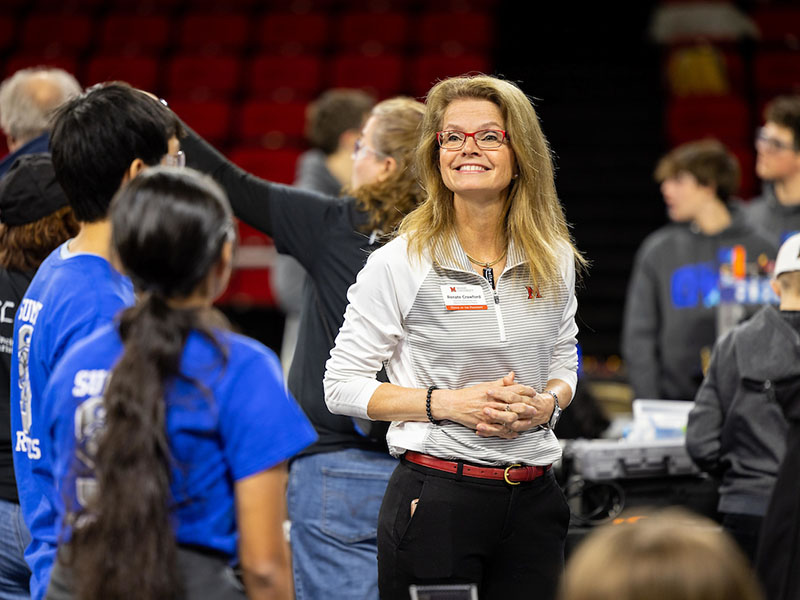
Renate Crawford
- Adjunct Professor, Physics
- University Ambassador
- College of Arts and Science
- Biography
My Approach to Teaching and Learning
My focus in the classroom is always on student understanding and success. To stimulate interest in complex physics, I highlight the exciting features of the natural world through my experience and expertise. Utilizing the teacher-scholar model, I connect the textbook material to research and application that solidify the concept in students’ minds. In a course on electricity, magnetics, and modern physics concepts for students preparing for medical school or other health careers, I used research on materials and soft condensed matter physics to stimulate their thinking about difficult concepts such as capacitors, dielectrics, and birefringence. I connect the simple schematic of a capacitor in a physics textbook to the mobile phone they use hundreds of times a day. Examples and demonstrations add the “Wow!” factor and expose students to more applied and translational research that impacts their daily lives. It reveals that very basic and fundamental research, on materials for example, is a pipeline to future applied research and applications. Some work I performed as a Ph.D. student and some of my patented ideas are just now showing up in commercial applications. This approach turns esoteric physics and textbooks schematics into a real-world application in contemporary research. My students, who are pre-medical or allied health professional bound, apply biology and microbiology to thinking about healing the human body – they resonate with the applied nature of my research to cement physics concepts in a real-world way, connecting with the latest research in my area of expertise.
My Teacher-Scholar Journey
Liquid crystalline materials used in display applications are essentially one-dimensional solids and two-dimensional liquids, with properties of both solids and liquids. These dielectric materials are manipulated with electric fields that ultimately change their optical character (i.e., birefringence). When aligned properly on the molecular level, against the substrate of a capacitor with micrometer separation, optical effects are achieved from scattering light, shuttering light, even steering light, depending on the application. Research in these areas revolves around the liquid crystal alignment on the substrates, and variations thereof, to achieve a plethora of optical effects for applications involving mobile phones, flat-panel televisions, displays found in automobiles, appliances, and portable electronics, and more. Contemporary research on display technology often centers on enhancing resolution, the thin-film transistor electronics required on large area television screens, new flexible or curved renditions of displays, and small displays for virtual reality glasses. Research often involves manipulating the order and structure of a liquid crystal in a capacitor to achieve a desired optical effect.

Education
Ph.D., Physics Kent State University
M.A., Physics Kent State University
B.S., Physics Kent State University
More About Me
I have 20 research publications, numerous educational publications, and three U.S. patents.