
Miami University answers call for inclusive education teachers with new major
The Inclusive Education major combines general and special education into integrated program
•
Published
•
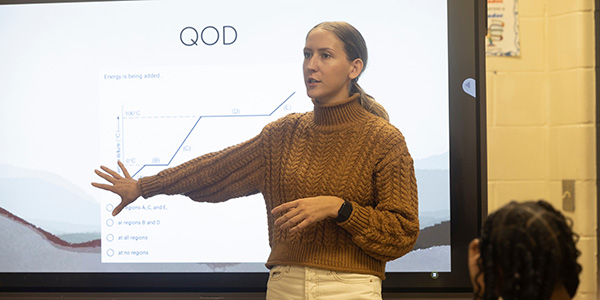
An EHS student teacher leads a lesson in a Hamilton school classroom.
Miami University answers call for inclusive education teachers with new major
The Inclusive Education major combines general and special education into integrated program
•
Published
•
Miami University’s new Inclusive Education major with licensure will prepare teachers to create inclusive classrooms that serve all communities – including those with or without disabilities, English learners, and students from all cultural backgrounds. The new degree program was recently officially approved by the Ohio Department of Higher Education.
Students earning a Bachelor of Science in Education majoring in Inclusive Education will meet the requirements for multiple Ohio teaching licenses, including Primary Education (PK-5), Special Education Mild to Moderate Intervention (K-12), Special Education Moderate to Intensive Intervention (K-12), and TESOL Endorsement.
Amity Noltemeyer, dean of the College of Education, Health, and Society (EHS), said the college designed the new major to build upon the success of the former ‘dual pathway’ option – Primary Education major with a Special Education minor. This new major streamlines requirements into one integrated program and reflects the latest research and best practices in inclusive education.
“In today’s diverse classrooms, teachers who have training and experience working with a range of learners are increasingly valued. Students pursuing this major will be in high demand and have a range of employment opportunities, and they will be able to effectively serve learners with a variety of educational needs,” Noltemeyer said.
There is growing demand, across Ohio and the nation, for teachers trained in both general education and special education, and who can support students with a wide range of cultural, linguistic, and learning needs. The Inclusive Education major’s courses and fieldwork combine general and special education content and methods, and students will learn skills to develop and teach a curriculum that utilizes accessible instructional strategies.
The vision for the new major is to develop inclusive educators who honor each student’s humanity, promote students’ full membership within the classroom and society, elevate a wide range of lived experiences, collaborate with families and communities, and apply Universal Design for Learning principles and multilingual frameworks for an equitable and accessible education.
“Schools need and desire educators who can teach diverse groups of students, work in collaborative teams, and foster positive and inclusive environments,” Ashley Cartell Johnson, assistant chair of Educational Psychology and the Inclusive Special Education program coordinator, said. “By creating a blended Inclusive Education major, we are modeling what we hope to see in the field: cohesion rather than separation between general and special education. Not only does this approach prepare our teacher candidates to be more effective educators, but it also makes them more marketable to schools seeking versatile teachers.”
Students earning a Bachelor of Science in Education majoring in Inclusive Education will meet the requirements for multiple Ohio teaching licenses, including Primary Education (PK-5), Special Education Mild to Moderate Intervention (K-12), Special Education Moderate to Intensive Intervention (K-12), and TESOL Endorsement.
Amity Noltemeyer, dean of the College of Education, Health, and Society (EHS), said the college designed the new major to build upon the success of the former ‘dual pathway’ option – Primary Education major with a Special Education minor. This new major streamlines requirements into one integrated program and reflects the latest research and best practices in inclusive education.
“In today’s diverse classrooms, teachers who have training and experience working with a range of learners are increasingly valued. Students pursuing this major will be in high demand and have a range of employment opportunities, and they will be able to effectively serve learners with a variety of educational needs,” Noltemeyer said.
There is growing demand, across Ohio and the nation, for teachers trained in both general education and special education, and who can support students with a wide range of cultural, linguistic, and learning needs. The Inclusive Education major’s courses and fieldwork combine general and special education content and methods, and students will learn skills to develop and teach a curriculum that utilizes accessible instructional strategies.
The vision for the new major is to develop inclusive educators who honor each student’s humanity, promote students’ full membership within the classroom and society, elevate a wide range of lived experiences, collaborate with families and communities, and apply Universal Design for Learning principles and multilingual frameworks for an equitable and accessible education.
“Schools need and desire educators who can teach diverse groups of students, work in collaborative teams, and foster positive and inclusive environments,” Ashley Cartell Johnson, assistant chair of Educational Psychology and the Inclusive Special Education program coordinator, said. “By creating a blended Inclusive Education major, we are modeling what we hope to see in the field: cohesion rather than separation between general and special education. Not only does this approach prepare our teacher candidates to be more effective educators, but it also makes them more marketable to schools seeking versatile teachers.”
Established in 1809, Miami University is located in Oxford, Ohio, with regional campuses in Hamilton and Middletown, a learning center in West Chester, and a European study center in Luxembourg. Interested in learning more about majors offered through the College of Education, Health, and Society? Visit the website for more information.