
Miami assistant professor earns New Faculty Teaching Award from Association of Collegiate Schools of Architecture
May Khalife will receive the honor during March ceremony held in Chicago
•
Published
•
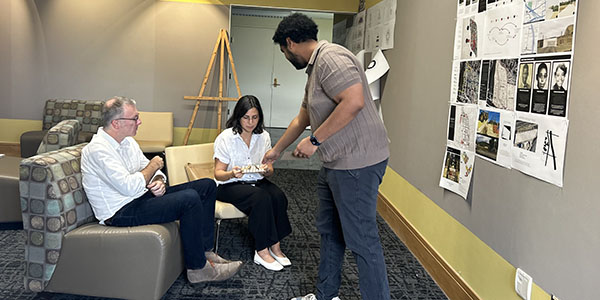
May Khalife, center, is one of three recipients of the New Faculty Teaching Award from the Association of Collegiate Schools of Architecture (ACSA).
Miami assistant professor earns New Faculty Teaching Award from Association of Collegiate Schools of Architecture
May Khalife will receive the honor during March ceremony held in Chicago
•
Published
•
From first-year students to graduate classes, May Khalife’s work reaches a wide audience at Miami University.
As assistant professor of Architecture and Interior Design, Khalife emphasizes collaboration, promotes interdisciplinary partnerships, and builds strong connections among her students and across campus.
Khalife was recently named one of three full-time faculty winners of the New Faculty Teaching Award from the Association of Collegiate Schools of Architecture (ACSA). The award is given in partnership with the American Institute of Architecture Students (AIAS) and is part of the 2026 Architectural Education Awards.
Khalife will receive the honor during the ACSA’s 114th annual meeting in Chicago. The Architectural Education Awards recognize exemplary work in building design, community collaborations, scholarship, and service.
“I was positively shocked to hear about the news,” said Khalife, who started at Miami as adjunct faculty before becoming assistant professor in 2023. “I knew it was very competitive.”
As assistant professor of Architecture and Interior Design, Khalife emphasizes collaboration, promotes interdisciplinary partnerships, and builds strong connections among her students and across campus.
Khalife was recently named one of three full-time faculty winners of the New Faculty Teaching Award from the Association of Collegiate Schools of Architecture (ACSA). The award is given in partnership with the American Institute of Architecture Students (AIAS) and is part of the 2026 Architectural Education Awards.
Khalife will receive the honor during the ACSA’s 114th annual meeting in Chicago. The Architectural Education Awards recognize exemplary work in building design, community collaborations, scholarship, and service.
“I was positively shocked to hear about the news,” said Khalife, who started at Miami as adjunct faculty before becoming assistant professor in 2023. “I knew it was very competitive.”

May Khalife, one of three recipients of the New Faculty Teaching Award from the Association of Collegiate Schools of Architecture (ACSA). The award is given in partnership with the American Institute of Architecture Students (AIAS).
Communication is an important aspect of Khalife’s work. She emphasizes writing to her students, and Khalife was part of the Faculty Writing Fellows program of Miami’s Howe Center for Writing Excellence.
Khalife has continued to do workshops with the Howe Center, and together with her colleagues, she seeks to help students create their own online platforms or ePortfolios to present and develop their work in a way that can be communicated to an outside audience.
She also participated in workshops with the Myaamia Center focused on developing indigenous curriculum and currently coordinates a lecture series within the Department of Architecture and Interior Design.
“I am always looking to bring in alumni and also people within the industry to engage with students in my classroom,” Khalife said.
“I really encourage my students to have conversations with each other, to be more creative, to think outside the box, but to also seek help when they need it and connect with peers and other faculty to learn from them.”
Nominations were needed for the AIAS/ACSA honor, along with letters of recommendation from faculty and students.
“This award would not be possible without their contributions,” Khalife said of her students. “The recommendation letters showed my impact on their lives, and it was very heartwarming. Even if I did not win this award, I was humbled by the words I read in those letters.”
Established in 1809, Miami University is located in Oxford, Ohio, with regional campuses in Hamilton and Middletown, a learning center in West Chester, and a European study center in Luxembourg. Interested in learning more about the College of Creative Arts? Visit the website for more information.