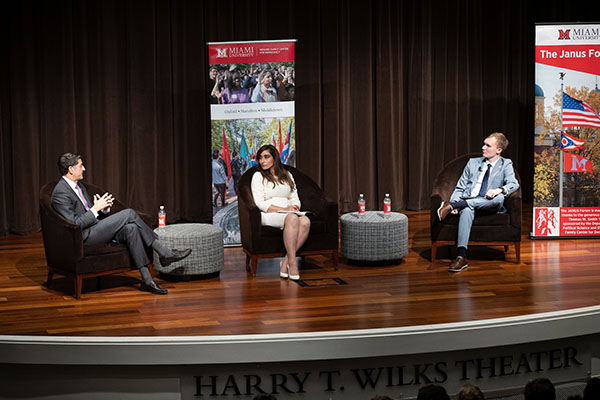
Paul Ryan, '92





Located under the twin spires of Harrison Hall, we are a large and active department. Many of our faculty members have experience working in government and politics, and we bring that experience alive in our classrooms.

Many of our alumni attend graduate and professional schools; others find careers in business, the Foreign Service, armed forces, federal, state, and local government, law enforcement, lobbying, and non-profit organizations. Some of our alumni serve in Congress, at the White House, and in U.S. embassies abroad, while others are attorneys and business professionals. Others have had successful careers in academia, including the president of a university, deans, and department chairs.
While this success is due in large part to the top-notch education Miami University provides, it's also a testament to the opportunities and resources our students can access in order to gain experience in applied settings including internships/fellowships, research centers and opportunities, education abroad, and more.
 Political Science is a social science oriented around the study of politics and government. The Department of Political Science at Miami University has a research active faculty working in a variety of areas within the discipline.
We regularly offer a range of courses that cover central issues and questions in the study of politics and government, including courses on the:
Join us on October 13, 2026 for the Forum entitled, Two Miamians, One Ballot: Lives of Public Service

Paul Ryan, '92: Speaker of the House of Representatives 2015-19 | Republican Vice Presidential Nominee 2012
Shefali Razdan Duggal, '93: United States’ Ambassador to the Netherlands 2022-25
The generous support of our donors provides our students and faculty with the resources to take part in a variety of activities that would otherwise be impossible.
Scholarships, special lectures, and support for student and faculty research projects enhance the academic mission of the Department of Political Science and the student experience. This support is a vital component in our mission.