Skip to Main Content

Design Innovation Competition

Through the Miami University Center for Assistive Technology (MUCAT) Design Innovation Competition, students can submit a project proposal, work with mentors and field experts to develop prototypes, and pitch their prototype to experienced judges.

Timeline

  • Proposal Due:  Friday, November 7, 2025, at 5 PM
  • Finalists Notified:  Friday, November 14, 2025, via email
  • Presentation of Project:  on or about Thursday, April 30, 2026 – in alignment with the CEC Senior Design Expo and CEC Alumni & Friends Conference

Funding and Awards

Participation Awards

  • All teams selected to participate in the competition will receive an initial budget to support the development of a prototype and related project needs. Requests for materials and equipment related to prototyping can be submitted per the competition guidelines for university personnel to purchase on behalf of each team.

Winning Award

  • One team will be designated as the winning team and will be eligible to receive up to $25,000 of university-approved purchases toward the future development of their project.
  • The winning award is intended to further advance the team’s project and may be subject to additional conditions or milestones as determined by the University.

University Credit

All students will receive one credit hour if selected as a finalist and fulfill all requirements of the competition. Note that the credit earned has the sole purpose of acknowledging participation in the competition and adding a record of a student's participation to their DAR and transcript. The one credit earned will not count toward the degree requirements. Students should discuss any questions with their advisor and the Director of MUCAT.

Prototype

Develop a prototype for the proposed design and show how it would work and be used. This prototype can be a simplification of the proposed design, but steps to refining and improving the design for a scalable implementation would be needed. The prize will only be awarded to teams with a working prototype.

Judging Criteria

The winner of the competition will be the team that has the highest aggregate score in the following categories:

  • Potential value of the idea (size of the market, potential size of enterprise)
  • Thoroughness of the design process
  • Completeness of prototype
  • Sustainability of business plan

Participation in Canvas Page

MUCAT has a dedicated Canvas page, which will be used for this competition. Please complete the general information survey to access this page.

Rules

Eligibility

 All enrolled Miami University undergraduate students are eligible to participate.

Teams

There is no limit to the number of team members, but each team must include at least one student from CEC and one from an academic division other than CEC. Prior teams have included students from nursing, biology, kinesiology, gerontology, speech pathology, business, marketing, finance, interactive media studies, and other related disciplines. Interdisciplinary teams are strongly encouraged, as judging will include aspects of software/prototype completeness, business plan, and market analysis.

Faculty Mentor

Teams are required to have a faculty mentor. A letter of support describing the planned mentorship is required from the faculty mentor. Please reach out to chagdejr@miamioh.edu if your team has trouble identifying a faculty mentor.

Business/Industry Mentor

Teams are required to have a business/industry mentor. Teams are welcome to select their own business/industry mentor; however, they may elect to have one assigned.

Registration

Teams should register to indicate their intent to participate in the challenge by completing the following general information survey.

Proposal

Teams will submit a design proposal (5-page max, including team composition, lay summary, technical abstract, design aims, design plan, budget summary, and references). Each team is encouraged to consult with MUCAT and potential faculty advisors. Design proposals should be emailed to Dr. Chagdes (chagdejr@miamioh.edu) by the deadline.

Finalists

Judges will select six (6) teams as finalists. Each finalist team will be provided a $2,500 budget to develop a prototype (and business model) for their project. All purchases using the $2,500 budget require the approval of MUCAT.

Presentation

Each finalist team will showcase their designs through a presentation. A completed prototype and a poster are required for the Design Presentation. Competition judges will attend the event and score teams based on their presentations and prototypes. The top teams will be announced after the Design Presentation.

Poster Instructions

Posters for the Design Expo should highlight the problem definition, design solution, and process:

Background

Summarize the design and its objective.

Market Analysis

Justification of market need and possible market size.

Design Process

Discuss your design process by including the following:

  • Identify the alternative options considered during the design process and a justification for the selected technology, approach, and/or process with a particular focus on its appropriateness to the local community and culture.
  • Provide details of the conceptual design, analysis, and final design. Design calculations or an explanation may be included, appropriate to the level of team experience.
  • Identify schedules and detailed design, construction, and maintenance costs associated with the completion and construction of the design.

Justification & Reasoning

Identify how the selected design is appropriate to the social, environmental, economic, and cultural context of the community.

Results and Future

Discuss ethics, long-term sustainability, and maintenance of engineering design and business plan.

References

Outline the details of any external support provided to the design team and identify any content not attributable to the design team

Last year's winner

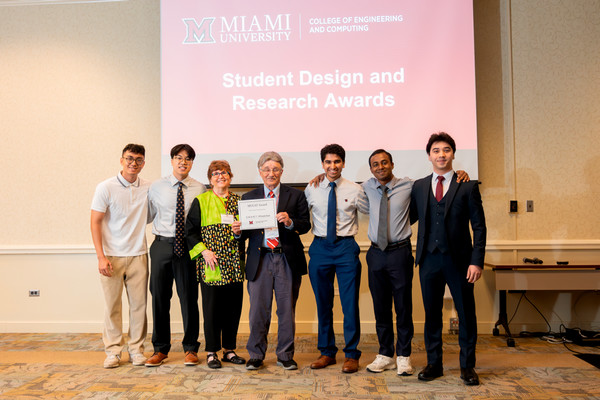
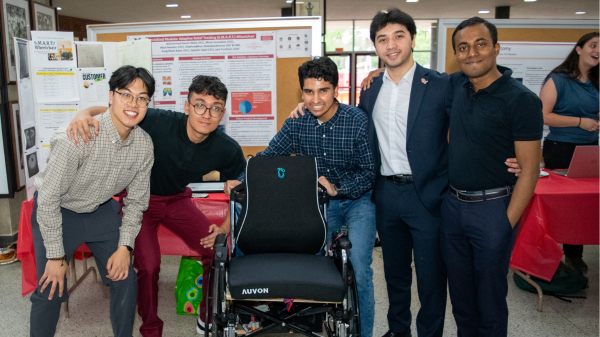
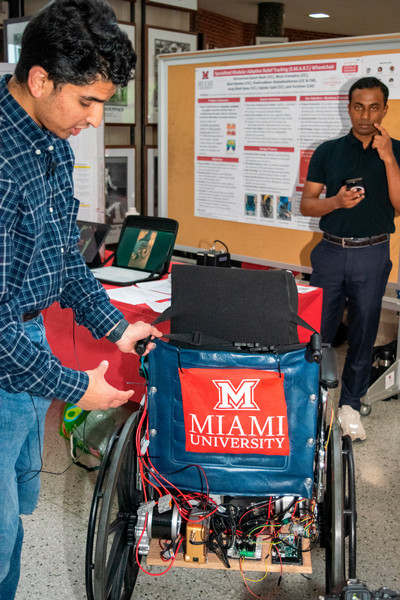
The Specialized Modular Adaptive Relief Tracking wheelchair, or SMART wheelchair for short, adds motorized elements to standard manual wheelchairs, which saves wheelchair users from having to buy entirely new and expensive motorized wheelchairs. CEC students Muhammad Danish Malik, Micah Granadino, Abud Hamdan, Shakhzodkhon Mukaddaskhonov, Aung Khant Kyaw, Sajjadur Sajid, and Jack Purtiman formed the team which designed the prototype device.

Muhammad Danish Malik, Micah Granadino, Abud Hamdan, Shakhzodkhon Mukaddaskhonov, Aung Khant Kyaw, Sajjadur Sajid, and Jack Purtiman receive their award from Lee and Rosemary Fisher Muhammad Danish Malik, Micah Granadino, Abud Hamdan, Shakhzodkhon Mukaddaskhonov, Aung Khant Kyaw, Sajjadur Sajid, and Jack Purtiman
Team members demonstrate the SMART Wheelchair's functionality.

Benefits of participating:

  • All teams selected to participate receive an initial budget to support the development of their prototype and related project needs.
  • One team will be designated as the winning team, and will be eligible to receive up to $25,000 of university-approved purchases toward the future development of their project.
  • Participating in the challenge fulfills some of the requirements of the Honors Programs (e.g., Honors College, Prodesse Scholars).
  • All participants enjoy access to the College of Engineering and Computing SEEC Makerspace.
  • By participating, students can build their professional network (teams are paired with technical and business advisors).
  • Taking part in the challenge allows students to improve their skills as a researcher and designer.
  • This competition offers students the opportunity to showcase their skills and start-up experience to potential future employers.