
Miami University students present foreign policy research in Washington, D.C.
Students presented a semester’s worth of foreign policy research at National Defense University
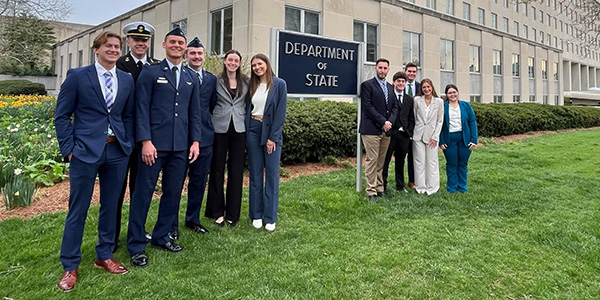
Miami University students present foreign policy research in Washington, D.C.
Students presented a semester’s worth of foreign policy research at National Defense University
Standing in a meeting room at National Defense University, Miami University students presented research that could influence policy recommendations and international relations. It wasn’t the venue they’d planned for – the annual Diplomacy Lab Fair had been put on hold this year – but professor of Strategic Communication Phillip Arceneaux had made sure they’d get to Washington, D.C., anyway.
That presentation at National Defense University was just the beginning of a four-day Washington immersion for 12 Miami students – an experience that included Senate tours, embassy visits, and meetings with foreign policy professionals. It happened only because Arceneaux refused to let the canceled fair derail students’ opportunity to present their foreign policy research.
Since joining the Diplomacy Lab in 2015, Miami University students have participated in foreign policy research projects for the U.S. Department of State. Miami was the first university in Ohio to join the public-private partnership between the State Department and the more than 60 domestic academic institutions conducting research on policy issues.
Embassies, consulates, and bureaus submit project proposals on complex international challenges – such as climate change, human rights, cybersecurity, and urban planning – to the State Department, which then compiles 60-80 of those proposals into a document to be sent to member institutions each semester. Arceneaux, who serves as Miami’s Diplomacy Lab program director and State Department point of contact, disseminates the document out to interested faculty. Using an experiential learning model, faculty members guide student teams through months of research that provide key insights for policymakers.
“It’s a win-win-win,” Arceneaux said. “The State Department gets advanced research and thought-out policy solutions for problems the U.S. government is facing. Faculty get connections and the ability to apply their research expertise, which gives practical application to scholarship and shows the value of higher education. And it gives students an ability to get hands-on, not only learning about the research process, but showing there is real-world impact to what you will do.”
Arceneaux himself was one of several Miami faculty leading Diplomacy Lab projects in fall 2024. One proposal in particular stood out to him.
In 2023, the United States and Japan signed a Memorandum of Understanding on Education Cooperation to boost curricular cooperation, research collaboration, and educational exchanges. The Japanese Ministry of Education has extensively documented which Japanese institutions – nonprofit, educational, governmental, corporate – promote international education options and what relationships those institutions have with American universities. Unfortunately, both countries lack comparable information about American institutions.
“A lot of Japanese students will come and study in the United States, but not as many Americans go to study abroad in Japan. There’s this very uneven balance,” Arceneaux said.
Arceneaux assembled a team of three students for the “Advancing U.S.-Japan Educational Ties” project: junior Natalie Janssen, a Strategic Communication and Political Science double major; Geography and Environmental Earth Science double major Trey Smith ‘25; and Economics major Ryan Collins ‘25.
Partnering with the U.S. Embassy in Tokyo, the Japanese Ministry of Education, and Virginia Tech, the Miami team spent 16 weeks identifying and mapping 290 American universities with Japanese programs – whether they had majors, minors, certifications, study centers, or study abroad agreements. They created an interactive map showing these institutions alongside Japanese consulates. Virginia Tech’s eight-student team took a different approach, interviewing Japanese exchange students about what motivated them to study in the U.S. and what challenges – language proficiency, transportation, community – they faced once here.
In April, both teams jointly presented their findings to U.S. Foreign Service officers from the U.S. Embassy in Tokyo, Japan’s Ministry of Education representatives, and an attaché of the Japanese Embassy in Washington, D.C. Arceneaux’s team had “just scratched the surface,” he said, and they could have kept the research going, but with two of the students on his team graduating that semester, the project came to a close.
Diplomacy Lab students can continue on to the Department of State’s annual Diplomacy Lab Fair each April, where students from across the country showcase their work to Washington policymakers. But 2025 wasn’t a typical year.
The fair has run into snags in recent years, most recently due to the COVID-19 pandemic. Discussion over the federal budget with the change in administration led officials to pause the fair in 2025. Arceneaux had already raised funds to take 12 students to Washington and decided to make the trip happen anyway.
In place of the fair, Arceneaux organized an alternative program that focused on professional development and networking. He arranged for students to present their research to the president and vice president of National Defense University instead, with Janssen taking the lead for the Japan project.
Although she was initially nervous about presenting her work, Janssen said, “It was truly fulfilling getting to show someone else all the work that was accomplished throughout the fall semester and to learn how to communicate research findings to individuals who didn’t have prior knowledge of my project.”
Over the course of the trip, the group met with congressman Warren Davidson’s office; connected with two Miami alumni: Chris Socha and Khenadi Grubb, staff director and press assistant for the U.S. Senate Committee on Foreign Relations, respectively; visited the Senate chambers and hearing room, the Luxembourg embassy, the Serbian embassy, and toured the White House.
Arceneaux is now working to secure funding to make the Washington, D.C., trip an annual and cost-free component for participating students. With the Diplomacy Lab Fair also greenlit to continue, Miami students will again have opportunities to present their work to policy professionals and see firsthand how their research will shape international relations.
For Janssen, the Diplomacy Lab has done more than just give her hands-on experience with foreign policy research – it’s also helped her network in a field she finds fascinating. She interviewed David Janes, executive director of the American Friends of the International House of Japan, as part of her research gathering. This connection led to her to start interning for the nonprofit organization in February 2025.
“This was an amazing experience. I truly fell in love with the work we were doing and the processes behind it,” Janssen said. “The Diplomacy Lab is a great program.”