
Ukrainian novelist Andrey Kurkov shares history, humor and humanity amid war
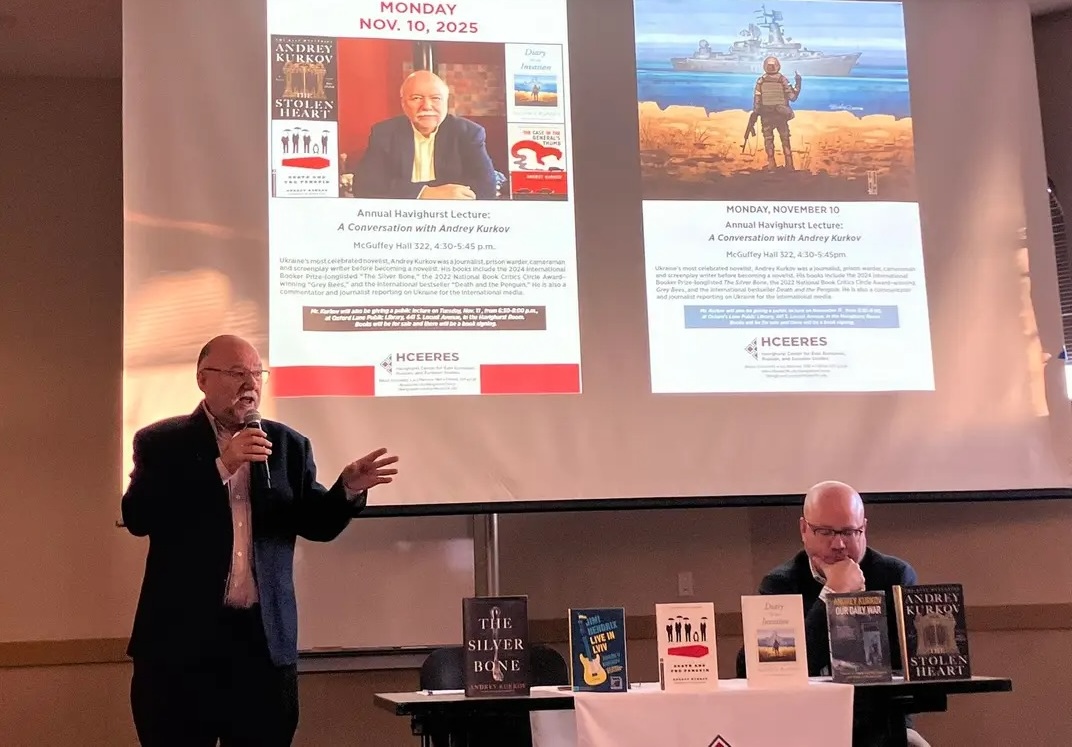
Ukrainian novelist Andrey Kurkov shares history, humor and humanity amid war
Ukraine’s most celebrated novelist, Andrey Kurkov, brought history, humor and hard truth to Miami University as part of the annual Havighurst Lecture, delivering a moving reflection on his country’s struggle for identity and resilience amid war.
Kurkov, author of “Grey Bees,” “The Silver Bone,” and “Death and the Penguin,” spoke to a full auditorium about Ukraine’s long fight for independence, cultural erasure under Russian rule, and the profound changes in everyday life since Russia’s full-scale invasion began in February 2022.
Born in St. Petersburg and raised in Kyiv, Kurkov reflected on Ukraine’s centuries-long effort to maintain its language and national identity. “Freedom is more important than stability for Ukrainians,” he said, contrasting Ukraine’s spirit of protest with Russia’s history of political conformity. “When Ukrainians aren’t happy, they organize protests. In Russia, people are fined, imprisoned, or silenced for dissent.”
Throughout this talk, Kurkov traced the roots of the war back to the 17th century, describing how shifting borders, Cossack independence movements, and repeated bans on the Ukrainian language have shaped the nation’s sense of self. He detailed the 1932-1933 Holodomor, the Soviet-imposed famine that killed millions, and drew parallels to modern attempts to suppress Ukrainian culture.
“It took three centuries to try to assimilate Ukrainians into Russian subjects,” Kurkov said. “Today, that same effort repeats itself.”
The novelist, who also works as a journalist and war diarist, shared how his own life changed when the first explosions reached Kyiv in 2022. “I was always a collector – books, coins, records – but suddenly none of that mattered,” he said. His wife took only her Bible as they fled the city and later sought refuge in Slovakia and France.
Despite displacement and loss, Kurkov emphasized how Ukrainian culture has rebounded. After Kyiv’s liberation, he said, underground art and literature flourished in metro stations and bomb shelters. “There was a resurrection of culture,” he said. “In one year, 13 new bookshops opened in Kyiv. It became impossible to buy theater tickets again.”
Kurkov also addressed his temporary loss of humor and ability to write fiction for two years. “It was very difficult to justify pleasure during this time,” he said. Only in mid-2024 did he complete his next novel, marking what he called “a return to normality, even in abnormal times.”
“I’m here because it was required from my Soviet propaganda class, but hearing him speak gave me a new perspective,” said Katelyn Zuehlke, a senior integrated social studies education major. “It’s powerful to learn how Ukrainians have resisted since 2014.”
Abigail McNally, a sophomore supply chain and operations management major, said she was struck by the ongoing nature of the war. “It’s very easy to forget a war that’s still happening,” she said. “Hearing his story reminded me that for Ukrainians, it’s been going on for nearly a decade.”
Kurvov closed by reflecting on Ukraine’s future and the uncertainty that lies ahead. He described the war as likely to continue “until the death of Putin, and maybe longer,” but also expressed confidence in Ukraine’s enduring independence and cultural vitality.
The Havighurst Lecture, hosted annually by Miami University’s Havighurst Center for Russian, East European, and Eurasian studies brings global voices to campus to discuss history, politics and culture across the region.