
Matteo Drobac ’28: Electrical engineering student and DI hockey goaltender
International student from Ontario reflects on his journey as a student athlete
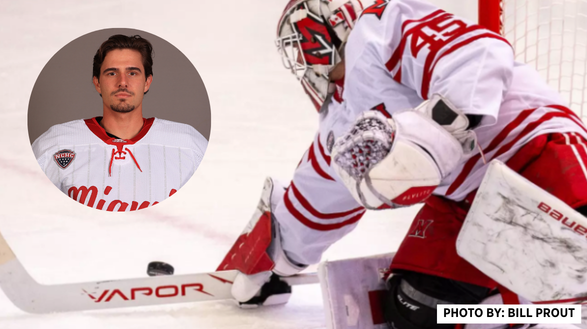
Matteo Drobac ’28: Electrical engineering student and DI hockey goaltender
International student from Ontario reflects on his journey as a student athlete
Matteo Drobac can often be found in the ice rink, skating and playing as a goaltender for Miami University’s Division I hockey team.
Fans know him for his skilled saves and consistency under pressure, but many hockey lovers may not know Matteo is also an electrical engineering student who passes time outside the rink juggling the load of his academic schedule. Between traveling to states for games, days with the team, and going to the Friendship Four overseas, Matteo spends his time doing work for robotics classes.
In the interview below, Matteo speaks about his experience as an engineering student and a hockey player. Read on to hear more.
What is the best part about being a student athlete?
Matteo: You have the hockey aspect, where you feel like you're working for something every day in that sense, but it also feels pretty rewarding to get your degree at the same time. I personally enjoy school, so there's that aspect to it where I'm doing what I want to do with hockey, but I'm also getting my degree at the same time.
How has playing hockey influenced your personal growth and development both on and off the ice?
Matteo: It just helps in the way that you can commit to something, and it's a daily thing you do in the morning, and it bleeds into everything that you do the rest of the day, so it teaches you about discipline and working hard at everything you do.
How has your engineering background influenced the way you approach hockey?
Matteo: Engineering is a pretty taxing degree, so you can't slack off or else that's going to really catch up to you later on. So, I think having that mindset where every day is a work day and you have to work hard if you want to succeed, translates to hockey in a way where you have to work hard if you want success on the ice, as well. So, I think they both go hand in hand, where hard work is going to lead to success, and you're not going to have success without it.
What sparked your desire to study electrical engineering?
Matteo: Both my parents were born and raised in Croatia, and my dad graduated as a land surveyor there; it's like a form of civil engineering. He was working as an engineer when he moved to Canada, and I'm his son, so I was super interested in what he does. It's kind of different from what I'm doing now with electrical, but I just found that one to be the most interesting. I guess my dad's life bled into mine a bit, and I enjoy it, too.
What's the coolest thing to you about electrical engineering at Miami?
Matteo: I would say how we have some hands-on classes, which I really like, where you get to actually build things. I think it's really cool. Growing up, I loved to play with toys like Legos. I grew up building stuff. Being able to design different circuit things and do coding, I enjoy putting that together.
What did your process look like coming to Miami? Why did you choose Miami?
Matteo: I'm a sophomore, and I went to school in Western University in Canada, and then pretty much I wanted to transfer to some NCAA Division I hockey school because there was a rule change. For the first time in history, this past year they allowed that floodgate of guys who played in the Ontario Hockey League to go play NCAA after. So once that changed, then I was looking at different options of where to go to school, and Miami really stood out to me. One, obviously athletically, just because it's a really good sports school. I think the hockey team was doing a really good job of changing up what they were all about and I wanted to be part of that process. But also, I knew it was a good academic school, as well, and I was able to get into the engineering school here, and two and two went well together. This was the best possible situation that could have happened, where I was able to come here and pursue what I want to do both academically and athletically.