
Student-Centered Teaching in Large Classes: A Research-Grounded Resource for Practical Redesign

(guide produced with heavy prompting with Chat)
Large classes do not prevent student-centered teaching. What they constrain is how it is implemented. This resource translates research into small, testable design moves that increase student thinking without requiring a full course overhaul.
Why Shift Toward Student-Centered Learning?
Active learning is not a trend; it is one of the most consistently supported findings in higher education research.
- Replacing lecture with structured engagement improves exam performance and reduces failure rates across STEM courses (Freeman et al., 2014).
- These gains are especially strong for students from underrepresented groups, narrowing achievement gaps (Theobald et al., 2020).
- However, students in active classrooms may feel like they are learning less, even when they are learning more (Deslauriers et al., 2019).
Implication:
Student-centered teaching improves outcomes, but requires intentional framing and design to be effective in large classes.
What Counts as “Student-Centered” (and What Doesn’t)
Not all activity leads to learning. The key question is:
Who is doing the thinking?
The ICAP framework (Chi & Wylie, 2014) distinguishes levels of engagement:
- Passive: Listening, copying notes
- Active: Highlighting, repeating
- Constructive: Explaining, predicting, generating ideas
- Interactive: Co-constructing understanding with peers
Design principle: Aim for constructive or interactive tasks. Many common “activities” never reach this level.
Adding activities on top of lecture increases cognitive load without improving learning.
- Replace short lecture segments with structured questions or tasks
- Even brief interventions (2–5 minutes) can activate retrieval and reasoning (Michael, 2006)
Say this, not that:
- ❌ “I’ll add a discussion at the end if there’s time.”
- ✔ “I will replace 5 minutes of lecture with a prediction task.”
One of the most robust large-class models is peer instruction (Crouch & Mazur, 2001):
- Pose a conceptual question
- Students answer individually
- Students discuss with peers
- Students vote again
Peer discussion improves understanding even when no one initially knows the answer (Smith et al., 2009).
Why it works:
Students must articulate reasoning, confront differences, and revise thinking.
Learning improves when courses have consistent structure:
- Pre-class preparation
- In-class engagement
- Post-class reflection
Increased structure improves performance, especially for students who struggle in less guided environments (Eddy & Hogan, 2014).
Design principle:
Consistency matters more than novelty.
Use prompts that force students to generate ideas:
- Predict what will happen before showing results
- Explain reasoning, not just answers
- Compare examples vs. non-examples
- Identify and correct errors
Say this, not that:
- ❌ “Solve this problem.”
- ✔ “Explain why this answer makes sense and what mistake someone might make.”
Students often misinterpret effort as poor teaching (Deslauriers et al., 2019).
Make the learning process visible:
- Tell students why you are using these methods
- Explain that difficulty signals learning
- Share evidence that active learning improves outcomes
High-Impact, Low-Lift Strategies
These can be implemented immediately in large classes:
- Think–Pair–Share: Individual thinking → peer discussion → whole-class synthesis
- Prediction prompts: Commit to an idea before instruction
- Worked example + “try one”: Model reasoning, then transfer
- Muddiest point: Identify confusion in real time
- Conceptual multiple-choice questions: Focus on reasoning, not computation
These align with learning science principles such as retrieval, feedback, and knowledge organization (Lovett et al., 2023).
Common Pitfalls in Large-Class Implementation
- Activity without purpose: Students are busy but not thinking
- No accountability: Participation without reasoning
- Too much change at once: Leads to instructor and student overload
- Ignoring student perceptions: Resistance undermines effectiveness
Start small. Test one change. Observe. Adjust.
A Practical Redesign Cycle
Adapted from classroom observation and redesign work:
- Observe
Identify patterns (e.g., long lecture stretches) - Interpret
What does this suggest about student thinking? - Redesign
Introduce one structured activity - Re-observe
Did student thinking become more visible?
Freeman, S., Eddy, S. L., McDonough, M., Smith, M. K., Okoroafor, N., Jordt, H., & Wenderoth, M. P. (2014). Active learning increases student performance in science, engineering, and mathematics. Proceedings of the National Academy of Sciences, 111(23), 8410–8415. https://doi.org/10.1073/pnas.1319030111
Deslauriers, L., McCarty, L. S., Miller, K., Callaghan, K., & Kestin, G. (2019). Measuring actual learning versus feeling of learning in response to being actively engaged in the classroom. Proceedings of the National Academy of Sciences, 116(39), 19251–19257. https://doi.org/10.1073/pnas.1821936116
Prince, M. (2004). Does active learning work? A review of the research. Journal of Engineering Education, 93(3), 223–231. https://doi.org/10.1002/j.2168-9830.2004.tb00809.x
Michael, J. (2006). Where’s the evidence that active learning works? Advances in Physiology Education, 30(4), 159–167. https://doi.org/10.1152/advan.00053.2006
Chi, M. T. H., & Wylie, R. (2014). The ICAP framework: Linking cognitive engagement to active learning outcomes. Educational Psychologist, 49(4), 219–243. https://doi.org/10.1080/00461520.2014.965823
Lovett, M. C., Bridges, M. W., DiPietro, M., Ambrose, S. A., & Norman, M. K. (2023). How learning works: Eight research-based principles for smart teaching (2nd ed.). Jossey-Bass. https://www.wiley.com/en-us/How+Learning+Works%3A+Eight+Research-Based+Principles+for+Smart+Teaching%2C+2nd+Edition-p-9781119862735
Eddy, S. L., & Hogan, K. A. (2014). Getting under the hood: How and for whom does increasing course structure work? CBE—Life Sciences Education, 13(3), 453–468. https://doi.org/10.1187/cbe.14-03-0050
Theobald, E. J., Hill, M. J., Tran, E., Agrawal, S., Arroyo, E. N., Behling, S., et al. (2020). Active learning narrows achievement gaps for underrepresented students in undergraduate STEM. Proceedings of the National Academy of Sciences, 117(12), 6476–6483. https://doi.org/10.1073/pnas.1916903117
Crouch, C. H., & Mazur, E. (2001). Peer instruction: Ten years of experience and results. American Journal of Physics, 69(9), 970–977. https://doi.org/10.1119/1.1374249
Smith, M. K., Wood, W. B., Adams, W. K., Wieman, C., Knight, J. K., Guild, N., & Su, T. T. (2009). Why peer discussion improves student performance on in-class concept questions. Science, 323(5910), 122–124. https://doi.org/10.1126/science.1165919
⭐⭐⭐⭐⭐Book Recommendations from X-Teach FLC Members (Check these out of the CTE Library, 317 Laws Hall)
Major, C. H., Harris, M. S., & Zakrajsek, T. D. (2021). Teaching for learning: 101 intentionally designed educational activities to put students on the path to success. Routledge.

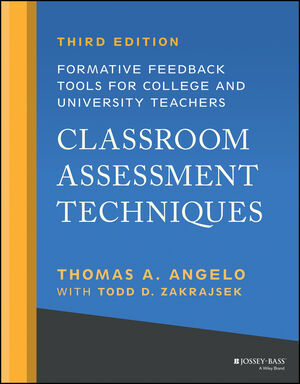
Angelo, T. A., & Zakrajsek, T. D. (2024). Classroom assessment techniques: formative feedback tools for college and university teachers. John Wiley & Sons.