
At Miami’s Undergraduate Research Forum, some of the most surprising discoveries had nothing to do with data
Among the more than 400 presenters, it wasn’t unusual to find students pursuing research outside their major
•
Published
•
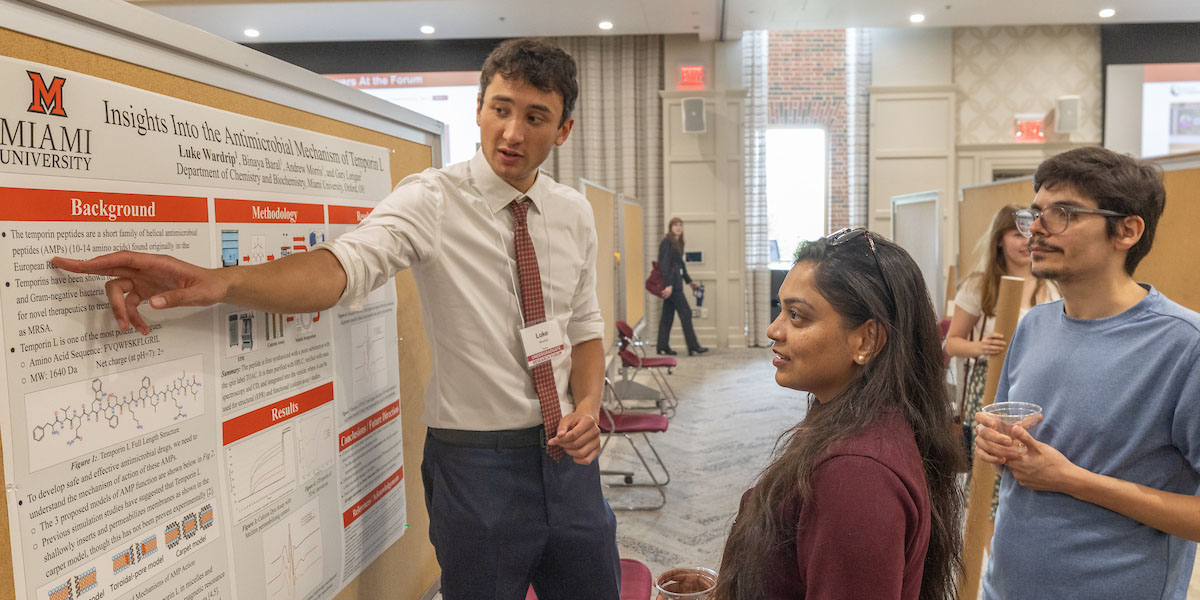
Luke Wardrip presents his research on "Insights Into the Antimicrobial Mechanism of Temporin L" to visitors at the Undergraduate Research Forum (photo by Scott Kissell).
At Miami’s Undergraduate Research Forum, some of the most surprising discoveries had nothing to do with data
Among the more than 400 presenters, it wasn’t unusual to find students pursuing research outside their major
•
Published
•
For many of the 447 undergraduates who presented at Miami’s Undergraduate Research Forum (URF) on April 24, the most surprising discovery wasn’t in their data — it was that their research took them somewhere they never expected to go.
The Shriver Center’s John Dolibois Room was packed with people looking to learn more about the 308 creative projects these students had worked on. Curious visitors milled through the aisles of posters or listened to 10-minute oral presentations from a wide range of research areas — public health, zoology, political science, journalism, and history could be found next to projects on microbiology, biochemistry, and engineering. It wasn’t unusual to find students pursuing research outside their major or discovering unique solutions to unexpected problems.
Danielle Goury, majoring in Psychology and the Western Program in Individualized Studies, found herself doing something she never expected for her capstone on attachment theory: writing a therapeutic storybook for children in foster care.
The project was outside of her comfort zone; she didn’t have any experience with creative writing, let alone for children’s literature. But foster children are underrepresented in children’s stories, Goury said, and she wanted something they could not only connect with but easily pick up and read on their own. She delved into bibliotherapy extensively and studied the books she read as a preschool teacher to her students. The result is a short book titled “My Name is Niamh.”
“I never would have thought that writing a book would be something I could have done,” Goury said. “I learned in the Western program, you can really combine so many different interests and make it into one passion.”
She added that this research taught her a lot about what she’d like to do in her career as a school psychologist.
For Goury, the unexpected path led to a creative form she’d never tried. For Ann Bixel, she didn’t anticipate finding a mentor outside of her major’s department.
Bixel, a junior Psychology and Professional Writing double major, started her research as a capstone in high school with plans to continue it in graduate school. Her exploration of how adoption stories of transnational adoptees impact their identity is a subject she’s personally connected to, as an international adoptee herself.
But “trying to find my mentor was a little bit of a tricky process,” Bixel admitted, as she wanted to work with a faculty member with a background in social psychology and identity development. Eventually, she found Anthony James, professor of Family Science and Social Work, to be her mentor. Although he’s not part of the Department of Psychology, Bixel said James has been very good at letting her take the reins while also giving her direction, and the occasional push.
While Bixel’s research took her across departments, Mary Catherine Kelly’s research took her across something bigger — a complete change in major.
Kelly was an Environmental Earth Science major her first year before pivoting to Global Politics, but she stayed active in associate professor of Geology and Environmental Earth Science Mark Krekeler’s lab. Kelly went on to double major in Global Politics and Diplomacy and Spanish.
Kelly’s time with her mentor Krekeler and his lab group led her to research how to improve in-park accessibility infrastructure in the Red River Gorge Geological Area in Kentucky. Being able to attend Geological Society of America conferences as part of Krekeler’s lab group allowed Kelly to network with professionals from the International Association of Disabled Geoscientists, who helped her develop her research.
Getting started on research can be as easy as reaching out. She also noted not to be afraid of failure either: “I have asked to be taken on to research projects and been rejected before. It’s disappointing, but it all works out if you keep reaching out.”
It was a lesson repeated across the 308 projects that day: in undergraduate research, the destination rarely looks the way students imagined it would.