
Faulkner earns peer review honor from Higher Learning Commission
Miami’s AVP for online learning and professional education leads peer review teams
•
Published
•
Faulkner earns peer review honor from Higher Learning Commission
Miami’s AVP for online learning and professional education leads peer review teams
•
Published
•
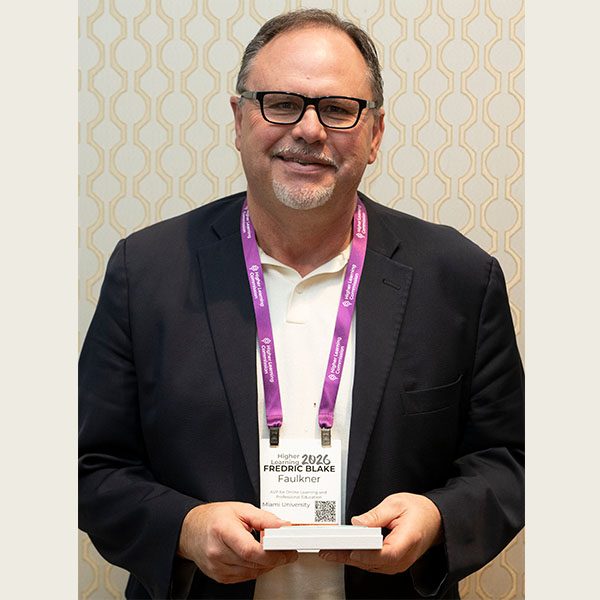
Blake Faulkner, Miami University's assistant vice president for online learning and professional education, recently received an honor from the Higher Learning Commission.
Gallentine considered peer review to be a cornerstone of those contributions, and Faulkner certainly took that advice to heart. Now the assistant vice president for online learning and professional education at Miami University, Faulkner takes great pride in his role leading peer team reviews for the Higher Learning Commission (HLC).
Founded in 1895, HLC accredits degree-granting colleges and universities throughout the United States. The group recently recognized Faulkner with its “Magnificent manager” accolade during its annual peer service review awards, which honor those who volunteer their time to assure quality higher education through accreditation.
“It is a privilege to be part of the peer review corp,” Faulkner said. “It’s a great group of people.”
Approximately 1,450 peer reviewers help HLC with the accreditation process. Awards were given to 21 peer reviewers in 10 categories based on nominations from colleagues and HLC staff.
HLC’s peer review corp conducts hundreds of evaluations every year to determine whether institutions meet HLC’s quality standards and requirements.
“I can’t say enough about the commitment that peer reviewers make to help colleges and universities on their path of continuous improvement,” HLC president Barbara Gellman-Danley said in a release. “We rely on peer reviewers’ work and thank them for all they do every day.”
Calling the peer review process “essential,” Faulkner is thankful Gallentine encouraged him to participate.
“He felt we have a responsibility as members of the higher education community to do our part. I’m very grateful he led me in that direction,” Faulkner said.
For 18 years, Faulkner has been involved as a peer reviewer. For many of those years, he’s served as a team chair. His work with HLC can include everything from leading change panels to comprehensive site visits with as many as five team members.
One of the most satisfying parts for Faulkner has been watching team members he’s led become chairs themselves. “That’s been fun to see,” he said. “I honestly just enjoy the talented folks I get the opportunity to work with and learn from. It’s an amazing group I’ve had the chance to work with since I’ve been a part of the peer review corp.”
While peer review has always been a crucial part of the accreditation process, Faulkner stressed the importance of evaluation by higher education peers who understand firsthand the need for colleges and universities to innovate and change at an accelerated pace, while also ensuring they are continuously improving in fulfilling their mission and meeting HLC quality standards. He noted that context and perspective has never been more important than it is today in helping to ensure higher education effectively evolves to meet the needs of modern learners and the communities served.
“We have so many caring and bright people working within higher education. I’ve had the opportunity to evaluate colleges and universities across all sectors, and I’ve seen how innovative and dedicated faculty and staff are within those institutions,” Faulkner said. “With all the changes in higher education, I’m confident that collectively we’ll meet the challenges and move forward.”
Established in 1809, Miami University is located in Oxford, Ohio, with regional campuses in Hamilton and Middletown, a learning center in West Chester, and a European study center in Luxembourg.