
More than a project: the mentors behind Miami’s Undergraduate Research Forum
Faculty mentors like Andor Kiss and Jeb Card guide students through every stage of the research process, from initial idea to final presentation
•
Published
•
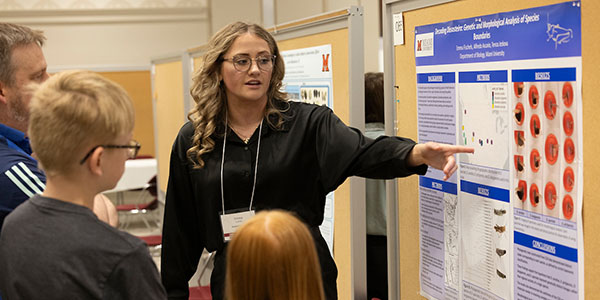
Emma Fischels presents her research on "Decoding Dissosteira: Genetic and Morphological Analysis of Species Boundaries" to a group of visitors at the Undergraduate Research Forum (photo by Scott Kissell).
More than a project: the mentors behind Miami’s Undergraduate Research Forum
Faculty mentors like Andor Kiss and Jeb Card guide students through every stage of the research process, from initial idea to final presentation
•
Published
•
Julia Moore ’25 came to Miami as a Creative Writing major, not a researcher. But by the time she presented her analysis on themes in middle grade fiction at last year’s Undergraduate Research Forum (URF), she had become both. Molly Weeldreyer, a senior double-majoring in Urban and Regional Planning and Creative Writing, had a similar experience — her study of accessibility at Chicago beaches took her further into the research process than she anticipated. For both, the difference was their mentors encouraging them and guiding them each step of the way.
For Miami’s URF participants, the experience yields far more than a line on a resume. Faculty mentors say the process builds a set of skills that follows students well beyond graduation.
Andor Kiss, adjunct assistant professor of Biology, and Jeb Card, associate teaching professor of Anthropology, know this better than most. The two have been mentoring undergraduate researchers for more than a decade.
If a student comes to Kiss or Card with an idea of what they’d like to do, they help shape that idea into a concrete, actionable plan. This can look like setting up a weekly schedule with semester-long targets and providing resources like books and articles to get a student methodologically to the right starting point. Submitting documentation to the Institutional Review Board (IRB), if needed, can also be challenging for first-time researchers without assistance.
Kiss said meeting with students once a week, even for a few minutes, can help refocus and motivate them if they’re feeling discouraged from initial lab results.
“Once they begin to understand that I don’t have the answer and they are discovering the answer in real time, they tend to really appreciate that science is all about trying and failing, and then trying again,” Kiss said.
Weeldreyer said, “I never saw myself actually being part of a research project,” but took the leap when her mentor, associate professor of Geography and Global and Intercultural Studies Damon Scott, asked if she wanted to turn her capstone project into something bigger. That leap helped her to pursue a topic she was passionate about.
Both Kiss and Card note that structuring and interpreting collected data so it can be understood by general audiences can be daunting for students. Mentors walk through this process with their students to help them make logical choices for their project.
By the end, their students have a physical project they can present to others and skills that will help them when they graduate: time and effort management, critical thinking, flexibility, public speaking, and professional communication. These skills, Card said, are “infinitely employable” and highly transferable to jobs outside of academia.
The work of 447 Miami students — including those mentored by Kiss and Card — will be on display at this year’s 32nd URF on April 24 at the Shriver Center. Three poster presentation sessions will be held in the Dolibois Rooms beginning at 10 a.m., and 10-minute talks will be held in the Heritage and Bystrom Rooms starting at 9:30 a.m. A new panel discussion titled “Meaningful Mentorship: The Essential Component of the Undergraduate Research Experience,” and the returning “Research as Instruction” exhibit will also be featured.
Although Moore initially questioned if she could turn her work into a research project — “Can I? Am I allowed?” — she’s glad she took the opportunity. Having her mentor to push and support her, she said, was exactly what she needed to pursue a skill outside her wheelhouse.
For more information, check out the Undergraduate Research Forum schedule.
For Miami’s URF participants, the experience yields far more than a line on a resume. Faculty mentors say the process builds a set of skills that follows students well beyond graduation.
Andor Kiss, adjunct assistant professor of Biology, and Jeb Card, associate teaching professor of Anthropology, know this better than most. The two have been mentoring undergraduate researchers for more than a decade.
If a student comes to Kiss or Card with an idea of what they’d like to do, they help shape that idea into a concrete, actionable plan. This can look like setting up a weekly schedule with semester-long targets and providing resources like books and articles to get a student methodologically to the right starting point. Submitting documentation to the Institutional Review Board (IRB), if needed, can also be challenging for first-time researchers without assistance.
Kiss said meeting with students once a week, even for a few minutes, can help refocus and motivate them if they’re feeling discouraged from initial lab results.
“Once they begin to understand that I don’t have the answer and they are discovering the answer in real time, they tend to really appreciate that science is all about trying and failing, and then trying again,” Kiss said.
Weeldreyer said, “I never saw myself actually being part of a research project,” but took the leap when her mentor, associate professor of Geography and Global and Intercultural Studies Damon Scott, asked if she wanted to turn her capstone project into something bigger. That leap helped her to pursue a topic she was passionate about.
Both Kiss and Card note that structuring and interpreting collected data so it can be understood by general audiences can be daunting for students. Mentors walk through this process with their students to help them make logical choices for their project.
By the end, their students have a physical project they can present to others and skills that will help them when they graduate: time and effort management, critical thinking, flexibility, public speaking, and professional communication. These skills, Card said, are “infinitely employable” and highly transferable to jobs outside of academia.
The work of 447 Miami students — including those mentored by Kiss and Card — will be on display at this year’s 32nd URF on April 24 at the Shriver Center. Three poster presentation sessions will be held in the Dolibois Rooms beginning at 10 a.m., and 10-minute talks will be held in the Heritage and Bystrom Rooms starting at 9:30 a.m. A new panel discussion titled “Meaningful Mentorship: The Essential Component of the Undergraduate Research Experience,” and the returning “Research as Instruction” exhibit will also be featured.
Although Moore initially questioned if she could turn her work into a research project — “Can I? Am I allowed?” — she’s glad she took the opportunity. Having her mentor to push and support her, she said, was exactly what she needed to pursue a skill outside her wheelhouse.
For more information, check out the Undergraduate Research Forum schedule.