
‘An archivist’s dream’: Time capsule unearthed at Wells Hall offers glimpse of Miami’s past
Letters, documents offer representation of life at the university more than 100 years ago
‘An archivist’s dream’: Time capsule unearthed at Wells Hall offers glimpse of Miami’s past
Letters, documents offer representation of life at the university more than 100 years ago
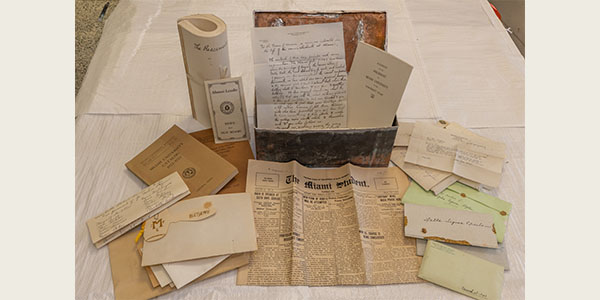
Letters from students. A course catalog. Even a transcribed address from Raymond Hughes, who served as Miami University’s president from 1911-1927.
Materials pulled from a time capsule unearthed at the Wells Hall site were not just captivating to comb through and read, they were so well preserved that they looked just as they did when they were placed there more than 100 years ago.
“They are in the same condition they were in 1923, which is amazing. Totally amazing,” said Jacqueline Johnson, head of Special Collections and Archives at King Library. “The items are in perfect condition. That is so impressive to me. Nothing is waterlogged. Nothing is damaged. Whoever created the time capsule did a great job sealing it. That’s an archivist’s dream.”
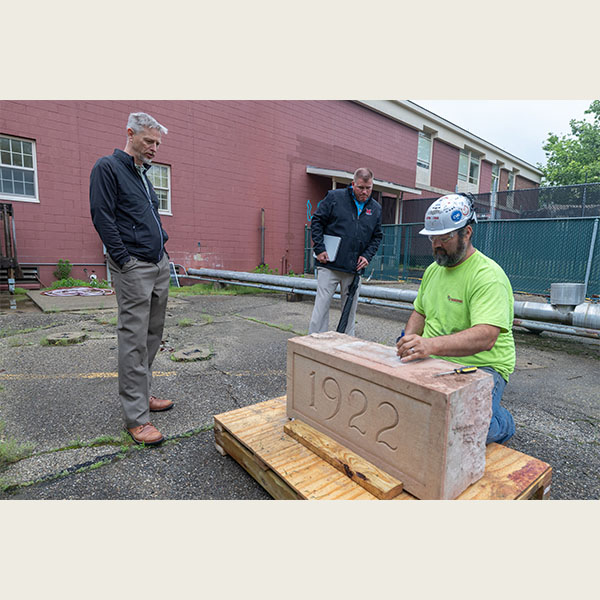
It was like a dream, too, for university architect Robert Bell when it was brought to his attention that older plans and drawings of Wells Hall noted there was a time capsule placed on site. The building, previously used as a dormitory until 2019, is in the process of being removed as part of a project that also included Hannah House, Joyner House, and Williams Hall. The capsule was in Wells Hall’s date stone, which, along with the name stone, will be salvaged and stored.
Bell, Miami’s director of planning, architecture, and engineering, opened the box to unveil several letters, addressed to Miamians of the future, as well as a Recensio yearbook, an edition of the Miami Student newspaper from March 23, 1923, an annual report, and additional keepsakes and mementos from more than 100 years ago.
Usually in the business of putting buildings together, Bell was thrilled to be a part of bringing a piece of Miami history to light. He read aloud one letter to the small crowd assembled at Wells Hall when the capsule, a copper box sealed with lead soldering around it, was opened.
“We didn’t know exactly what was in there or what condition it would be in,” Bell said. “It was neat to understand that there was something put in there intentionally for people in the future.”
The letter was written in cursive and what appeared to be by fountain pen, Bell noted. “I felt honored to be the one reading it,” he said.
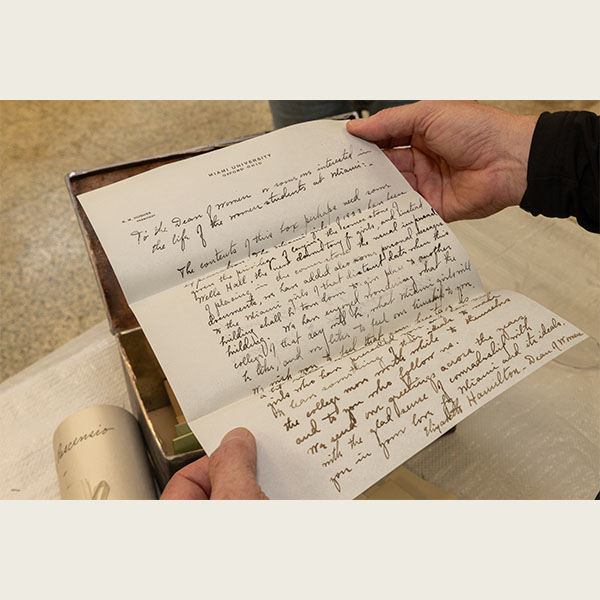
One of the letters was written by Elizabeth Hamilton, Miami’s dean of women from 1905-1945. Several of the letters were from members of organizations, like the Alpha Sigma Tau sorority. Many were sealed with wax stamps.
Constructed in 1922-1923, Wells Hall was named for William Wells, an Oxford resident whose bequest was used to purchase the land where the dormitory was located.
That first moment of wonder, Bell said, was seeing what great condition the materials were in. The second was digging through them finding how personal the letters were.
“I was a little surprised at the way the letters were worded, in terms of the expectation for the time capsule to come out when the building was torn down,” Bell said. “We rarely think when a building is being built about it coming down. It was neat to think about what you would say and how you would say it, considering people might see this 100 years from when it was written.”
Johnson said that time capsules on campus are rare, and they tend to be found in dormitories rather than academic buildings. The Wells Hall time capsule contents are available for viewing in University Archives.
“We have items telling the story of what was going on at the university in 1923. That’s the perfect thing to help preserve the university’s history,” Johnson said. “Time capsules are supposed to be representative of all the connections and agencies of a specific institution, and they did a good job of doing that. Faculty, staff, and students were all represented.”