
Miami University Sustainability invites you to join the Plastic Free July 2026 challenge
Plastic Free July is a shared global movement that helps millions of people reduce plastic waste through simple, everyday choices
Miami University Sustainability invites you to join the Plastic Free July 2026 challenge
Plastic Free July is a shared global movement that helps millions of people reduce plastic waste through simple, everyday choices

Miami Sustainability is taking the challenge
The office of sustainability first introduced the Plastic Free July challenge to the Miami community in 2019. The goal is to challenge people to reduce and refuse single-use plastics and build sustainable habits.
“Plastic Free July is an invitation to start taking action with one small step,” Olivia Herron, director of the office of sustainability, said. “Your small steps in July, such as choosing reusable shopping bags, could turn into a lifelong habit."
Taking steps to use reusable containers, instead of single-use ones, for instance, can make it more likely that others will do so as well. Research has demonstrated a strong impact on social norms, according to the Plastic Free July Foundation.
"Sign up for the pledge and check the PlasticFreeJuly.org website for tips and resources to help reduce single-use plastic," said Alex Miller, sustainability engagement coordinator. "What are the disposable plastic items you most commonly throw away? Try taking an audit for a day, or week, of the disposable plastic items you use, and choose one to swap out with a reusable item."
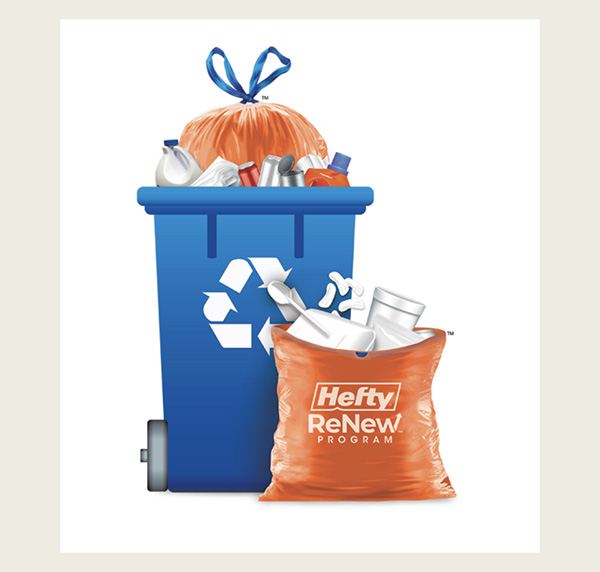
Can’t avoid plastic? Reduce, Recycle, or ReNew
Recycling bins on campus: Rumpke Waste and Recycling (Miami's waste hauler) accepts:
- Plastic bottles, jugs, tubs, and disposable plastic cups (not colored party cups).
- Check the list of accepted items on the Sustainability at Miami website.
Try a Hefty Renew bag for certain hard-to-recycle items: Rumpke customers can collect hard-to-recycle items — like foam take-out containers, plastic utensils, and plastic grocery bags — in orange Hefty ReNew bags.
- The Hefty ReNew bags are picked up by Rumpke with the regular recycling collection, whether curbside in your neighborhood or on campus. Start a ReNew bag in your office and place it near your recycling bin.
- Order a free Hefty Renew starter kit online or contact the office of sustainability for a starter bag for your office.
Miami University Sustainability
Miami University is a signatory of Second Nature’s President’s Climate Leadership Commitment -Climate Commitment and is committed to carbon neutrality on its Oxford campus by 2040 (Miami 2040 Climate Action Plan). Miami is decarbonizing its campus through energy systems transformations, including geothermal exchange and solar energy, and has achieved a 50% reduction in utility-based carbon emissions since 2008. Miami’s 36 LEED Silver-and Gold certified buildings account for 36% of the gross square footage of buildings on the Oxford campus. Miami received its third AASHE STARS (3.0) Gold rating in summer 2025 in recognition of sustainability achievements and is named on the Princeton Review’s 2026 Guide to Green Schools. For more information, visit MiamiOH.edu/Sustainability.