
Resilient, reliable, sustainable: Q-and-A with Vince Weatherstein, Miami’s director of energy systems
"Energy systems are often behind the scenes, but they are critical to everything the university does"
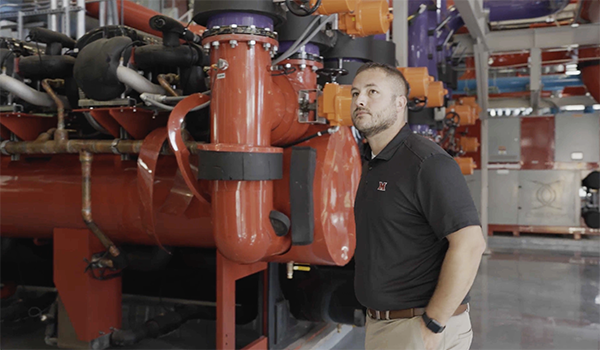
Resilient, reliable, sustainable: Q-and-A with Vince Weatherstein, Miami’s director of energy systems
"Energy systems are often behind the scenes, but they are critical to everything the university does"
Vince Weatherstein, director of energy systems at Miami University, joined Miami last fall. Since then, among other projects, he has overseen the completion of the Western Solar North and South arrays in the new Sharon and Graham Mitchell Sustainability Park, and the completion of the North Geothermal project.
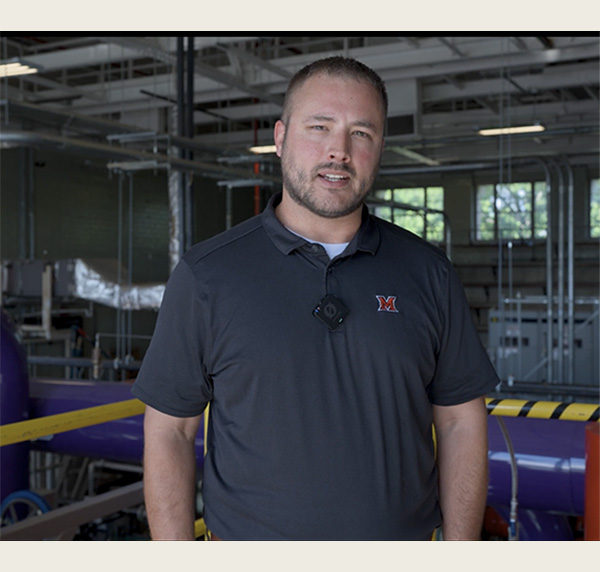
Prior to Miami, Weatherstein was director of Energy Management at Ohio University. He spent about 13 years in the energy industry before shifting to higher education and district energy systems.
Miami is committed to decarbonizing its Oxford campus and reaching carbon neutrality by 2040. “Many of the projects we are implementing today were envisioned and planned years ago by leaders and staff who understood the importance of investing in the university's future,” Weatherstein said.
Likewise, the decisions he and his team are making today “are investments that will impact the campus for decades,” Weatherstein said.
“Our goal is to provide safe, reliable, resilient, and sustainable energy systems that support Miami's mission while being responsible stewards of the university's resources.”
Learn more about Weatherstein and plans for decarbonizing Miami’s energy systems in our Q-and-A.
What drew you to this position at Miami?
Weatherstein: The opportunity to lead a diverse and complex utility portfolio while making a meaningful impact on the university's long-term energy strategy. Miami has demonstrated a commitment to reliability, sustainability, and infrastructure investment through initiatives such as geothermal expansion, renewable energy projects, and utility modernization. Those priorities aligned well with my background and interests.
Most importantly, I saw an opportunity to build a strong team, improve reliability and efficiency, and help position the university for future energy challenges. Being able to contribute to an institution whose mission is education while leading critical infrastructure that supports students, faculty, and staff made the role particularly appealing.
What is your background in the energy industry, and what are some of the changes you’ve seen in the industry?
Weatherstein: My background in the energy industry has been primarily focused on utility generation, distribution, and energy management. Throughout my career, I've worked with steam plants, electrical generation systems, chilled water systems, and campus utility distribution networks. I've had the opportunity to lead operations, maintenance, capital projects, and strategic planning efforts while ensuring reliable utility service to critical facilities.
One of the biggest changes I've seen in the industry is the shift from a sole focus on reliability and production to balancing reliability, sustainability, efficiency, and resiliency. Years ago, success was often measured simply by whether the lights stayed on and the heat kept running. Today, organizations are also expected to reduce carbon emissions, improve energy efficiency, integrate renewable resources, and leverage advanced controls and analytics to optimize operations.
A campus energy system differs significantly from an industrial facility. In industry, energy systems are typically designed around a single process or product. On a university campus, the utility infrastructure supports a wide variety of building types and users: classrooms, laboratories, residence halls, dining facilities, athletic venues, and research spaces, each with unique operating requirements.
What would you like the Miami community to know about energy systems on campus?
Weatherstein: The energy systems that support campus don't happen by accident. The heat in the winter, air conditioning in the summer, electricity, hot water, and the infrastructure that supports research and learning are all the result of decades of planning, investment, and dedicated work by many individuals.
Much of what we do is intentionally invisible. When our systems are operating as designed, most people never think about them and that's actually a sign of success. Behind the scenes, there are teams of professionals operating and maintaining hundreds of millions of dollars' worth of critical infrastructure 24 hours a day, 365 days a year.
Many of the projects we are implementing today were envisioned and planned years ago by leaders and staff who understood the importance of investing in the university's future. My predecessors and the teams that came before us laid the foundation for much of the progress we are seeing today, and they deserve tremendous credit for their vision, planning, and persistence.
The decisions being made today are not just for the next year or two; they are investments that will impact the campus for decades. Our goal is to provide safe, reliable, resilient, and sustainable energy systems that support Miami's mission while being responsible stewards of the university's resources.
After completion of the solar arrays and the North Geothermal Project this year, what are some upcoming projects toward decarbonizing our Oxford campus energy systems ?
Weatherstein: One of the most impactful upcoming initiatives is the continued conversion of the campus heating distribution system from steam to heating hot water (HHW). This transition improves overall system efficiency, reduces distribution losses, lowers maintenance requirements, and creates opportunities to integrate renewable and low-carbon heating technologies in the future. Several buildings, including Armstrong Student Center, Warfield Hall, and MacMillan Hall, are currently being converted as part of this effort.
We are also advancing plans to expand our geothermal infrastructure to support future campus growth. As new facilities are planned, energy systems are being evaluated early in the design process to maximize efficiency and sustainability. The proposed multipurpose arena, for example, is planned to be connected to the campus geothermal loop.
Looking further ahead, we are continuing to develop plans for Phase 1 of the Steam Plant Transformation Project. While still several years away, this project represents a major milestone in Miami's decarbonization journey. The long-term vision is to transition from a centralized steam generation system to a modern heating hot water-based energy system, positioning the university to leverage geothermal, heat recovery, and other emerging technologies while maintaining the reliability and resilience required to support campus operations.
What is one of your favorite things about working at Miami?
Weatherstein: One of my favorite things about working at Miami is the opportunity to make a visible impact on the campus every day. Energy systems are often behind the scenes, but they are critical to everything the university does. Whether it's providing heat during the winter, cooling during the summer, supporting research laboratories, or ensuring students have a comfortable place to learn and live, our work touches every part of the campus.
I also enjoy the variety that comes with working in energy systems. No two days are exactly alike. One day I may be working on a long-term infrastructure project such as geothermal expansion or utility modernization, and the next I may be focused on operational challenges, reliability improvements, or supporting the team through an outage or emergency response.
Most importantly, I enjoy working with the people. We have a highly skilled team with decades of experience, and there is a strong sense of pride in what we do. Watching the team solve problems, adapt to new technologies, and continue improving our systems is extremely rewarding.
Energy systems are the backbone of the university, and being part of a team that ensures those systems operate safely, reliably, and efficiently is something I genuinely enjoy.