
Award-winning Architecture and Interior Design students explore how spaces shape people and places
Four students earn national and state recognition for projects that look beyond buildings themselves
Award-winning Architecture and Interior Design students explore how spaces shape people and places
Four students earn national and state recognition for projects that look beyond buildings themselves
Most people think of architecture in fairly basic terms. Where do the doors go? How big is the bedroom? How does the kitchen connect to the living room?
But the decisions behind a building involve far more than floor plans and blueprints. Successful architects and designers also consider how buildings connect to the social and cultural environments of the communities they serve.
This is how Miami students are taught to approach the field. They’re concerned not only with what a building looks like, but also what it does for the people and places around it.
“Architecture and interior design approach the built environment from different but overlapping perspectives—from how buildings shape communities and respond to their surroundings to how people experience and inhabit a space,” said Liz Martin-Malikian, professor and chair of Miami’s Department of Architecture and Interior Design. “Having both disciplines in one department helps our students connect the scale of the individual experience with the larger social, cultural, and ecological systems their designs influence.”
That broader approach is reflected in the work of four Miami students who recently received recognition for their design projects.
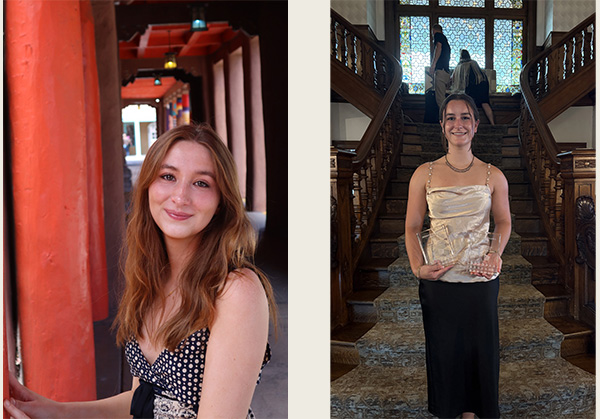
Interior Design majors Piper Campbell and Ava Widrig received different honors for their work, while Master of Architecture students Yihan Zhao and Syed Abu Sufian Kushol both received Awards of Merit from the AIA Ohio Foundation.
Undergraduate Interior Design Awards
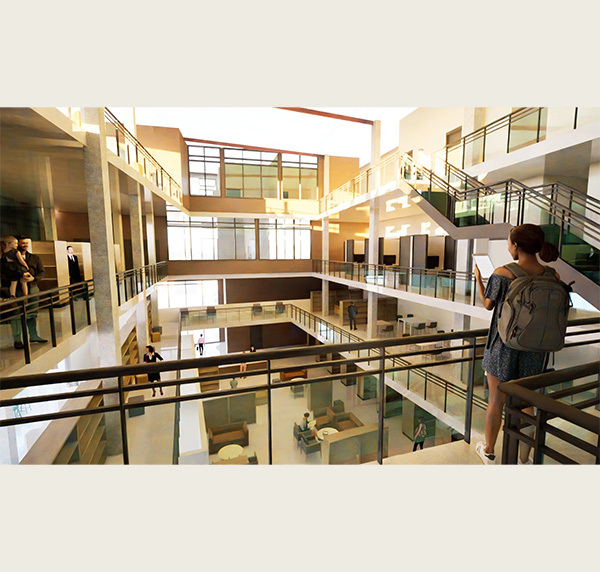
Campbell won two gold awards from the Ohio South/Kentucky chapter of the American Society of Interior Designers (ASID) for a commercial library and a residential apartment concept, both of which were completed during her sophomore year.
Campbell described the library as the largest and most detailed project she’s tackled so far, explaining that its extensive square footage, detailed program requirements, and unique architectural elements were among its strengths. Her residential concept focused on the needs of fictional clients for a New York City apartment, which was first designed with hand-rendered drawings before being finalized digitally.
Widrig received a $30,000 senior scholarship from the Angelo Donghia Foundation, and it was one of just 15 awarded nationally this year.
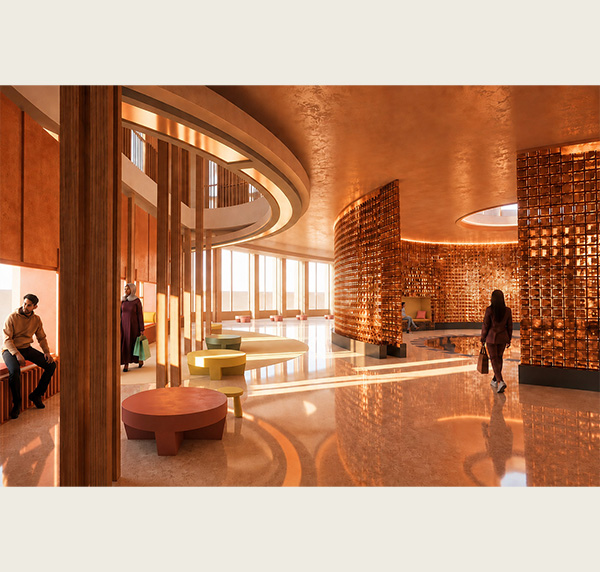
Her award-winning work also centered on a library, but with a different approach. Inspired by the movement of water, her concept, called “rippling,” used patterns of ripples to shape the building’s exterior and interior. She also designed a copper lattice system to create a rippling effect with light throughout the space.
“I was so shocked. I actually found out on my birthday,” Widrig said. “I was at my internship, working, and I got a message from my professor telling me that I had won. It’s definitely a significant award, especially because I am here on scholarship. So it means a lot to me.”
Graduate Architecture Awards
Zhao and Kushol, both Master of Architecture students, received Awards of Merit from the AIA Ohio Foundation for thesis projects exploring how the built environment can respond to changing social and cultural needs.
Kushol’s thesis, “Hybrid Habitat,” examined how the growth of remote work could reshape high-density housing. Moving beyond the traditional separation of home and workplace, he explored how housing could accommodate working from home while creating opportunities for residents to connect with their communities.
Zhao’s thesis, “Buddhist Cultural Exhibition Center,” explored how architecture can support people navigating migration and cultural adaptation. His project considered how a cultural center could help people maintain connections to their heritage while finding a sense of belonging in unfamiliar surroundings. Zhao is now a graduate student at the University of Pennsylvania.
“Our students learn to connect the experience of an individual space with the larger context of a community,” Martin-Malikian said. “They consider how design responds to people’s everyday needs while contributing to the social, cultural, and ecological systems around them.”
The AIA Ohio Foundation received 36 entries from several universities including Miami, Cincinnati, Bowling Green, Kent State and Ohio State, making the awards a direct comparison among students from architecture programs across the state.
While the four Miami students addressed different challenges, their projects share a concern for how design shapes everyday life—from fostering community in high-density housing to helping people navigate unfamiliar cultural settings.
For Campbell, that impact often comes down to details most people might never consciously notice. And as she’s progressed through her program, she’s learned to look more critically at how individual design decisions can influence the experience of a space.
“If it's off, people might not understand what's off, but they do feel it,” Campbell said. “And that's why I think design is very important. Even if you don't understand it, you still feel it.”
Established in 1809, Miami University is located in Oxford, Ohio, with regional campuses in Hamilton and Middletown, a learning center in West Chester, and a European study center in Luxembourg. Interested in learning more about the Department of Architecture and Interior Design? Visit their website for more information.