
Miami partnership helps entrepreneurs turn business ideas into reality
Course equips entrepreneurs who are blind or have low vision to launch their businesses
Miami partnership helps entrepreneurs turn business ideas into reality
Course equips entrepreneurs who are blind or have low vision to launch their businesses
Five aspiring entrepreneurs transformed their business ideas into actionable business plans through a unique partnership between Miami University Online and The Chicago Lighthouse, culminating in a business pitch competition that awarded a $25,000 grand prize to one participant.
The collaboration paired Miami faculty expertise with The Chicago Lighthouse's longstanding commitment to expanding opportunities for individuals who are blind or have low vision. Together, the organizations created a customized, non-credit online course that guided participants through every step of developing a practical, investor-ready business plan.
"This experience demonstrates how higher education can remove barriers while empowering individuals with the knowledge and confidence to pursue their entrepreneurial goals," said Erica Noll Crawford, director of online engagement for Miami Online. "Watching participants refine their ideas into viable businesses through expert mentorship was incredibly rewarding."
Noll Crawford oversees a variety of short-term credential programs, including Miami University Regionals for-credit Microcredentials and Miami Online's non-credit professional education offerings.
Building on a shared vision
The partnership has its roots in the generosity and vision of Miami alumnus Richard "Rick" Forsythe '69 and his wife, Sandy. After Rick began losing his vision later in life, the couple sought organizations providing meaningful support for individuals who are blind or have low vision and found The Chicago Lighthouse.
Inspired by the organization's impact, the Forsythes became longtime supporters, helping establish both the Forsythe Entrepreneurial Center and the Sandy Forsythe Assistive Technology Center. They have also remained dedicated supporters of Miami University.
Conversations among Miami leaders, the Forsythes, and The Chicago Lighthouse began several years ago to explore expanding educational opportunities for individuals with visual impairments, including pathways to college credit, Noll Crawford said.
Their first collaborative effort combined Chicago Lighthouse's entrepreneurship programming with a Miami for-credit course to create a co-branded microcredential. In 2024, however, The Chicago Lighthouse identified an opportunity to take the program a step further.
“While participants already learned foundational business concepts such as accounting, value propositions, and target audiences, they wanted entrepreneurs to leave with something more tangible: a complete business plan ready for implementation and refined through expert feedback,” Noll Crawford said.
A course designed for real-world success
To meet that need, Miami Online partnered with Paul Williams, associate clinical lecturer for Miami Regionals Department of Commerce, who used his expertise and experience as a former Fortune 50 executive and successful entrepreneur, to create a 10-part online course titled Developing Your Business Plan.
Throughout the program, participants developed every major component of a business plan, including:
- Defining their business concept
- Identifying target customers
- Projecting income and expenses
- Assessing risks and mitigation strategies
- Developing an effective business pitch
Assignments were submitted throughout the course, with Williams providing individualized feedback that helped entrepreneurs strengthen and refine their plans before presenting them to a panel of Miami faculty judges including:
- Sonseeahray Ross, associate professor, Commerce
- Monticha Sompolvorachai, associate teaching professor, Commerce
- Steven Feldmann, associate clinical professor, Commerce
- Dan Carroll, associate professor, Commerce
"This project reflects the very best of what our department strives to do by connecting practical business education with meaningful community impact,” said Tom Mays, chair and associate professor of Commerce. “Paul Williams and our faculty judges brought deep expertise and commitment to the partnership."
Ideas ranged from adaptive clothing and accessibility consulting to photography and moving services. Despite their different ventures, each entrepreneur shared the same goal: turning a promising idea into a business ready for the real world.
The final presentations included a question-and-answer session with faculty experts representing multiple business disciplines, ensuring entrepreneurs considered marketing, accounting, leadership, and risk management from every angle.
By the end of the program, Noll Crawford noted, participants had more than an understanding of entrepreneurship. They left with a complete business plan, expert feedback, and the confidence to present their ideas to a panel of Miami faculty.
Accessibility by design
Because all participants were legally blind or visually impaired, accessibility was central to every aspect of the course.
Rather than relying on traditional textbooks, Williams incorporated open educational resources. This reduced costs for both The Chicago Lighthouse, which funded participants' tuition, and the students themselves, while ensuring materials were more accessible through formats such as screen readers and audio technologies.
Miami Online also designed the experience using Universal Design principles to create an inclusive learning environment from the outset.
"We always approach our online experiences with accessibility in mind because every learner deserves access to the same high-quality education," Noll Crawford said. "At the same time, we know collaboration makes us better."
She credited Colleen Wunderlich of The Chicago Lighthouse as an invaluable partner in reviewing course materials, providing accessibility guidance, and helping faculty understand how to best support this population.
From ideas to investment
Eleven entrepreneurs initially submitted business concepts ranging from adaptive technology services and accessibility consulting to photography, clothing created by individuals with disabilities, ready-to-eat food products, and moving services.
Seven entrepreneurs were selected to participate, with tuition for the $1,500 course fully funded by The Chicago Lighthouse. Five participants completed the program and presented their final business plans.
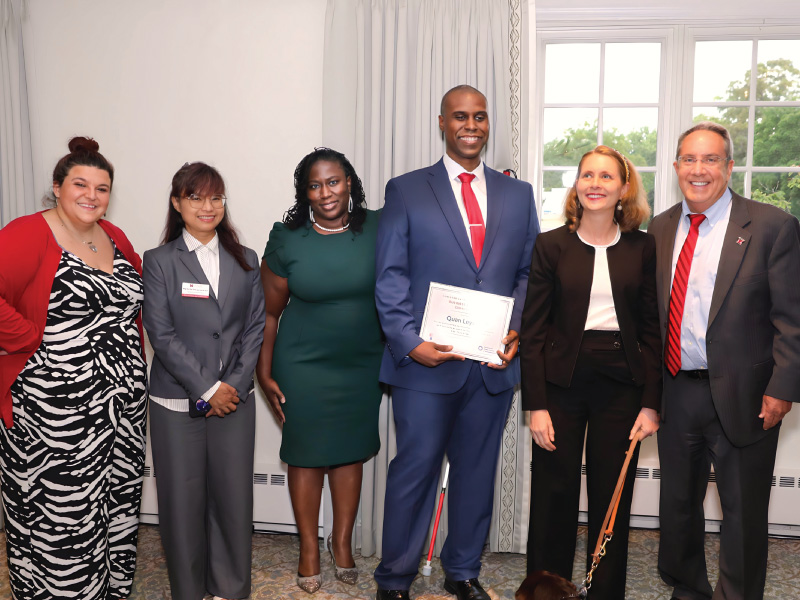
The competition concluded with Quan Leysath, from South Carolina, receiving the 2026 Business Enterprise Competition's $25,000 grand prize for Pak Then Stak, LLC, a company providing reusable moving crates that are delivered and picked up after use. Leysath plans to invest the award in expanding inventory and marketing to accelerate business growth.
The award was announced during the Forsythe Entrepreneurial Award Dinner held in late June.
Looking ahead
The Chicago Lighthouse previously offered the business competition regularly before it was paused during the COVID-19 pandemic. Following the success of this year's partnership, both organizations hope the collaboration becomes an annual tradition.
"It has been incredibly rewarding to be part of this experience," Noll Crawford said. "We hope to continue inspiring and supporting more entrepreneurs in the years to come while demonstrating what's possible when education, accessibility, and community partnerships come together."