
Regional growth and the power of the I-75 corridor in southwestern Ohio
Creating business and education collaborations to build the Cincinnati-Dayton corridor for the future of advanced manufacturing in the region
Regional growth and the power of the I-75 corridor in southwestern Ohio
Creating business and education collaborations to build the Cincinnati-Dayton corridor for the future of advanced manufacturing in the region
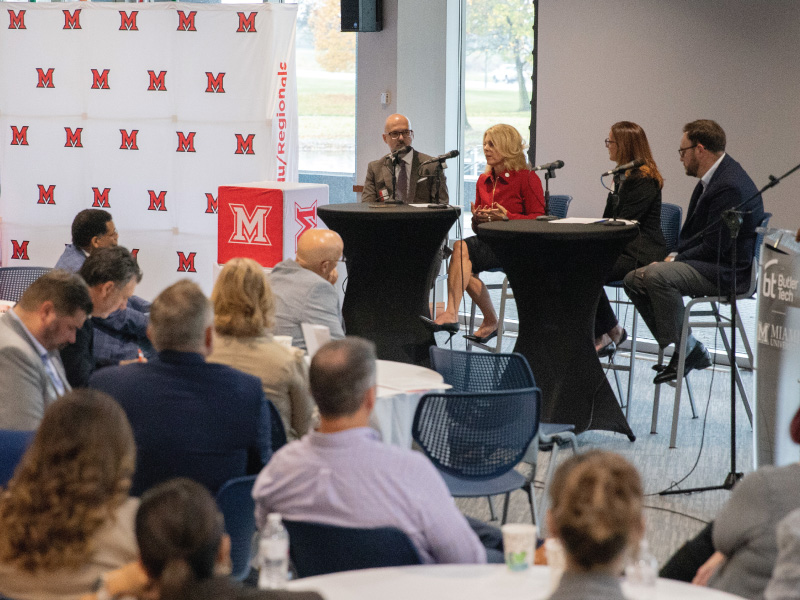
More than 160 area business and government leaders came together at the Advanced Manufacturing Workforce and Innovation Hub on Nov. 4 to look to the future and explore building southwest Ohio’s manufacturing strength.
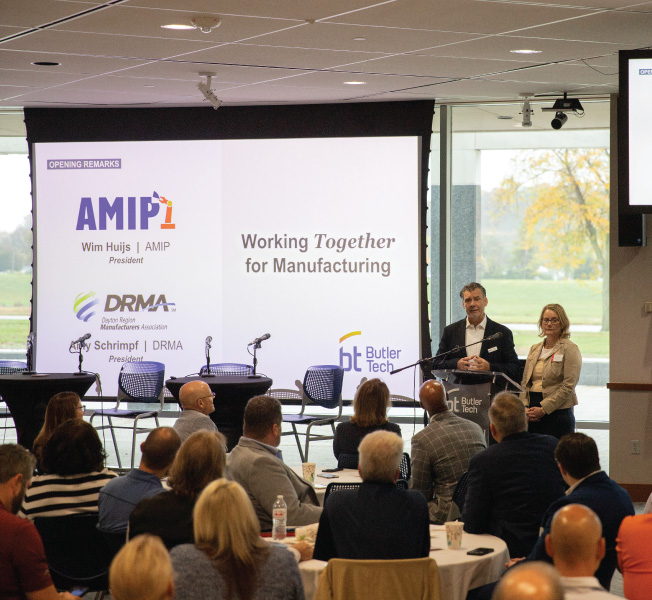
The Power of the Corridor: Collaboration, Innovation, and Regional Growth was presented by Miami University Polytechnic, Butler Tech, Dayton Regional Manufacturers Association and the Cincinnati-based Advanced Manufacturing Industry Partnership.
The event focused on how Cincinnati and Dayton can leverage their combined strengths in manufacturing, workforce, innovation, education, and economic development to create new opportunities for the region.
Miami University’s Vice President for Strategy and Partnerships, Ande Durojaiye, moderated a panel discussion that included Orfeo Finocchi, CEO of Modula, and Mike DeSantis, Global HR Executive, GE Aerospace, joined by Kimm Lauterbach, CEO of REDI Cincinnati, and Julie Sullivan, executive vice president of regional development at Dayton Development Coalition.
Asked what makes this corridor uniquely positioned for advanced manufacturing growth, Finocchi pointed to the region’s strategic position, excellent transportation infrastructure, and strong manufacturing tradition. “There's also a well-established network of industrial suppliers and technical expertise and, from my perspective, an excellent level of education — from schools to universities and technical schools — which is essential for developing the workforce of the future.”
DeSantis referenced the growing demand for advanced manufacturing in the region. “When you combine that demand with training partners, technical schools, and companies willing to collaborate across traditional boundaries, you create a great environment for regional and industry growth.”
Last year REDI Cincinnati reported that technologically advanced manufacturing experienced growth of 19% nationally over the five-year span of 2019 to 2024. During that same time period there was 33% growth in that sector in the Cincinnati MSA.
Miami University President Gregory Crawford shared the work that led to Miami’s strategic plan. “The first thing we heard was that you needed in-demand programs and new types of degree programs that could address workforce shortages across the state. We also knew you wanted to keep talent here in Ohio.”
With its curriculum designed in consultation with business and industry, President Crawford pointed out that Miami University Polytechnic, with its technology-oriented degrees and credentials at the certificate, associate, and bachelor's levels, is designed to address those needs.
The partnership between Miami University and Butler Tech is a key component of this regional workforce strategy. At the Advanced Manufacturing Hub, Butler Tech high school students have opportunities to learn alongside Miami University students in an environment that connects career-technical education, higher education and industry. Aligned programs create pathways for students to continue their education through Miami's certificate and degree programs while developing technical skills needed in advanced manufacturing.
William Sprankles, superintendent and CEO of Butler Tech, spoke of Miami’s being “willing to do things differently than any other college partner we've ever worked with,” and that word of this transformative work had reached as far as Spokane, Washington.
“Last week we hosted a tour for representatives from three different school districts in Spokane, Washington, along with representatives from community colleges. They came primarily to tour the AM Hub. They wanted to see some other places in the region, too, but word has gotten out as far as Spokane, Washington, that something is happening in Southwest Ohio involving Miami University and Butler Tech, and that we're doing things differently. So much so that they sent 30 people.”
Referencing connecting the corridor, Sullivan pointed out that, “Because Dayton and Cincinnati are so connected, we often bring Cincinnati-area partners into conversations with Dayton-area companies, and vice versa. We're doing more and more of this work together. There's power in a larger geography, especially when we're attracting new investment.”
In addition to making those connections, Lauterbach spoke of the need to attract more people to the corridor. “JobsOhio's relocation incentives can provide up to $15,000 per qualified relocated employee coming from out of state. So we're looking at both sides: How do we train the workforce we already have, and how do we bring in new workers?”
When asked about next steps, Desantis said that, “The most important thing is continuing to come together and communicate. We need to identify shared needs and one common demand signal that we can jointly work to address.”
“We're all facing similar challenges. Everyone in this room — and the organizations they represent — will be much more successful if we solve those challenges together instead of individually.”
Finocchi summed it up this way: “Strengthening cooperation and communication is crucial. Technology is changing, and education should evolve alongside industry to meet future needs.”
“We need to strengthen partnerships so industry and educational institutions grow together. They can't be disconnected. It's important to make sure industry and education are working in alignment.”