
Twin sisters sketch Miami landmarks for Great Seal book
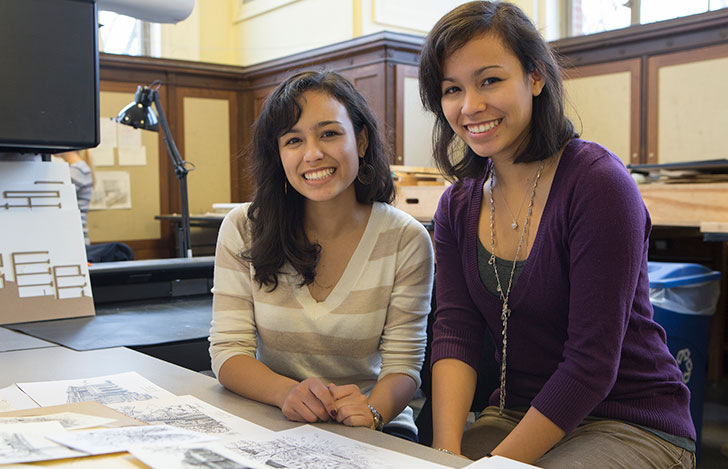
Miami University seniors Madelyn and Sophia Delgado were selected to sketch 12 Miami landmarks for 'The Great Seal Essays' book after a contest within the department of architecture and interior design last spring.
Twin sisters sketch Miami landmarks for Great Seal book
Miami University seniors Madelyn and Sophia Delgado were selected to sketch 12 Miami landmarks for 'The Great Seal Essays' book after a contest within the department of architecture and interior design last spring.
Miami University seniors Madelyn and Sophia Delgado were selected to sketch 12 Miami landmarks for The Great Seal Essays book after a contest within the department of architecture and interior design last spring.
The book is among the life-size objects included in a 3-D version of the university seal recently installed in the Bicentennial Rotunda of the new Armstrong Student Center, opening in January.
The twin sisters who are majoring in architecture teamed up on the pen-and-ink drawings of Kumler Chapel, Alumni Hall, the Tri Delt Sundial and other well-known sites on campus.
"Madelyn was more in control of the details and the brickwork, and I focused more on the landscaping and the base drawing," Sophia said.
John Weigand, chair and professor of the department of architecture and interior design, said the "enormously talented" duo tackled the Great Seal project together. They did all of the sketches in a two-week period during the summer.
"Completing 12 sketches in only a few weeks is a challenge," Weigand said, "so this team approach produced the drawings quickly and with a consistent look."
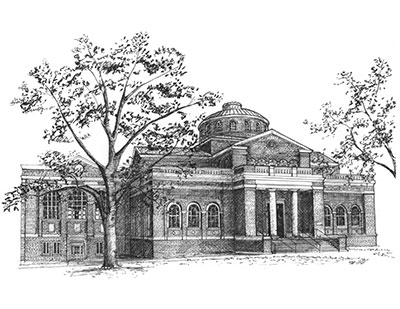
Alumni Hall
"A tremendous amount of enthusiasm"
Sophia and Madelyn said they researched the history of the various landmarks and took photographs of each before starting their sketches.
The most difficult building to draw was the one they were most familiar with — Alumni Hall, home to the architecture and interior design department and the studio where they work side by side.
"I think Alumni was a very challenging one," Madelyn said, noting the intricate brickwork and other structural elements, including the front steps and columns.
"Plus, we practically lived there," Sophia added with a laugh, "so we wanted to make sure it was really good."
Another challenging one was the university seal at the hub on campus.
"We did it so that you could also get the Upham Arch in the background. There are all those trees right in front as well," Sophia said, noting the difficulty of blending the building with the trees.
One of their favorites to draw was Kumler Chapel, which graces Western campus, its light-colored stones standing out from the red brick buildings at Miami.
Lisa Blankenship, visiting assistant professor of English, worked closely with the Delgados on the project when she was interim associate director of the Howe Writing Center earlier this year. Their talent and professionalism impressed her.
"They have a tremendous amount of enthusiasm for Miami, and I think it comes through in their sketches," she said.
A passion
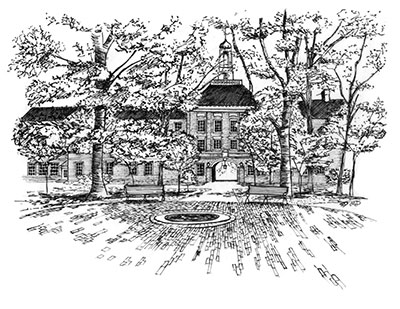
The university seal and Upham Hall
Artwork came naturally to Sophia and Madelyn, whose mother was a freelance illustrator for such publications as Scholastic.
Their parents, Mario and Carol Delgado of Lebanon, Ohio, bought them their first sketchpads and charcoal pencils when they were 16. They share a fond memory of their mother teaching them how to draw a properly shaded apple.
At Kings High School the twins collaborated on an art class mural that featured paint cans (labeled with words like inspiration and creativity) spilling down to create a scene.
When it came time to start considering college, both were thinking about art schools. Their father suggested they also consider architecture.
The summer of their junior year in high school, they participated in the six-week Junior Scholars Program at Miami. One of their classes was in architecture.
"Speaking for myself, after taking that course here with the staff of the department, I ended up falling in love with it pretty easily," Madelyn said. Sophia arrived at the same conclusion, joining her sister at the Oxford campus.
"It feels right. Mad and I both love what we do," Sophia said. "It's a passion now."
Each received a 2012 Miami Undergraduate Summer Scholars award, which paid $2,600 for them to do research over nine weeks and get 3 hours credit. Madelyn did research on landscape design and proposed a redesign of a park near their hometown. Sophia researched biomorphic design, which models artistic design elements on patterns reminiscent of nature or living organisms.
Their focus lately has been on the January opening of the Armstrong Student Center, where the 3-D Great Seal — and its various elements — are sure to be a focal point. Read the full story about the 3-D version online.

Kumler Chapel
Blankenship said the university plans to sell commemorative versions of the book, both in hard and soft cover. She's thrilled the way it turned out. It was her idea to use traditional pen-and-ink sketches to give the landmarks a timeless quality, and she couldn't be happier the Delgado sisters fulfilled that vision.
The young women have launched a freelance business to make their sketches commercially available as prints, notecards and postcards.
They named the business, Pen and Ink in a Blink, playing off their ability to do architectural renderings quickly. They are developing a website to sell the items online and also are working with Miami's trademarks & licensing office and the Miami University Bookstore.
Samantha Stevens, manager of university trademarks & licensing, said the Delgados own the rights to their artwork. They would get a percentage of the sales, while the university would receive licensing royalties with some proceeds going to student scholarships.
The sisters said they enjoyed being part of the team that contributed to the approximately 150-page Great Seal book. The experience also gave them a unique opportunity to collaborate on something special before they graduate in the spring.
Based on their work in the book, President David Hodge and his wife, Valerie, university ambassador, commissioned them to sketch the president's residence, Lewis Place, as well as the rotunda of the new student center.
"Seeing all of this come together is kind of surreal in a way," Madelyn said.
Written by Margo Kissell, University News and Communications, kisselm@miamioh.edu
Miami University is gearing up for an exciting addition to its campus this fall with the unveiling of the Richard M. McVey Data Science Building. Located in the heart of the campus, this remarkable facility is set to provide students in the departments of Statistics, Computer Science, Software Engineering, and especially, Emerging Technology in Business + Designs (ETBD) Immersive and Reactive Classes with a groundbreaking space to promote innovation and creativity.
One of the standout features of the Richard M. McVey Building is the Immersive and Reactive Lab, where students from the Emerging Technology in Business and Design (ETBD) program come together in their capstone class to create capability demos for ongoing use on the XR (Extended Reality) stage. This cutting-edge XR stage will serve as a platform for students to develop and showcase their projects, which span a wide range of immersive experiences.
“The projects developed by ETBD students promise to be nothing short of extraordinary,” said ETBD student Laney Miller. “Groups of individuals are presently collaborating on projects, all poised to leverage the immersive capabilities of the XR stage.”
The students' creations will encompass everything from live broadcasting the excitement of esports to replicating the lively ambiance of a subway train. These projects are not just for fun, though; they offer numerous valuable opportunities for the students.
The XR stage project allows students to actively participate in setting up and integrating virtual production on a professional stage. They will have the privilege of collaborating with one of the world's best integration companies, Meptik, gaining hands-on experience and exposure to industry-standard practices.
Secondly, the projects are designed to exhibit the capabilities of the Immersive and Reactive Lab and the XR stage itself. Including projection mapping for dynamic displays, camera tracking for precise interactions, and blended reality capture for seamless integration of real-world video. These features provide students with a versatile platform to showcase their creativity and technical skills. This stage provides students with the opportunity to showcase their creativity and exhibit their technical skills to a wide audience, both within the university community and beyond.
Lastly, this initiative places professional-grade tools in the hands of students, enabling them to create and build with the same tools and technologies used by industry professionals. This equips them with real-world skills that are invaluable in their future careers.
For more information, visit the Department of ETBD or reach out to ETBD Professor Benjamin Nicholson.
One enthusiastic student expressed, "This was the most exciting and rewarding class that I have been a part of, and I can’t wait for people to experience it" (ETBD Student Caleb Adelman).