
The beginning of a legacy: Robert Hamilton Bishop and 200 years of the Miami Student
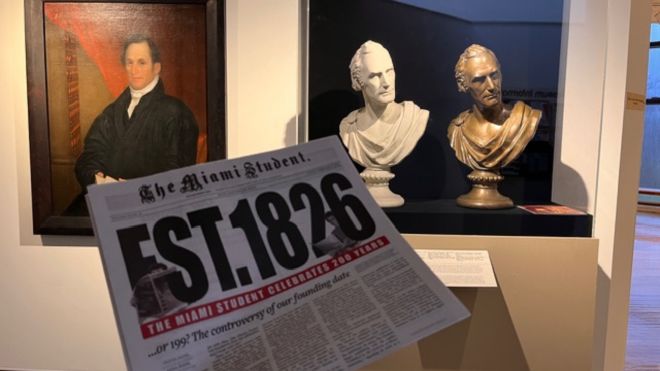
The beginning of a legacy: Robert Hamilton Bishop and 200 years of the Miami Student
In the parish of 1777 Whitburn, Linlithgowshire, Scotland, the first president of Miami University, Robert Hamilton Bishop, was born. As a young man, he studied at the University of Edinburgh, where he received his Doctor of Divinity in 1798. Just a few years later, Bishop emigrated to New York in 1802. Following this, he served as a pastor in various Presbyterian churches in Kentucky, while also serving as a professor at Transylvania University in Lexington. In 1824, Bishop accepted the offer to serve as the first president of Miami University as well as Professor of Logic, Moral Philosophy, and History.
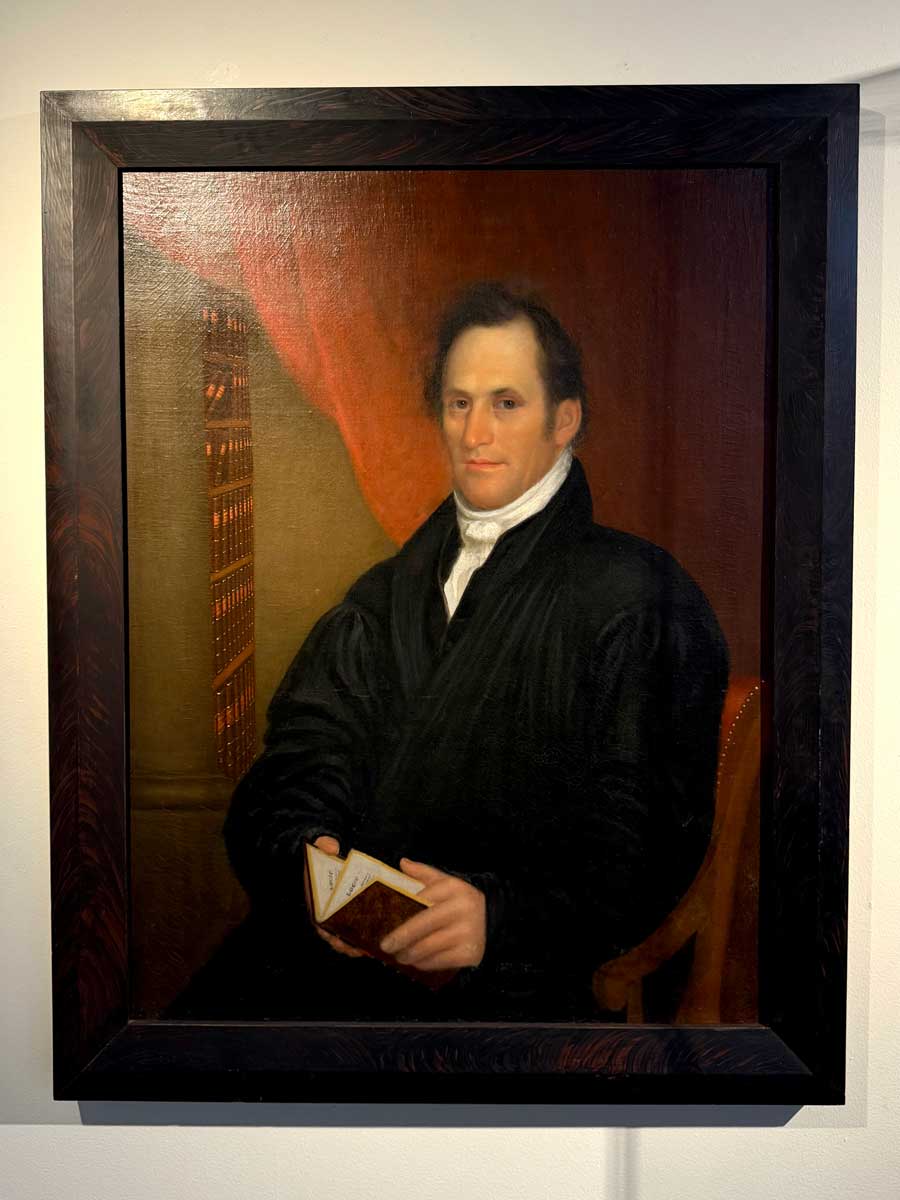 Horace Harding (American, 1794 - 1857)
Robert Hamilton Bishop (1777 - 1855), 1829
Oil on canvas, 42" x 32"
Commissioned by the Miami Union Literary Society
1829.P.1.1
Throughout his time as president, Bishop valued student initiative and encouraged the formation of literary societies to educate students on the importance of rhetoric, equipping them to effectively communicate their perspectives. We see this support with the rise of periodicals posted by the Erodelphian and Union Literary Societies. Bishop was known for his progressive thinking, even to a fault. While he was not quite an abolitionist, he denounced the expansion of slavery and advocated for the modernization of the Presbyterian religion. Unfortunately, in 1841, Bishop was removed from his presidency due to conflicting views with his conservative colleagues over lax student discipline. Despite this controversy, we can appreciate the impact he had on early students in Miami’s history.
In May of 1828, Literary Focus became one of the first periodicals to be published on campus at Miami University. Run by ambitious and passionate students, this periodical focused primarily on literature and philosophy. Despite their drive, the periodical was quickly rendered defunct due to a lack of subscriptions that could not support the organization’s financial needs. However, Bishop understood the importance of having a literary periodical, resulting in the formation of the Literary Register just months after the closing of Literary Focus. To guarantee its success, Bishop, along with professors William H. McGuffey and John E. Annan, oversaw this periodical. This was the push it needed to continue into the future for the next 200 years, where we now know it as the Miami Student.
Bishop's influence has not only been felt through the Miami Student, but also through the arts. At the Richard and Carole Cocks Art Museum, we are currently exhibiting artworks made in Bishop’s likeness to celebrate the extensive history of Miami and the amplification of student voices. Through this commemoration, we continue the values held by Bishop in providing the students with the opportunities and resources to become well-rounded, educated individuals who will drive the future of our society toward greatness.
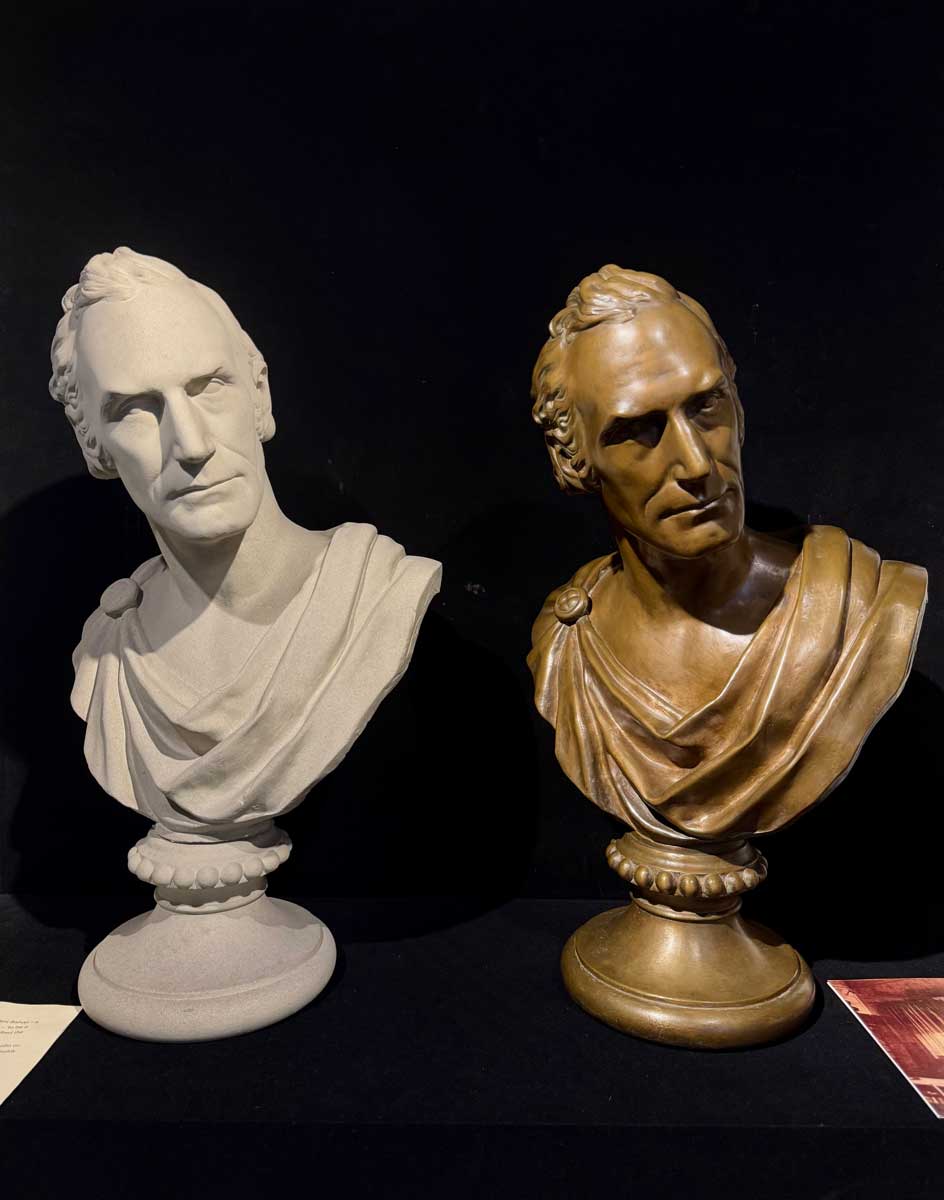 (Left) Hiram Powers (American, 1805-1873)
Robert Hamilton Bishop, 1834
Plaster , 27 ⅜” x 17” x 17”
Gift of Family of Dr. and Mrs. Robert Hamilton Bishop, class of 1903
1986.6
(Right) Hiram Powers (American, 1805-1873)
Robert Hamilton Bishop, early 20th century
Cast bronze, 27” x 16 ⅝” x 16 ⅝”
Gift of the Family of Dr. and Mrs. Robert Hamilton Bishop, class of 1903
1987.42
For the first time in over 15 years, a culmination of sculpture and painting depicting Bishop will be displayed in tandem. The oil on canvas painting, created by Horace Harding, depicts Bishop positioned in front of a curtain as he unveils to us a library of books and knowledge. This work was commissioned by the Union Literary Society and created to celebrate Bishop's publication of his book, A Manual of Logic, as we see him flipping through the book in question. This artwork captures a pivotal moment in Miami’s history and celebrates the prowess of Miami in its early life.
Next to the painting are two busts of Bishop, one of plaster and one of bronze. These represent a rivalry in literary societies, led by their affirmation of Bishop. These sculptures by Hiram Powers were commissioned by the contending Erodelphian Society to one-up the Literary Union. In these busts, you see Bishop depicted in a robe draped over his shoulders, paying homage to the great minds of ancient philosophy.
Miami University, as one of the first educational institutions in Ohio’s 222 years of existence, has served countless students, professors, and artists throughout its history. In part, this is thanks to the efforts made by Bishop and his willingness to trust his students to perpetuate an environment that encouraged educational excellence. As we move toward the future, we hope to maintain the progressive mindset held by Bishop and allow our students to act to their fullest potential.
About the Author
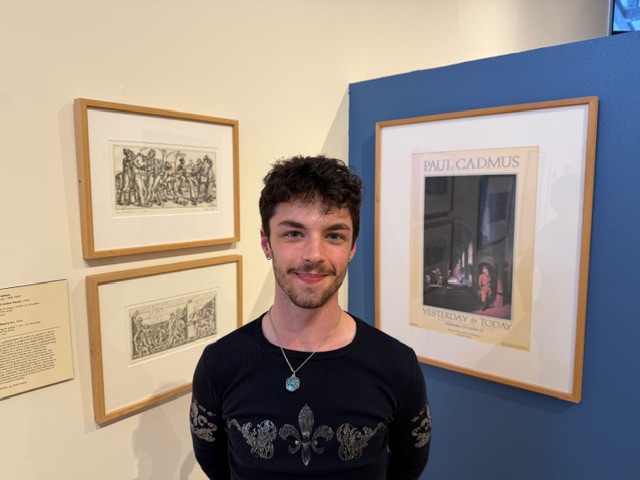 Anderson Knapp is a Senior in Emerging Technology in Business and Design with a co-major in Arts Management and Minors in Museums and Society and Leading Digital Innovation. He is currently a Student Assistant at the museum, Event Planner for the Art Museum Student Organization, and the Co-Chair for Sparkfest.