
Miami economists study link to voluntary sleep loss from late-night sports to fatal car crashes
Researchers’ publication ‘Soccer’s Record on the Road’ reveals the deadly cost of staying up late
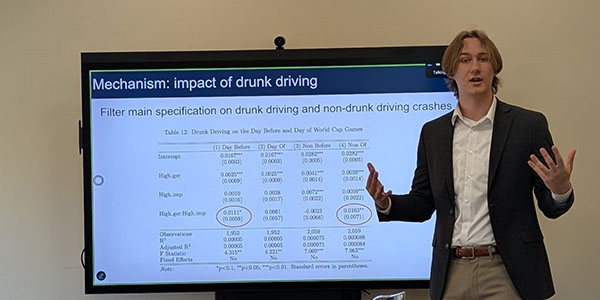
Miami economists study link to voluntary sleep loss from late-night sports to fatal car crashes
Researchers’ publication ‘Soccer’s Record on the Road’ reveals the deadly cost of staying up late
Choosing to stay up late for entertainment can be deadly - not just for the sleep-deprived driver, but for everyone else on the road too. A new study by Miami University economic researchers found that when Americans stayed up to watch the 2002 FIFA World Cup soccer games, it led to 28.8 fatal car crashes and cost $86.5 million, revealing how voluntary sleep loss for recreational activities poses a significant public safety threat.
In today’s dollars, those deaths would translate to $394.6 million, based on the Department of Transportation 2024’s guidance on the Value of a Statistical Life (VSL). The VSL is used to assess the value of safety improvements to reduce risk of death. The economic toll extends to include property damage, hospitalization and health care, insurance costs, and funerary expenses.
“Soccer’s Record on the Road: The Effect of Late-Night Sporting Events on Fatal Car Crashes,” published by the IZA Institute of Labor Economics Discussion Paper Series , examined crashes following World Cup matches broadcast from South Korea and Japan - matches that aired in the middle of the night or early morning for U.S. viewers.
“If you’re staying up until 2 a.m. or 3 a.m. to watch a game, you’re not just losing one hour of sleep, you’re potentially losing many. You might do that for multiple weeks in a row,” said Peter Nencka, assistant professor of Economics and lead author of the study. “We were interested in these periods of acute, voluntary, recreational decisions to not sleep.”
The study was conducted by Nencka, assistant professor of Economics Jim Flynn, and Noah Meyers-Richter ‘25. The paper started as Meyers-Richter’s economics master’s thesis in the Department of Economics’ 3+1 program (where students complete both a bachelor’s and master’s degree in four years), advised by Nencka and Flynn. After that thesis was completed, the three decided to turn it into an expanded research paper.
Germany’s strong 2002 World Cup performance provided a natural experiment for the study. Germany played seven games, advancing to the semifinals and finals before losing to Brazil, with viewership increasing as the tournament progressed.
With over 30 million U.S. residents claiming German heritage in 2000, the researchers hypothesized that viewers with German ancestry were more likely to stay up to watch the late-night broadcasts. They compared fatal car accidents in areas with high percentages of German-heritage residents to areas with low percentages in the days before and after each German match.
The Fatal Accident Reporting System (FARS), which tracks every fatal U.S. car accident, provided key information for their analysis. The system captures details including: date, time, location, local weather conditions, driver demographics, and suspected alcohol involvement. After controlling for weather conditions and excluding alcohol-related crashes, the results showed increased fatal accidents in high-German-heritage areas following the games, supporting their conclusion that sleep-deprived driving caused the crashes.
Meyers-Richter emphasized that staying up late for recreation happens constantly, not just during major sporting events. Playing video games, watching movies with friends, or attending concerts all involve the same voluntary sleep loss that can lead to dangerous driving.
“Sleep loss is not without consequence,” Meyers-Richter said. “It’s not just about protecting oneself and protecting one’s own safety, it’s also about protecting society.”
The findings also made him reflect on his own experience with recreational sleep loss: “I’ve changed some of my own habits when it comes to sleep loss because it’s sobering to understand how negative and risky that type of behavior is.”
The researchers suggest specific strategies that could prevent similar tragedies. Public service announcements before and during late-night events could remind people to plan alternative transportation or avoid driving while sleep-deprived. Increased police presence on the roads following late-night events, watching for reckless driving consistent with sleep loss, could also prevent accidents and save lives.
The study builds on existing research examining sleep loss and traffic safety, such as studies on daylight saving time’s impact on fatal crashes, but breaks new ground in understanding recreation-driven sleep deprivation and its community-wide consequences.
Established in 1809, Miami University is located in Oxford, Ohio, with regional campuses in Hamilton and Middletown, a learning center in West Chester, and a European study center in Luxembourg. Interested in learning more about the Department of Economics? Visit the website for more information.