
Miami graduate students turn global experience into lasting impact
Two master’s students from the Department of Teaching, Curriculum, and Educational Inquiry travel to Luxembourg through the Menard Family Center for Democracy
•
Published
•
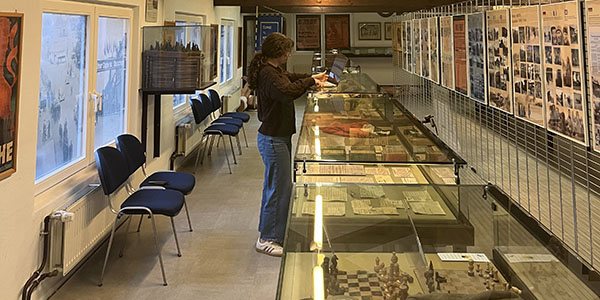
Becca Borton works at the General Patton Memorial Museum in Luxembourg.
Miami graduate students turn global experience into lasting impact
Two master’s students from the Department of Teaching, Curriculum, and Educational Inquiry travel to Luxembourg through the Menard Family Center for Democracy
•
Published
•
When Becca Borton ’26, a master’s student in History, was approached to work with the General Patton Memorial Museum in Luxembourg, she couldn’t pass up the opportunity. This past winter term, Borton and classmate Marina DeNunzio ’26 traveled to Luxembourg to take on this experiential learning project.
Borton and DeNunzio met with Professors John Forren and Thomas Misco throughout the fall semester to brainstorm ideas and devise a conceptual framework, but once they arrived in Luxembourg, they were tasked with responding to needs and constructing educational programming for the museum in just under two weeks.
The General Patton Memorial Museum honors George S. Patton, a renowned U.S. general during World War II. The museum attracts a broad age range of visitors and is filled with artifacts from the Nazi regime, often difficult for younger visitors to digest. Borton said, “Our challenge was figuring out how to make such heavy, sensitive content and artifacts appropriate and intelligible for fairly young kids, sometimes as young as 6, but aiming for that fourth-grade, fifth-grade level.”
Yet within two weeks, Borton and DeNunzio had created an array of age-appropriate activities for the museum’s younger visitors.
For its youngest clientele, Borton and DeNunzio created a coloring book, featuring General Patton’s battle dog Willie as a friendly mascot and museum guide. Additionally, they created a booklet activity to depict food rationing during World War II. “Food and the welfare of families is something that young kids care about a lot,” Borton said. “Luxembourg, just like nearly every other country during the war, had to go through rationing. So the ration booklet activity is just a lighthearted way to kind of get them used to what war is like and the hardships and struggles that come with it.”
Borton and DeNunzio met with Professors John Forren and Thomas Misco throughout the fall semester to brainstorm ideas and devise a conceptual framework, but once they arrived in Luxembourg, they were tasked with responding to needs and constructing educational programming for the museum in just under two weeks.
The General Patton Memorial Museum honors George S. Patton, a renowned U.S. general during World War II. The museum attracts a broad age range of visitors and is filled with artifacts from the Nazi regime, often difficult for younger visitors to digest. Borton said, “Our challenge was figuring out how to make such heavy, sensitive content and artifacts appropriate and intelligible for fairly young kids, sometimes as young as 6, but aiming for that fourth-grade, fifth-grade level.”
Yet within two weeks, Borton and DeNunzio had created an array of age-appropriate activities for the museum’s younger visitors.
For its youngest clientele, Borton and DeNunzio created a coloring book, featuring General Patton’s battle dog Willie as a friendly mascot and museum guide. Additionally, they created a booklet activity to depict food rationing during World War II. “Food and the welfare of families is something that young kids care about a lot,” Borton said. “Luxembourg, just like nearly every other country during the war, had to go through rationing. So the ration booklet activity is just a lighthearted way to kind of get them used to what war is like and the hardships and struggles that come with it.”
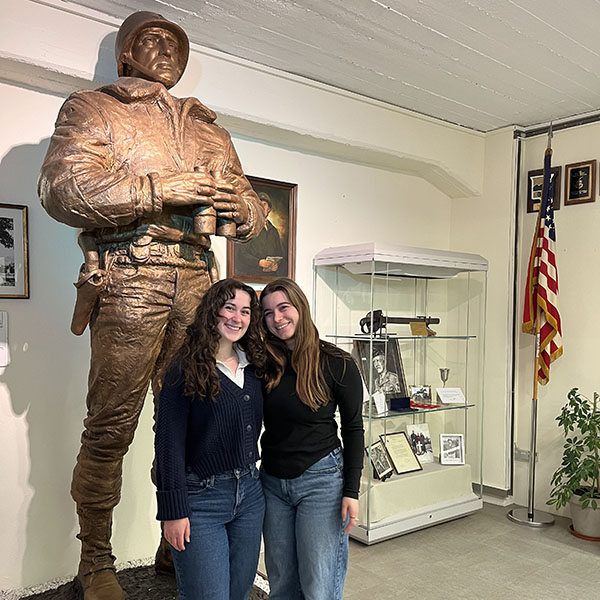
Miami University graduate students Becca Borton (left) and Marina DeNunzio (right) worked at the General Patton Memorial Museum in Luxembourg this winter term.
Borton and DeNunzio also created several lesson plans for volunteers to use when Luxembourg students attend the museum on field trips. These plans explore specific artifacts, life during World War II, and Luxembourg's wartime history.
“One way that we're trying to make the program sustainable is we've actually been in contact with student teaching here at the TCE department,” Borton said. “We're trying to place Miami University students in the museum to be able to teach and deliver those workshops in the future.”
Borton received her bachelor’s degree from Miami in the spring of 2025, graduating as a double major in Political Science and Integrated Social Studies Education and a triple minor in Spanish, Musical Theater, and History. Throughout her time, she has worked closely with Thomas Misco, professor and director of graduate studies, and John Forren, associate professor and executive director of the Menard Family Center for Democracy.
After graduation this spring, Borton aims to become a social studies teacher, being licensed in seventh through 12th grade. Borton credits Misco’s class within the Integrated Social Studies Education major for helping her find her place at Miami. She currently serves as a teacher assistant for Misco and is a Fulbright Program semifinalist for Poland, where she engaged with a civic education project in January 2025, also through the Menard Family Center for Democracy. Borton said, “Miami's given me everything.”
Borton and DeNunzio were approached by Forren and Misco last spring about the Patton Museum. At the time, the Menard Family Center for Democracy had been working alongside the museum, and they needed some additional resources and new ideas to reach younger audiences.
Established in 2019, the Menard Family Center for Democracy aims to support a broad range of teaching, research, and service activities at Miami that enhance civic dialogue and engagement, active citizenship, community problem solving, and public understanding of democracy, politics, and civic affairs. Each semester, the Menard Family Center connects students with experiential learning opportunities to promote these goals.
“I think the most amazing part of all of this is what Prof. Forren and the Menard Family Center for Democracy does for students,” Misco said. “Each semester and with each new project or experience, we see a tremendous amount of growth, understanding, complexity, and depth in our students that they wouldn’t have unless they were actually in these places.”
Similar to the Menard Family Center, Miami University encourages students to study abroad and take part in experiential learning opportunities both inside and outside the classroom.
“When you come to Miami, you're going to have many opportunities to get out, experience, and learn new things, whether it's in Luxembourg, whether it's through Menard Family Center programming, or something else entirely,” Forren said. “Pushing yourself outside of your comfort zone — that's where the real growth often takes place with study abroad or any experience.”
Email MenardFamilyCenter@miamioh.edu for more information.
Established in 1809, Miami University is located in Oxford, Ohio, with regional campuses in Hamilton and Middletown, a learning center in West Chester, and a European study center in Luxembourg.