
CEC faculty member earns TAPPI’s highest honor
Douglas Coffin named 2026 Gunnar Nicholson Gold Medal Award honoree
•
Published
•
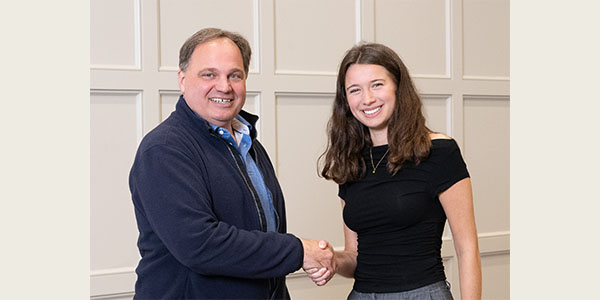
Douglas Coffin, left, with Miami University student Julia Hall. Coffin, professor of Chemical, Paper, and Biomedical Engineering, was recently named the 2026 recipient of the Gunnar Nicholson Gold Medal Award, the highest technical honor given by TAPPI, the leading association for the pulp, paper, tissue, packaging, and converting industry.
CEC faculty member earns TAPPI’s highest honor
Douglas Coffin named 2026 Gunnar Nicholson Gold Medal Award honoree
•
Published
•
Douglas Coffin never intended to work with paper.
A longtime professor of Chemical, Paper, and Biomedical Engineering at Miami University, Coffin’s professional life started as a structural engineer primarily focused on nuclear submarines. When the Cold War ended, Coffin’s focus switched from structural analysis to education.
In 1994, Coffin’s wife brought him an advertisement for a position at the Institute of Paper Science and Technology in Atlanta. He was initially skeptical.
“I didn’t know anything about paper before I went there,” he said.
He quickly learned. Now considered one of the world’s foremost authorities on the mechanics of fiber-based materials for research, Coffin explores the complexities of dimensional stability, creep, and the mechanical behavior of paper and board.
His work has not gone unnoticed. Coffin recently received the 2026 Gunnar Nicholson Gold Medal Award from the Technical Association of the Pulp and Paper Industry (TAPPI), the leading association for the pulp, paper, tissue, packaging, and converting industry.
The Nicholson Medal is TAPPI’s highest technical honor in recognition of an individual’s exceptional contributions to the industry.
“I was totally surprised,” Coffin said of earning the award. “I’ve been working in paper for 30 years now. I’m pleased that people in the industry have found value in the work that I do.”
TAPPI praised Coffin for his “unique blend of high-level industrial experience and academic rigor,” as well as for the mentorship role he’s played for future engineers and scientists in the forest products sector.
“Dr. Coffin’s work has fundamentally advanced our understanding of the mechanical behavior of paper and paperboard,” TAPPI president and CEO Lawton C. Roberts said in a news release. “His research has bridged the gap between fundamental science and practical application, providing insights that have influenced both academic research and industrial practice across the global pulp and paper industry. We are proud to recognize his remarkable contributions with the Gunnar Nicholson Gold Medal Award.”
Coffin joined Miami in 2002. His research topics have ranged from tissue papers to corrugated board, nano-fibers, and converted boxes.
Taking complex problems and simplifying them is one of Coffin’s trademarks.
“When I met the people and saw the facilities at the Institute of Paper Science and Technology, I saw what a rich field this is,” Coffin said. “Over the years, I’ve found the work I’ve done to be challenging, useful, and helpful. I had the opportunity to go into paper, and I’ve enjoyed it. There are a lot more complexities with it than a lot of other materials.”
Coffin served two tenures as editor in chief of the TAPPI Journal. He also was a guest researcher at STFI, a pulp and paper research institute in Stockholm, Sweden, for a year before joining Miami’s faculty.
Miami’s focus on undergraduate teaching drew him to Oxford.
“That was a good opportunity for me. I came here in 2002 and I love it,” Coffin said. “My area is kind of unique. There aren’t a lot of schools in the country who deal with paper on the engineering side. Miami has been doing it since 1957. Even though a lot has changed over the years, we still have a paper science foundation. The industry hires our students. They value the education we give people at Miami.”
A longtime professor of Chemical, Paper, and Biomedical Engineering at Miami University, Coffin’s professional life started as a structural engineer primarily focused on nuclear submarines. When the Cold War ended, Coffin’s focus switched from structural analysis to education.
In 1994, Coffin’s wife brought him an advertisement for a position at the Institute of Paper Science and Technology in Atlanta. He was initially skeptical.
“I didn’t know anything about paper before I went there,” he said.
He quickly learned. Now considered one of the world’s foremost authorities on the mechanics of fiber-based materials for research, Coffin explores the complexities of dimensional stability, creep, and the mechanical behavior of paper and board.
His work has not gone unnoticed. Coffin recently received the 2026 Gunnar Nicholson Gold Medal Award from the Technical Association of the Pulp and Paper Industry (TAPPI), the leading association for the pulp, paper, tissue, packaging, and converting industry.
The Nicholson Medal is TAPPI’s highest technical honor in recognition of an individual’s exceptional contributions to the industry.
“I was totally surprised,” Coffin said of earning the award. “I’ve been working in paper for 30 years now. I’m pleased that people in the industry have found value in the work that I do.”
TAPPI praised Coffin for his “unique blend of high-level industrial experience and academic rigor,” as well as for the mentorship role he’s played for future engineers and scientists in the forest products sector.
“Dr. Coffin’s work has fundamentally advanced our understanding of the mechanical behavior of paper and paperboard,” TAPPI president and CEO Lawton C. Roberts said in a news release. “His research has bridged the gap between fundamental science and practical application, providing insights that have influenced both academic research and industrial practice across the global pulp and paper industry. We are proud to recognize his remarkable contributions with the Gunnar Nicholson Gold Medal Award.”
Coffin joined Miami in 2002. His research topics have ranged from tissue papers to corrugated board, nano-fibers, and converted boxes.
Taking complex problems and simplifying them is one of Coffin’s trademarks.
“When I met the people and saw the facilities at the Institute of Paper Science and Technology, I saw what a rich field this is,” Coffin said. “Over the years, I’ve found the work I’ve done to be challenging, useful, and helpful. I had the opportunity to go into paper, and I’ve enjoyed it. There are a lot more complexities with it than a lot of other materials.”
Coffin served two tenures as editor in chief of the TAPPI Journal. He also was a guest researcher at STFI, a pulp and paper research institute in Stockholm, Sweden, for a year before joining Miami’s faculty.
Miami’s focus on undergraduate teaching drew him to Oxford.
“That was a good opportunity for me. I came here in 2002 and I love it,” Coffin said. “My area is kind of unique. There aren’t a lot of schools in the country who deal with paper on the engineering side. Miami has been doing it since 1957. Even though a lot has changed over the years, we still have a paper science foundation. The industry hires our students. They value the education we give people at Miami.”
Established in 1809, Miami University is located in Oxford, Ohio, with regional campuses in Hamilton and Middletown, a learning center in West Chester, and a European study center in Luxembourg. Interested in learning more about the College of Engineering and Computing? Visit the website for more information.