
Mapping belonging: How residents help rethink community spaces
Cognitive mapping at heart of Jeff Kruth’s ‘Avoidance and Belonging’ workshop
Mapping belonging: How residents help rethink community spaces
Cognitive mapping at heart of Jeff Kruth’s ‘Avoidance and Belonging’ workshop
Two people could walk down the same street yet experience two entirely different cities.
For some, a block could feel welcoming, a place filled with memories and experiences. For others, that same space may be avoided entirely. That contrasting idea was at the heart of the “Avoidance and Belonging” workshop led by Jeff Kruth, Miami University associate professor of Architecture and Design and director of both the Architecture Graduate Studies and the Miami Center for Community Engagement.
The workshop, developed in collaboration with Aaron Landsman of Perfect City and Princeton University, introduced participants at the Miami Center for Community Engagement in Cincinnati’s Over-the-Rhine to a concept known as cognitive mapping, drawing a city not as it physically exists, but as it is experienced.
Participants gathered around a table and reflected on their personal experiences within their city, places they feel safe, places they avoid, and the routes they take to navigate their environment. Using simple drawings, words, and symbols, they created maps based entirely on memory. “There’s no right or wrong way to do it,” Kruth explained. “What comes out of your pen is valid.” Some maps included bright lines marking familiar routes, while others highlighted areas of discomfort or avoidance. The result is not a single, objective map, but a collection of deeply personal perspectives.
The power of this workshop wasn’t in the completion of the maps, but the comparison of them.
A person might avoid a street late at night, while a longtime resident might see that same space as part of their daily rhythm. A highway could be a barrier to one person and yet a vital connection to another.
This isn’t the first time Kruth has experimented with this idea however. Kruth often asks for his students’ perspectives in class, having them do the same cognitive mapping activity but with a map of Oxford. “It's a bit messy, but that's kind of the point,” he mentioned.
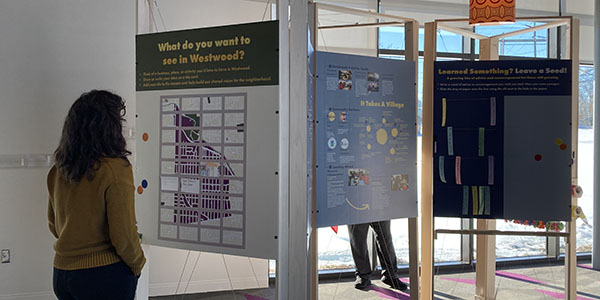
The idea of this workshop has expanded and become part of a larger community effort in the Westwood neighborhood of Dayton. The exhibition is titled “The Westwood Rising Experience: Our Neighborhood. Our Future.” Over the past year, Kruth and his collaborators have worked with residents to develop a neighborhood plan. A recent exhibition, held at the Dayton Public Library, transformed those ideas into an interactive experience, inviting residents to share their opinions on what spaces and options they’d like to see more of within the neighborhood. The exhibition is the result of months of planning and design work between Kruth, students, and community partners.
The “Avoidance and Belonging” workshop challenged a basic assumption: that cities can be understood through infrastructure alone. Instead, it suggests something deeper, that the true map of a city is drawn through human experience. And if cities are going to work for everyone, those experiences need to be seen, shared, and understood.