
EACC SUSTAIN 2026: Translating sustainability into strategy and competitive advantage
President Crawford’s keynote presented Miami’s inclusive sustainability vision combining academic achievement and operational efficiency
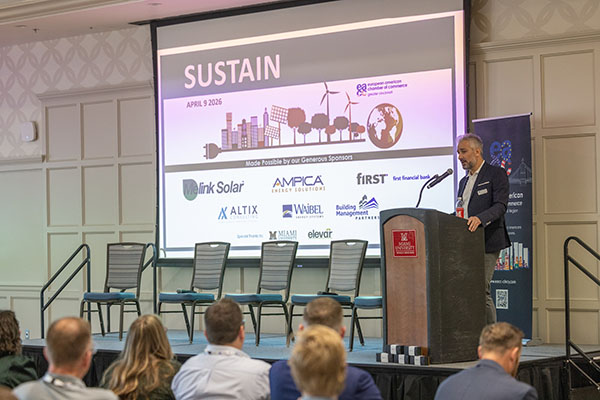
EACC SUSTAIN 2026: Translating sustainability into strategy and competitive advantage
President Crawford’s keynote presented Miami’s inclusive sustainability vision combining academic achievement and operational efficiency
More than 85 business and organization leaders from the greater Cincinnati area gathered at Miami University last week for EACC SUSTAIN 2026. The event — one of the flagship programs of the European American Chamber of Commerce of Greater Cincinnati (EACC) — spotlighted how organizations are translating sustainability into strategy and competitive advantage.
EACC SUSTAIN 2006 included presentations and insights from business leaders, a guided tour of Miami’s Western Geothermal Plant, and tours of the new Sharon and Graham Mitchell Sustainability Park and solar fields.
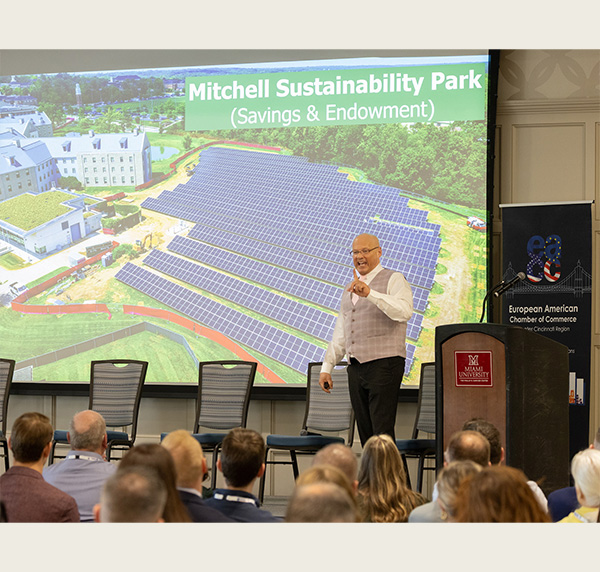
Deliver real results, strengthen resilience
Miami University President Gregory Crawford presented the keynote address, “Decarbonization Champions,” highlighting the goal of decarbonizing Miami's Oxford campus and reaching carbon neutrality by 2040.
President Crawford presented his translation of “inclusive sustainability”: academics (vision) and sustainability (purpose). Miami combines academic achievement and operational efficiency guided by a strategy to drive efficiency, reduce risk, and strengthen resilience.
MiamiTHRIVE and the Miami University Polytechnic Campus are examples of this strategy for academic achievement.
Miami’s “trifecta of geothermal, hot water, and solar” and operational efficiency have helped the Oxford campus reduce energy-based carbon emissions by more than 50% and reduce carbon emissions per gross square foot by 63%, since 2008.
More than $125 million in accumulated cost savings has been realized since 2008, through operational efficiency and energy systems conversions.
Miami’s Sharon and Graham Mitchell Sustainability Park — which will be dedicated April 20 — features two solar arrays with more than 3,300 ground mount solar panels that will produce around 2,000 megawatt hours (MWh) of electricity annually.
The Western Solar North array sits on top of Miami’s Western Geothermal Well field. Completed in 2014, the wellfield consists of 690 geothermal wells, each 600 feet deep. This is the first co-located solar and geothermal project on a college campus and is the largest solar array in Butler County, Ohio. Melink Solar installed the arrays.
Miami’s second geothermal system at the North Geothermal Plant in Billings Hall will be online by next month.
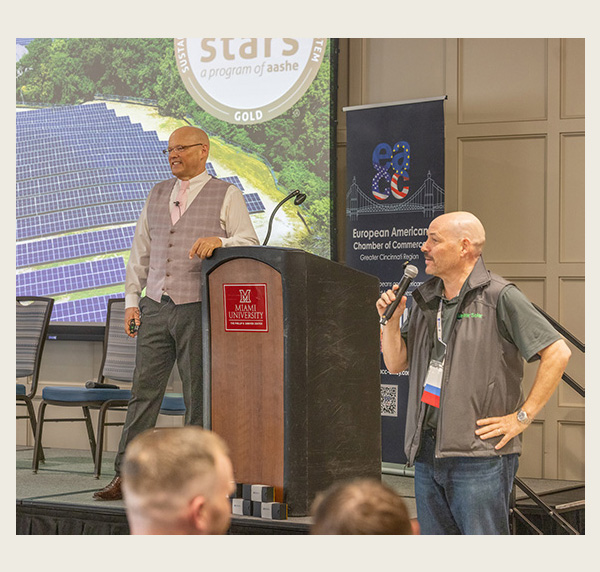
Sustainability: A pillar of the EACC
Fabian Schmahl, business development partner with Melink Solar — the presenting sponsor of the event — introduced President Crawford before his keynote address. Schmahl, also the EACC board of directors vice president, worked with Miami on the solar array project, among others. He said President Crawford “leads with purpose, not position,” and “that really shows in (Crawford’s) his engagement with students.”
Cincinnati-based Melink Solar is recognized as one of the top solar contractors in the country. The company focuses its work in the Great Lakes region and has installed more than 275 megawatts (MW) of solar power and eliminated millions of tons of CO2 emissions.
The company is currently building a 1.5 MW solar array to power the city of Fairfield’s water treatment plant, and the city of Oxford has contracted with Melink to build a solar array near its water treatment plant. When completed in 2027, it will provide more than 75% of the city’s annual electric consumption.
The EACC
The European American Chamber of Commerce of Greater Cincinnati creates business opportunities for members by connecting them to its extensive European and American network and by providing strategic and relevant programming to help members grow.
Established in 2007, it was the first European American Chamber of Commerce in the United States.
Other sponsors of EACC SUSTAIN 2026 were Ampica Energy Solutions, First Financial Bank, ALTIX Consulting, Waibel Energy Systems, and Building Management Partners.
Sustainability at Miami
Miami University is a signatory of Second Nature’s President’s Climate Leadership Commitment -Climate Commitment and is committed to carbon neutrality on its Oxford campus by 2040 (Miami 2040 Climate Action Plan). Miami is decarbonizing its campus through energy systems transformations, including geothermal exchange and solar energy, and has achieved a 50% reduction in utility-based carbon emissions since 2008. Miami’s 36 LEED Silver-and Gold certified buildings account for 36% of the gross square footage of buildings on the Oxford campus. Miami received its third AASHE STARS (3.0) Gold rating in summer 2025 in recognition of sustainability achievements and is named on the Princeton Review’s 2026 Guide to Green Schools. For more information, visit MiamiOH.edu/Sustainability.