
SLAM student takes World Cup research to Washington
Abigail Echtenacher presents findings on the 2026 FIFA World Cup and its impact on Mexico City communities at Diplomacy Lab Fair in D.C.
•
Published
•
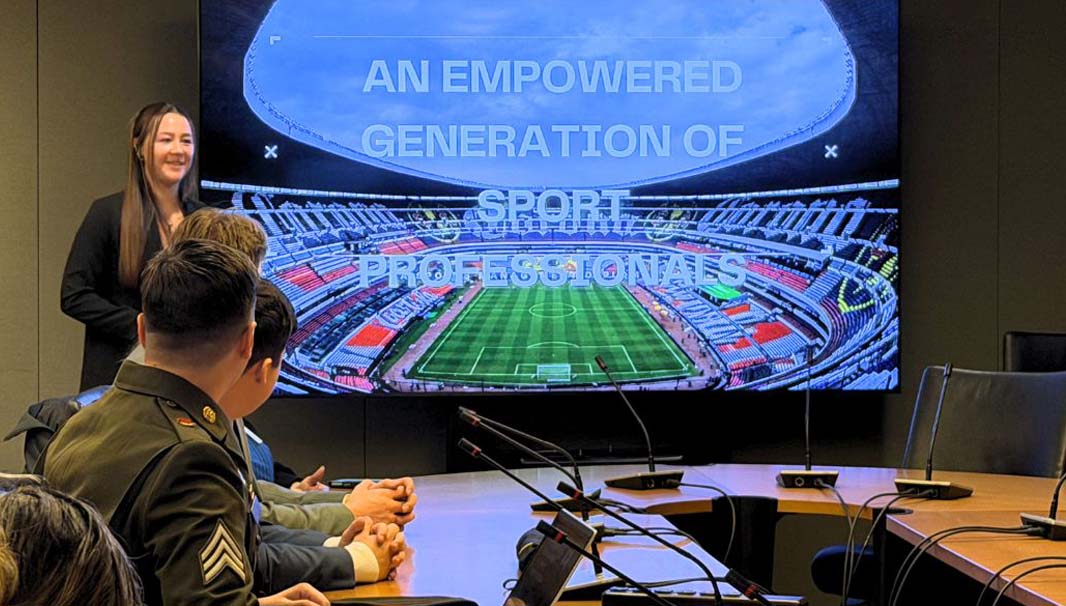
Abigail Echtenacher presents her research at the Diplomacy Lab Fair in Washington, D.C.
SLAM student takes World Cup research to Washington
Abigail Echtenacher presents findings on the 2026 FIFA World Cup and its impact on Mexico City communities at Diplomacy Lab Fair in D.C.
•
Published
•
When a global sport mega-event comes to your city, it may be a celebrated occasion. But it rarely comes without consequences for the people who call that place home.
This year, for the first time ever, the 2026 FIFA World Cup will unfold across three countries as the United States, Canada, and Mexico prepare to host matches throughout the summer. And for Miami University Sport Leadership and Management (SLAM) students, it also created a unique opportunity to examine how such an event impacts local communities.
Working alongside students from Universidad YMCA Mexico, SLAM students explored both the opportunities and challenges tied to hosting one of the world’s largest sports events in Mexico City.
“They provided valuable insight into what it’s like living in a city where they’re hosting a mega event like this,” SLAM major Abigail Echtenacher said. “Because we hear and see a lot of things on the news, but what we don’t often realize is how it’s actually impacting people and their lives.”
Echtenacher’s project focused on renovations surrounding the Estadio Azteca stadium and the broader impact of FIFA regulations on Mexico City’s infrastructure and its local residents. While improvements have helped prepare the stadium and the city for a global audience, her research also highlighted the unintended consequences that often accompany such changes.
For local residents, those changes can carry the risk of displacement. But they can also threaten certain cultural traditions and business practices that many depend on for their livelihoods.
“The people who should benefit the most from this aren’t,” Echtenacher said. “A large part of their culture is street vending. But by FIFA regulations, vendors aren’t allowed around the stadium. That’s how many families make their income, and they’re not able to benefit from all the tourism. So then it becomes clear that what is being presented as progress is, in reality, coming at the expense of the very community that gives Mexico City its identity and life.”
For Echtenacher, this was also work that extended far beyond the classroom.
This spring, she was invited to present her findings in Washington, D.C., at the Diplomacy Lab Fair, where students engage with policymakers on issues ranging from foreign policy to national security.
During her trip, Echtenacher presented to professionals at the U.S. Department of State by sharing insights drawn from her academic research and her direct collaboration with students living in a World Cup host city.
“The 2026 World Cup will be the most geographically, commercially saturated, and politically entangled sport mega-events ever held,” said Adam Beissel, SLAM associate professor. “It will require a new level of international cooperation and global partnership between host countries to deliver matches across the entire North American continent. Abigail’s project was able to draw upon knowledge learned in the SLAM program to propose event-related programming that will ensure shared benefits for Mexico City community members and local business.”
Her research ultimately concluded that Mexico City’s preparation for the World Cup will leave a dual legacy: One marked by both modernization and global visibility, but also by uneven social and economic impacts. That is, what is often viewed as progress on a global stage can also come at the expense of the very communities that define a host city.
As the 2026 World Cup approaches, Echtenacher hopes her work will encourage a broader sense of responsibility among organizers, policymakers, and fans alike -- to help ensure that the legacy of global sport events extend beyond the fields and screens themselves, to also consider and benefit the local communities that make it possible.
“I had never even thought about combining sports with foreign affairs before,” Echtenacher said. “So being able to take what I learned and present it in that setting was really unique.”
“This isn’t something that’s going to be fixed before the World Cup,” she continued. “But I want it to be on people’s minds. We have this opportunity to create something great, but it can’t come at the expense of the people who live there.”
This year, for the first time ever, the 2026 FIFA World Cup will unfold across three countries as the United States, Canada, and Mexico prepare to host matches throughout the summer. And for Miami University Sport Leadership and Management (SLAM) students, it also created a unique opportunity to examine how such an event impacts local communities.
Working alongside students from Universidad YMCA Mexico, SLAM students explored both the opportunities and challenges tied to hosting one of the world’s largest sports events in Mexico City.
“They provided valuable insight into what it’s like living in a city where they’re hosting a mega event like this,” SLAM major Abigail Echtenacher said. “Because we hear and see a lot of things on the news, but what we don’t often realize is how it’s actually impacting people and their lives.”
Echtenacher’s project focused on renovations surrounding the Estadio Azteca stadium and the broader impact of FIFA regulations on Mexico City’s infrastructure and its local residents. While improvements have helped prepare the stadium and the city for a global audience, her research also highlighted the unintended consequences that often accompany such changes.
For local residents, those changes can carry the risk of displacement. But they can also threaten certain cultural traditions and business practices that many depend on for their livelihoods.
“The people who should benefit the most from this aren’t,” Echtenacher said. “A large part of their culture is street vending. But by FIFA regulations, vendors aren’t allowed around the stadium. That’s how many families make their income, and they’re not able to benefit from all the tourism. So then it becomes clear that what is being presented as progress is, in reality, coming at the expense of the very community that gives Mexico City its identity and life.”
For Echtenacher, this was also work that extended far beyond the classroom.
This spring, she was invited to present her findings in Washington, D.C., at the Diplomacy Lab Fair, where students engage with policymakers on issues ranging from foreign policy to national security.
During her trip, Echtenacher presented to professionals at the U.S. Department of State by sharing insights drawn from her academic research and her direct collaboration with students living in a World Cup host city.
“The 2026 World Cup will be the most geographically, commercially saturated, and politically entangled sport mega-events ever held,” said Adam Beissel, SLAM associate professor. “It will require a new level of international cooperation and global partnership between host countries to deliver matches across the entire North American continent. Abigail’s project was able to draw upon knowledge learned in the SLAM program to propose event-related programming that will ensure shared benefits for Mexico City community members and local business.”
Her research ultimately concluded that Mexico City’s preparation for the World Cup will leave a dual legacy: One marked by both modernization and global visibility, but also by uneven social and economic impacts. That is, what is often viewed as progress on a global stage can also come at the expense of the very communities that define a host city.
As the 2026 World Cup approaches, Echtenacher hopes her work will encourage a broader sense of responsibility among organizers, policymakers, and fans alike -- to help ensure that the legacy of global sport events extend beyond the fields and screens themselves, to also consider and benefit the local communities that make it possible.
“I had never even thought about combining sports with foreign affairs before,” Echtenacher said. “So being able to take what I learned and present it in that setting was really unique.”
“This isn’t something that’s going to be fixed before the World Cup,” she continued. “But I want it to be on people’s minds. We have this opportunity to create something great, but it can’t come at the expense of the people who live there.”
Established in 1809, Miami University is located in Oxford, Ohio, with regional campuses in Hamilton and Middletown, a learning center in West Chester, and a European study center in Luxembourg. Interested in learning more about the Department of Sport Leadership and Management or the Diplomacy Lab? Visit their website for more information.