
The College Artisans Shop: Built for the students, by the students
Current owner Rhett Bilski is pursuing degree in Human Capital Management and Leadership
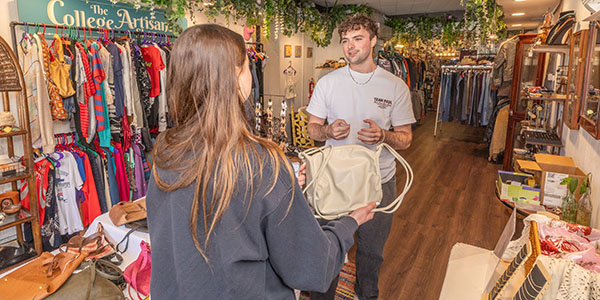
The College Artisans Shop: Built for the students, by the students
Current owner Rhett Bilski is pursuing degree in Human Capital Management and Leadership
On a typical day in Oxford, hundreds of Miami University students walk past the storefronts of Uptown without a second glance. Tucked among them at 10 S. Poplar Street is the College Artisans Shop: A business built by students, for the students, allowing them to showcase and sell their art.
The current owner, Rhett Bilski, is a Miami student himself who is completing his degree in Human Capital Management and Leadership this semester and is pursuing his master's in Business Analytics. However, Bilski wasn’t the original owner of the store, that title belongs to his freshman year roommate, Julian Bradley, and his girlfriend Genevieve Gerenz, who initially had the idea to run a storefront which would sell Miami students' artwork while helping young artists get exposed and generate profit as well.
The pair would travel to the Findlay Market in Cincinnati every weekend, selling a select few pieces to cover their rent. The original storefront was in Armstrong Student Center, but it wasn't long until it became untenable for the couple to continue selling there. They proceeded to get a space uptown in the Interfaith Center, where they began allowing other students to display their work, both to build out what would become the College Artisans Shop and to fill the enormous space. They continued there up until they decided to move to the current location on April 1, 2024. However, the two eventually found more success in Manhattan, selling through the Chelsea market under Google, which they worked toward full-time before ultimately selling the Oxford store to Bilski on Feb. 15, 2025.
Moving from a space eight times larger into the current Poplar Street location came with its share of growing pains. With the new location being significantly smaller, this required a lot of rearrangement which led to some clutter. By the time Bilski took over as owner, nearly 10 months after the move, the space had already been mostly sorted out. However, over time, Bilski, someone who prides himself on a clean and organized space, found an even better way to optimize the space using product evaluation.
Artwork, while central to the store's identity, demanded the most floor space. At the same time, permanent jewelry, spoon rings, and vintage clothing were proving to be the stronger sellers. As a result, they decided to rearrange and to create space for the vintage clothing while still offering a smaller collection of artwork. Yet regardless of how the product mix has evolved, the student artists behind those pieces have remained at the heart of what makes the shop unique.
For Bilski, connecting with student artists has been one of the more rewarding parts of running the shop. Early on, the store created an outreach post, but since then has had a steady stream of students coming into the store asking to sell their art. As Bilski explained, the process is very simple: “I have a contract drafted already and I send it to the student who just has to fill it out and send it back to me.” The willingness of students to walk into the store and request to showcase their art attests to the “for the students, by the students”culture the Artisans Shop was built upon.
Even with all the foot traffic in Uptown Oxford during the school year, being an entrepreneur here is extremely challenging. Oxford has a population of roughly 30,000 during the academic year and drops to about 11,000 during the summer. Because of this, Bilski relocates the business fully to Cleveland where he spends summers and has to operate with no storefront. So in truth, the same students who give the shop its identity are also the ceiling on what it can earn.
With a customer base made up almost entirely of college students, price sensitivity is a constant reality. While $50 in the real world may be small, to a college student with little to no income it can feel like a significant purchase, especially for a non-necessity. Due to this fact, Bilski has had to be intentional about stocking items across a range of price points. Higher-ticket pieces are expected to take longer to sell, but events like sorority or club orders have become a reliable channel for pushing them.
As a senior, Bilski is planning to graduate and pursue his dream of owning his own business analytics firm. However, his aspirations for the College Artisans Shop won’t end upon graduation. Bilski plans to continue running the store for a while before then selling, as early as the end of the current semester, either to a group of students to continue the philanthropic vision for the store or an individual if deemed capable in his eyes. Bilski feels that delegating the business to a team rather than an individual will allow the challenges to be delegated in a much more efficient manner.
Since taking over, he has already credited much of the store's success to the team that helps run it. His clothing manager, who he states is fantastic at her job, deals with sourcing clothing which previously took up a ton of his time. All of his in-store employees have received great reviews from the customer base and his social media team has set the basis for what he hopes will expand into an even stronger marketing presence. In many ways, the team he's already built is the strongest proof of concept that the College Artisans Shop is ready to be run by a group, and thrive without him.
Since its beginning, the College Artisans Shop has always been more than a storefront; it's proof that student entrepreneurship can take root, adapt, and thrive even in the most unlikely of college towns. Which is why even after Bilski graduates and pursues his career, the shop's foundation is strong enough to outlast any one person.