
Computer Science Ph.D. student’s research focuses on agency artificial intelligence
‘All of this experience helped me a lot to grow as a leader’
Computer Science Ph.D. student’s research focuses on agency artificial intelligence
‘All of this experience helped me a lot to grow as a leader’
Videography by Zach Burnett and Cameron Johnson
The artificial intelligence (AI) landscape is continuously changing, and Miami University’s Computer Science department aims to lead improvements that will help our community.
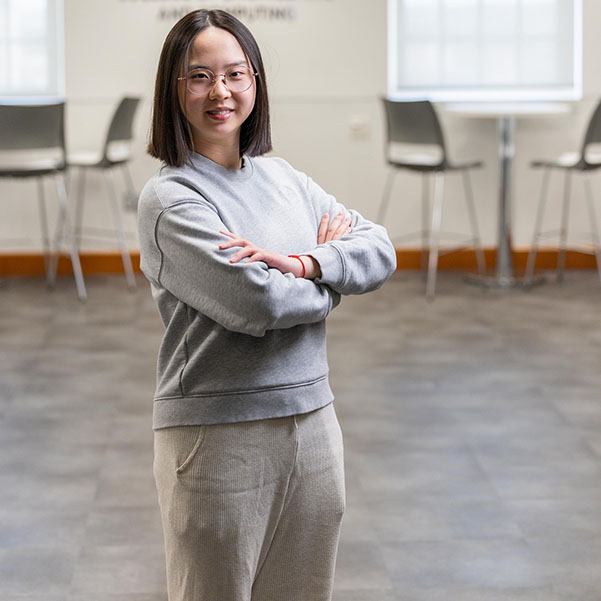
Originally from China, Jingyi Huang is a first-year student pursuing her doctoral degree in Computer Science at Miami, choosing it because of its helpful community. “The reason why I chose Miami for grad school is Miami is so supportive. The department and the faculty, the staff, they are so friendly and helpful,” Huang said.
Embracing research
Huang’s research focuses on agency artificial intelligence, and she is so excited to design her own framework. “My research is about large language model. It’s typically the model behind ChatGPT or Gemini that we use for it every day,” she said. “And I think AI, it's so powerful that you almost can train it to do almost everything.”
She works alongside Yang Zhang, assistant professor of Computer Science and Software Engineering, who serves as the lead principal investigator of a data compression project funded by the U.S. National Science Foundation. Huang appreciates his guidance, inspiration, and that he’s always there to help. “He's a 100% domain expert. And he has concrete research experience and (a) solid knowledge base,” she said.
In summer 2026, Huang will be interning with researchers at Cleveland Clinic to apply her agency AI research to other domains, such as healthcare and drug discovery. “I think this could be the future of AI, because currently the AI is at the second half, which is you are applying the AI agents to different domains, and you utilize AI agents to not just a chatbot but also other task(s),” she said. “If you are a software engineer, you can use it to help you develop the program. And if you are (a) researcher, then you can utilize AI to speed up your research.”
Growing together
Beyond computer work and research, Huang is grateful for the other opportunities to collaborate during her time at Miami, such as attending seminars, academic workshops, and conferences. “You can utilize these chances to build up your own connection and learn from others,” she said.
She even views checking out the best restaurants across campus — her favorites are the Chinese restaurants — as an opportunity to connect, chatting with her friends and classmates about AI and future plans.
During her first year in the Ph.D. program, Huang has collaborated with undergraduate students — crediting that as her “most valuable experience” — where they focused on proactive AI agents for the medical health industry. She said, “During that collaboration, I learned how to give guidance to others and do the timeline control and to do the task allocation. So, I think all of this experience helped me a lot to grow as a leader.”
Huang had some sage advice for those interested in Miami’s graduate program, saying it really depends on what you want to do in the future for your career path. She mentioned that if you choose the non-research track, you can focus on polishing your resume, practicing interviewing skills, and participating in an internship. If you’re interested in becoming an AI researcher, she suggests selecting the research track. She said, “You will have plenty of time and chances to work with other professors and some research team like us to experience the entire research, such as design your own framework, implement a program, and finally submit a paper to a conference or journal.”
Looking toward the future
When it comes to research, Huang says the most important thing to her is to continue doing it. “My plan is to become a faculty (member) so I can have time to share my experience, share my research, what I learned from my research, and also to present my work to others,” she said.
“Because of Miami, I finally have the chance to chase my goal, to finalize my dream, to design my own framework, design my own project, and implement the program.”