
Greener by design: Mary Ben Bonham and May Khalife are redefining ecological architecture for a new generation
CCA faculty members receive ARCC Research Incentive Award
Greener by design: Mary Ben Bonham and May Khalife are redefining ecological architecture for a new generation
CCA faculty members receive ARCC Research Incentive Award
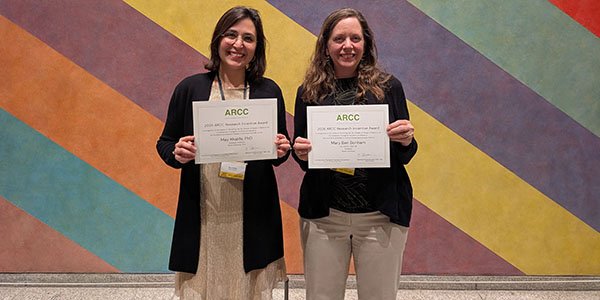
In 2000, architect Peter Buchanan released his Ten Shades of Green framework through an exhibition organized by the Architectural League of New York. His framework, a vision of sustainable design, goes far beyond energy efficiency and captures social, cultural, psychological, and economic dimensions of the built environment. Now, more than two decades after its release, Miami University’s Mary Ben Bonham and May Khalife believe the framework is not only still relevant but also urgently in need of a fresh look. The pair received the Architectural Research Center Consortium (ARCC) Research Incentive Award in support of their work toward bringing Buchanan's principles into the present practically and aesthetically.
Bonham, professor of Architecture and Interior Design, first came across the Ten Shades of Green framework while teaching and was immediately intrigued by its holistic perspective on green design. Unlike green building rating systems, such as LEED or WELL, which offer points and certifications, Buchanan’s framework can be used as an analytical tool for understanding ecological architecture. As Bonham noted, it offers a comprehensive interpretation of the building rather than a checklist. Bonham and Khalife, assistant professor of Architecture and Interior Design, believe that with updated case studies, the framework could become globally applicable.
As ecological architecture has grown into one of the most crowded conversations in modern design, greenwashing has quietly muddied the waters. With a large push toward green architecture and certification systems, much of the architecture we see today is greener in appearance than it is in practice. As Khalife put it, “The word ecological has been used interchangeably with green, sustainable, and regenerative, and this leads to ambiguity in defining and talking about this type of architecture.” The Ten Shades of Green has always been a strong foundation, and now with the ARCC grant in hand, Bonham and Khalife are setting out to revisit the framework for a new generation of architects and students.
So what will this update look like? Well, when asked about it, Bonham and Khalife made it clear they wanted their work to be accessible to the next generation of architects. Their goal is to create an open access platform that will include the Ten Shades of Green framework, new case studies, floor plans, diagrams, and more. As Khalife explained, the goal is to give students universal concepts that are not going to change with the next trend or rating system that comes out. Meanwhile, the new case studies represent the updated methods in ecological architecture since 2000.
The pair's complementary backgrounds and experience helped them write a strong proposal. The ARCC reviewers noted specifically that the “submission was selected for its exceptional quality and relevance to the field.” Bonham, a published author and veteran of multiple research grants, brought a level of credibility and budget clarity. Her book, “Bioclimatic Double-Skin Façades,” published by Routledge in 2019, and her work with Solar Decathlon interdisciplinary student teams signal a career built around translating complex ecological systems into architectural education. Khalife, the 2026 recipient of the ACSA/AIAS New Faculty Teaching Award, brings a different but equally vital lens with practice and research rooted in social equity and architectural history. Where Bonham anchors the project in technical and environmental systems, Khalife pushes it toward the social and historical dimensions of design that the Ten Shades framework was always meant to capture.
As for the future of this duo and their work in architecture, Bonham is already looking to spring 2027. “Around this time next year, we should have a working prototype of the open access resource, and we're also going to be designing ways for people to engage with it, not just let it sit there and stagnate.” However, Bonham and Khalife’s work does not look to end there, as they described the award as a seed grant, meaning the goal is that it will lead to more growth and thus more funding for future research and projects, allowing them to expand the framework they believe in, as well as the impacts it can have.