
Miami Physician Associate alumna’s capstone project becomes a clinical resource
Jillian DiTusa’s comprehensive review article aims to help clinicians make faster decisions for injured athletes
•
Published
•
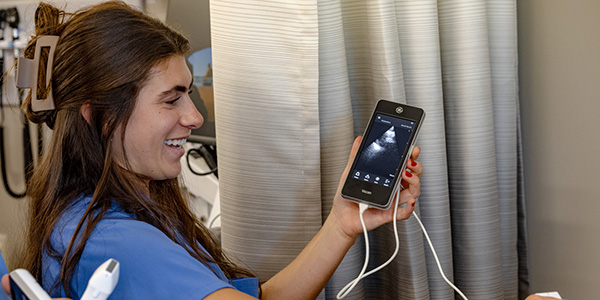
As part of the Physician Associate Studies program, Jillian DiTusa and other classmates trained on point-of-care ultrasounds.
Miami Physician Associate alumna’s capstone project becomes a clinical resource
Jillian DiTusa’s comprehensive review article aims to help clinicians make faster decisions for injured athletes
•
Published
•
For athletes dealing with osteochondral defects — a type of joint injury that damages the cartilage and bone of the knee, ankle, or elbow — there was no clear roadmap for treatment. As physicians had to piece together guidance from scattered literature, patients waited and their recovery time slowed. Jillian DiTusa PA ‘25 then a student at Miami’s Physician Associate Studies (PA) program, decided to fix that.
After graduating in 2023 from the University of Southern Indiana with a bachelor’s in Community and Public Health, DiTusa began looking for PA programs away from her native Chicago. Miami’s campus and brand new PA program stood out to her and the program “was the most innovative, and had the newest resources and best facilities by far.”
Early on, DiTusa knew she wanted to pursue a career in orthopaedics as a PA; her years as a soccer player — including time spent on the sidelines recovering from injuries — shaped her interest in the specialty.
“I know a lot of people who’ve had injuries that have required extensive downtime from their sport and rehabilitation. I personally had a few surgeries that required me to have extensive rehabilitation, and I wanted to have my hand in the mix,” DiTusa said.
As part of a capstone class for the PA program, students worked with a mentor to research a topic they were interested in. DiTusa paired up with Karey Davis, director of clinical education and assistant professor for the Physician Associate Studies program who has a background in orthopaedics, to research surgical orthopaedics and treatment for osteochondral defects in athletes. Together, they co-authored an article that DiTusa wished had existed during her own athletic career.
“A Review of Current Treatments of Knee Osteochondral Defects in High-Level Athletes” was published in the JBJS Journal of Orthopaedics for Physician Assistants (JOPA) in November 2025.
“Before we sat down and wrote this, there wasn’t a standard of treatment, meaning there wasn’t one good way to fix this. Everything was kind of jumbled. The literature was not great at saying ‘if the patient has these symptoms, you do this,’” DiTusa said. “There wasn’t one article to go to. There wasn’t a very quick and efficient way to go and find all of this information.”
The stakes are significant for athletes — depending on the severity of the joint damage, recovery can take anywhere from three months to a full year. That’s not just time away from the sport; it’s lost seasons, roster spots, and scholarships. DiTusa knew that timeline and wanted to make sure the path from diagnosis to treatment was as clear and efficient as possible. She worked with Davis to compile the most helpful treatments and surgeries available and create the comprehensive review article.
“I know people who’ve been affected by osteochondral defects. I know people who’ve been affected by generalized knee injuries, and sometimes the amount of time from diagnosis to treatment can take a while due to instructions. This article aims to accelerate treatment time and decision making,” DiTusa said.
In April, DiTusa was on her way home from a long shift in the operating room when Davis called to let her know that their article had won JOPA’s Writing Award, which recognizes excellent peer-reviewed articles on practical and timely orthopaedic topics. It was exactly the pick-me-up DiTusa needed.
For DiTusa, the experience did more than produce a publishable article. Working on the research, she said, helped “jumpstart my confidence in treating orthopaedic patients.” She also added that “it’s really cool to have your work be recognized and validated by multiple different professionals.”
These days, DiTusa works for an orthopedic surgery practice in Indiana, having trained previously at this practice as part of her clinical rotation in the PA program. She now treats the kinds of injuries she once recovered from herself — working with patients on the road back to full function. For athletes dealing with joint injuries, the guidance she helped create could mean a faster path back to the sport they love.
After graduating in 2023 from the University of Southern Indiana with a bachelor’s in Community and Public Health, DiTusa began looking for PA programs away from her native Chicago. Miami’s campus and brand new PA program stood out to her and the program “was the most innovative, and had the newest resources and best facilities by far.”
Early on, DiTusa knew she wanted to pursue a career in orthopaedics as a PA; her years as a soccer player — including time spent on the sidelines recovering from injuries — shaped her interest in the specialty.
“I know a lot of people who’ve had injuries that have required extensive downtime from their sport and rehabilitation. I personally had a few surgeries that required me to have extensive rehabilitation, and I wanted to have my hand in the mix,” DiTusa said.
As part of a capstone class for the PA program, students worked with a mentor to research a topic they were interested in. DiTusa paired up with Karey Davis, director of clinical education and assistant professor for the Physician Associate Studies program who has a background in orthopaedics, to research surgical orthopaedics and treatment for osteochondral defects in athletes. Together, they co-authored an article that DiTusa wished had existed during her own athletic career.
“A Review of Current Treatments of Knee Osteochondral Defects in High-Level Athletes” was published in the JBJS Journal of Orthopaedics for Physician Assistants (JOPA) in November 2025.
“Before we sat down and wrote this, there wasn’t a standard of treatment, meaning there wasn’t one good way to fix this. Everything was kind of jumbled. The literature was not great at saying ‘if the patient has these symptoms, you do this,’” DiTusa said. “There wasn’t one article to go to. There wasn’t a very quick and efficient way to go and find all of this information.”
The stakes are significant for athletes — depending on the severity of the joint damage, recovery can take anywhere from three months to a full year. That’s not just time away from the sport; it’s lost seasons, roster spots, and scholarships. DiTusa knew that timeline and wanted to make sure the path from diagnosis to treatment was as clear and efficient as possible. She worked with Davis to compile the most helpful treatments and surgeries available and create the comprehensive review article.
“I know people who’ve been affected by osteochondral defects. I know people who’ve been affected by generalized knee injuries, and sometimes the amount of time from diagnosis to treatment can take a while due to instructions. This article aims to accelerate treatment time and decision making,” DiTusa said.
In April, DiTusa was on her way home from a long shift in the operating room when Davis called to let her know that their article had won JOPA’s Writing Award, which recognizes excellent peer-reviewed articles on practical and timely orthopaedic topics. It was exactly the pick-me-up DiTusa needed.
For DiTusa, the experience did more than produce a publishable article. Working on the research, she said, helped “jumpstart my confidence in treating orthopaedic patients.” She also added that “it’s really cool to have your work be recognized and validated by multiple different professionals.”
These days, DiTusa works for an orthopedic surgery practice in Indiana, having trained previously at this practice as part of her clinical rotation in the PA program. She now treats the kinds of injuries she once recovered from herself — working with patients on the road back to full function. For athletes dealing with joint injuries, the guidance she helped create could mean a faster path back to the sport they love.