
Mike Crowder and Tom Poetter awarded the Benjamin Harrison Medallion
They are honored with Miami’s most prestigious career faculty award for ‘outstanding contribution to the education of the nation’
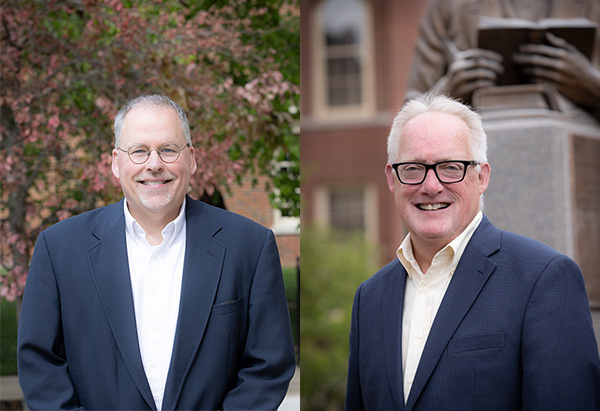
Mike Crowder and Tom Poetter awarded the Benjamin Harrison Medallion
They are honored with Miami’s most prestigious career faculty award for ‘outstanding contribution to the education of the nation’
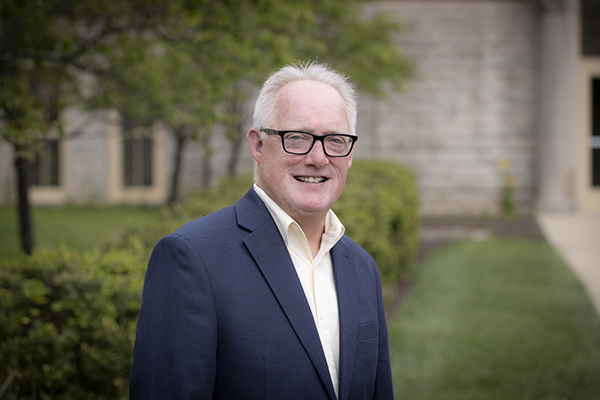
Miami University has honored two professors — Mike Crowder and Tom Poetter — with its most prestigious career faculty award, the Benjamin Harrison Medallion.
The medallion is awarded annually for extraordinary and sustained contributions related to teaching, research, and service over the course of a career at the university.
Crowder, associate provost and dean of the Graduate School and professor of Chemistry and Biochemistry, and Poetter, professor of Educational Leadership, have received the award for "outstanding contribution to the education of the nation."
They were selected for achieving the highest standards of teaching, attaining significant stature within their field, their record of outstanding and enduring service to Miami, and for recognition of influence beyond their primary discipline.
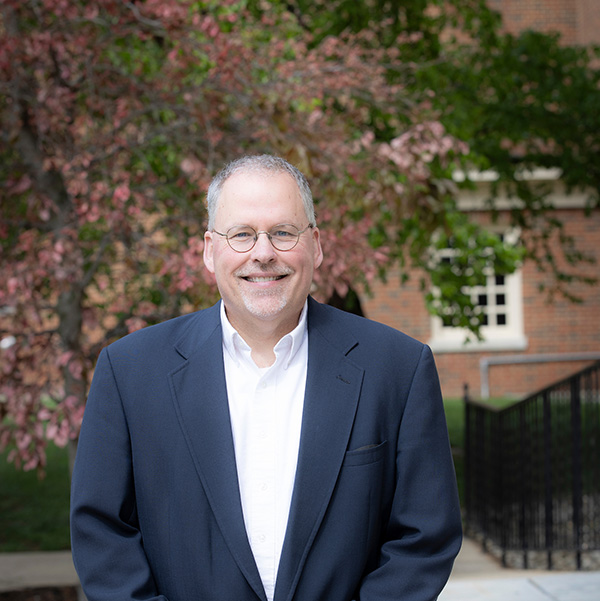
Mike Crowder
‘In every dimension of his career (teaching, research, service, and leadership), Professor Michael Crowder exemplifies the ideals of Miami University and the legacy of the Benjamin Harrison Medallion’
Crowder served as chair of the Department of Chemistry and Biochemistry for seven years; has twice served as interim vice president for Research and Innovation; and has served as the associate provost and dean of the Graduate School since 2020.
Research
Crowder is an internationally recognized expert in metallo-β lactamases and antibiotic resistance. He is highly regarded for his engaging and rigorous teaching, both in the classroom and the laboratory, and he directs one of the most productive research programs at the university, according to several of his nominators.
Since he joined Miami in 1995, he has mentored nearly 30 graduate students and about 80 undergraduate students, guiding them to conduct high-level research and preparing them for successful careers in academia, medicine, and industry.
His research, in collaboration with colleagues at other universities, “involves efforts to curb antibiotic resistance, specifically due to bacteria that produce metallo-β-lactamases (MBLs),” one of his collaborators said. His research involves a combination of biochemical and spectroscopic studies to probe the mechanism by which the MBLs hydrolyze antibiotics. He has extended this work to probe how new, potential inhibitors bind to the MBLs.
“Recently his research has focused on developing tools that can be used by the entire MBL community in our collective effort to discover new clinical inhibitors,” the nominator said.
Crowder’s lab group and team of collaborators have developed a toolbox of techniques to determine how new potential MBL inhibitors work.
Working with a team of Miami undergraduate Computer Science and Software Engineering students, Crowder and his team created the free website called MBLinhibitors.com, a repository of all MBL inhibitors and is available to the entire science community, explained a nominator.
He is also developing a state-of-the-art machine learning/artificial intelligence approach to predict whether a chemical compound will be a good MBL inhibitor. He assembled a team of faculty members and undergraduate students from Miami’s Business Analytics program, a research partner from the University of Texas at Austin, staff scientists from the National Center for Advancing Translational Science at NIH, and members of his lab group to develop a computer algorithm that uses data from high-throughput screening to identify attributes of a chemical compound that would make it a great MBL inhibitor, according to the nominator.
Crowder’s research has been supported by more than $7 million, including nearly $4 million in research grants, $3.5 million in equipment grants, and more than $600,000 in grants that provide scholarships to Miami graduate and undergraduate students.
Crowder’s research has resulted in more than 110 publications while at Miami, most in top-tier biochemistry, chemistry, and medicinal chemistry journals, according to a nominator. Nearly all include undergraduate and graduate co-authors.
These efforts have made a lasting impact on Miami’s ability to recruit, retain, and support outstanding young scientists, a nominator said.
Crowder also serves as a James Beam Institute for Kentucky Spirits Faculty Fellow and contributes to the scientific understanding of beer and distilled spirits. He has started a new project to develop a library of chemical fingerprints of these beverages to be used to authenticate valuable products and to better understand the differences between the brands of these beverages. (Read his Conversation article about “The complex chemistry behind America’s spirit”).
“This productivity is remarkable” given the fact that Dr. Crowder was department chair of a Ph.D.-granting department, serves as the dean of the Graduate School, and is involved with so much department, college, university, and community service,” a nominator said.
Administrative service
Crowder was the chair of the Department of Chemistry and Biochemistry from 2013-2020. “The fact that Mike led this excellent department, supporting its accomplishments and innovating in areas that would contribute to its increasing distinction, while also continuing to maintain his lab is a truly notable feat,” a nominator said.
“Being a chair and a dean is no easy job; one is not in control of their schedule or of the day’s unexpected challenges. To continue to grow a portfolio of research in this environment speaks to Mike’s intelligence, hard-work, administrative skills, and tenacity,” the nominator said.
“This is exactly the kind of extraordinary expression that merits the University’s highest award.”
Crowder began to serve as dean of the Graduate School in 2020, “during what could arguably be called a significant paradigm shift in higher education,” a nominator said, in reference to the COVID-19 pandemic.
“Yet, despite these major hurdles, Mike has already made major strides to improve graduate education through numerous policy changes, tireless advocacy for new and high-quality programs, new procedures, new staffing models and a strong communication plan,” another nominator said.
“ In fact, in my nearly three decades at Miami, I have never seen graduate education and the priority for it to improve as much as it does now.”
He served as interim vice president for Research and Innovation from July 2020-November 2020, and again from fall 2021-spring 2022, and co-chaired the Return to Research committee.
Crowder has led other demanding efforts university-wide, including directing a recent MiamiTHRIVE task force.
He was the administrator responsible for Miami Online: “the complicated merger between Miami Online in Oxford and the Regional campuses’ operation was a multi-year initiative that could not have happened without him,” a nominator said.
“Beyond the many personal attributes (e.g., integrity, competence, organization, thoroughness, compassion, empathy) that make him so effective, Mike has a strong ability to collaborate and lead others toward positive change,” another nominator said.
Crowder’s “steady leadership” is exemplified by his work with student-athletes as Miami’s Faculty Athletic Representative for the Mid American Conference (MAC). “He was always thinking of them and their unique opportunities and challenges as Miami athletes,” a nominator said.
“In short, despite Mike’s long and successful career as an administrator at Miami, he always kept his teacher’s heart. It is what energizes him and gives his work meaning.”
Service beyond Miami
Crowder has served as Faculty Athletic Representative (FAR) for the MAC since 2020, and is regarded as “an incredible asset” to the conference, according to a nominator.
“I met Dr. Crowder in November of 2020, amidst the pandemic chaos and the attempts to continue to provide student-athletes with the best possible experience in the worst possible situation,” the nominator said. “Crowder’s “passion for protecting the academic success and development of the young people we work with (in the MAC) is remarkable.”
As Miami’s representative on the Council of Graduate Schools (CGS), Crowder’s contributions “to the administration of, and best practices in, graduate education have had a national impact,” a nominator said.
“He is a powerful voice on the national scene for the kinds of issues and opportunities that Miami University graduate faculty and students experience,” the nominator said. “He reminds us that it is the multiplicity of geographies, institutional types, and program mixes that make American graduate education the best in the world.”
Community
Crowder’s service extends to the greater Oxford community, He was elected three times for the Talawanda City School board, serving from 2007-2019.
He co-organized and hosted the annual Miami-Talawanda Science Week, a community outreach initiative introducing local elementary students to STEM education, from 2006-2013.
He has served as board president of the Oxford Swim and Dive and MAKOS teams, and officiated at high school and university swim meets as a certified USA, NCAA, and OHSAA official (2013-2024). He has also served as a whiskey competition judge for the 2023 U.S. Open Whiskey and Spirits Championship.
“In every dimension of his career (teaching, research, service, and leadership), Professor Michael Crowder exemplifies the ideals of Miami University and the legacy of the Benjamin Harrison Medallion,” a nominator said.
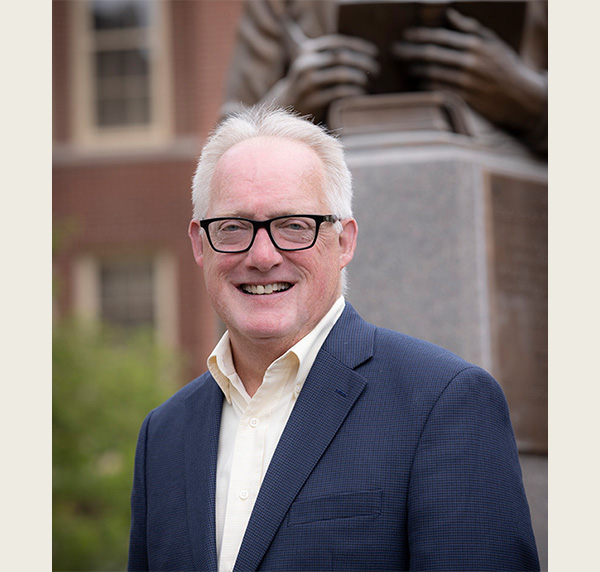
Tom Poetter
‘Prolific scholar,’ ‘transformative mentor,’ and ‘gifted storyteller
This award “represents not merely recognition of outstanding achievement, but acknowledgment of a career that has fundamentally reshaped curriculum studies as a field while elevating Miami University’s standing in the national and international academic community,” one of Poetter’s nominators said.
Across nearly three decades, Poetter has steadily built a nationally and internationally recognized model of academic life. Though his work cannot be easily separated into the traditional categories of teaching, research, and service – because, in practice, they operate as a single collaborative system – he is widely regarded as a scholar, educator, and mentor who always places students at the center of his work.
“I am certain that Professor Poetter immensely deserves this honor, because his work in the great triumvirate of these categories of university accomplishment is exemplary in all three realms,” one nominator said. “In fact, it is exemplary because it is uniquely one piece, wherein each of these three areas enhances, nurtures, and rejuvenates the other two. Moreover, the influence of his work is evidenced, not only in his designated discipline, but also in related disciplines and in its positive effects on the Greater Good of humanity.”
Throughout his career, Poetter, who joined Miami in 1997, has built a substantial scholarly and professional portfolio across the field of educational leadership and curriculum studies. With particular influence in curriculum theory and currere-based scholarship, he has also supported the long-term mentoring of students at every level, while his service has also advanced collaborations between schools and universities across the region.
His scholarly productivity “is nothing short of extraordinary,” according to a nominator, with 100 total publications, including 27 books and monographs, 48 peer-reviewed journal articles, and 25 book chapters.
Transforming students into co-authors and scholars
An enduring throughline of Poetter’s work is treating students not as passive learners but as emerging scholars and co-authors within the field. This approach frames teaching as an entry point into scholarly life, where inquiry, writing, and publication are shared intellectual practices, rather than a final end goal.
Across his courses, seminars, and doctoral advising, students regularly co-author journal articles and book chapters. In fact, to date, 15 books co-authored with students have emerged directly from this approach to shared inquiry. These books also include the “Curriculum Windows” series. Each book in this series focuses on a different decade spanning the 1950s to the 2010s, and within each, students produced essays that retroactively reflect on curriculum trends of each era by analyzing their impact, evolution, and enduring significance.
This collaborative model extends into other scholarly spaces as well, as his students regularly participate in academic forums, peer-reviewed editorial opportunities, and conference presentations.
He has mentored the doctoral dissertations of 47 students.
Influence on curriculum theory and academic discourse
Another centrality of Poetter’s work is his sustained commitment to currere-based scholarship, which treats lived experiences as a foundational approach for gaining a deeper understanding of curriculum and curriculum theory.
At its core, the idea is simple: what happens in the lives of real people in real classrooms matters for both understanding curriculum and how education happens. Instead of treating curriculum as just policy or course content, he argues, it should also be understood through the lived experiences of the teachers and students themselves.
This autobiographically centered methodological approach, known as “currere,” is a way of thinking about education through personal experience and reflection. Poetter has expanded it to include related ideas like curriculum fragments, where small pieces of life experience are used to understand larger educational questions, and through his efforts to establish the Currere Exchange Journal, which has helped this approach become more widely recognized as a serious and academically rigorous way of studying education.
Poetter served as editor of the Journal of Curriculum Theorizing and president of the Foundation for Curriculum Theorizing from 2019-2024, stewarding the field’s flagship journal through a period of significant growth and change, and helping to “open more spaces for the kind of critical questioning that has expanded our understanding about what curriculum is and what it can do,” a nominator said.
Leadership and service
Across his career, Poetter has held significant leadership roles as well, including president of the Foundation for Curriculum Theorizing and as long-time leader of the Bergamo Conference, which “invites curriculum theorists, educators, and scholars to confront the ways curriculum operates.”
He served as chair of the Department of Educational Leadership from 2018-2023, providing steady leadership during a period that included navigating the COVID-19 pandemic and its profound impacts on higher education, according to a nominator. He has also contributed to institutional policy and faculty leadership by serving in university governance through the University Senate and as chair of its Executive Committee. And a major focus of his service has also been aimed toward building long-term partnerships between the university and regional schools.
In 2005, Poetter helped establish and served as the university's first director of the Partnership Office, and he helped sustain collaborations with Talawanda Schools and Butler Tech by supporting teacher development and joint programming. His broader service has also included leadership in national professional organizations, local community partnerships, and civic engagement efforts aimed at connecting universities, schools, and the broader public.
Throughout it all, his work has consistently centered on connecting education theory to practice and on advancing access, equity, and democratic engagement for all. It’s an impressive effort that marks an even more impressive career, which was also summed up by another nominator, who said: “These works solidify that teaching and mentoring, service (local and global), and research and scholarship form the unity represented by the corpus of Professor Tom Poetter's work and compel me to recommend him enthusiastically and without reservation for the Benjamin Harrison Medallion. His record of accomplishment is outstanding and truly remarkable, and his dedicated contributions will surely continue to grow and influence many in the years ahead.”