
‘Figuring things out’: Miamians excel with recent research publication
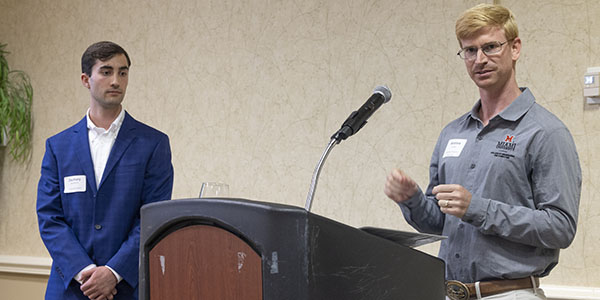
Andrew Jones, associate professor of Chemical, Paper, and Biomedical Engineering, worked with several students on project featured in Metabolic Engineering
‘Figuring things out’: Miamians excel with recent research publication
Andrew Jones, associate professor of Chemical, Paper, and Biomedical Engineering, worked with several students on project featured in Metabolic Engineering
Zachary Abrahms knew he had big shoes to fill.
Mohammad Majdi, a postdoctoral scholar, had just left the lab of Andrew Jones in April 2024, creating a void in a psilocybin research project.
Enter Abrahms, then a Miami University senior, Astronaut Scholar, and Biology major with a Premedical and Pre-Health Studies co-major.
The challenge, Abrahms said, was “daunting.”
“It was really intended for someone with a lot more experience. I was just so intrigued by the unknown and how much I needed to learn very quickly,” Abrahms said. “But, a big part of research is figuring things out, identifying what you don’t know, and reading journals to make things clear.”
Abrahms and Majdi are listed as co-first authors on “Genome-based optimization of psilocybin and N,N-dimethyltryptamine (DMT) biosynthetic pathways in E. coli using CRISPR-associated transposases,” recently published by Metabolic Engineering, a peer-reviewed scientific journal.
Jones, associate professor of Chemical, Paper, and Biomedical Engineering, said the study “introduces ePathIntegrate, a genome-engineering strategy that enables rapid integration and balancing of complex biosynthetic pathways directly on the chromosome.” Jones added, “We created and characterized a library of new promoters for genome-based pathway optimization and leveraged this technique to produce record titers of psilocybin and DMT in E. coli.”
Many other Miami students are co-authors on this work, including Siena Madsen, a Chemical Engineering major with an Energy co-major; Chloe Morton, a Biology major and Premedical and Pre-Health and Premedical Studies co-major; Abhishek Sen ’25, who graduated with a doctorate in Cell, Molecular, and Structural Biology; Niya Fried ’26, who graduated with a bachelor’s in Biochemistry with a Premedical and Pre-Health Studies co-major; Lily Sawyer, a Psychology major and Pre-Health and Premedical Studies co-major; Evelyn Cegielski, a Microbiology and Nutrition double major; and Sean Spezzano, a Biochemistry major and Pre-Health and Premedical Sciences co-major.
“I’m proud of the team we assembled to put this together,” Jones said, noting the project spanned three to four years. “For many of the students, this was their first publication or first lead-author publication. I think that’s something they’ll always remember.”
The Jones Lab used CRISPR-associated transposases (CASTs) to balance heterologous pathway expression on the genome to enable high titer recombinant production of both psilocybin and DMT in E. coli.
During the course of the research, they produced record levels of psychedelics, as well as discovering higher than expected mutation and off-target activity rates for the CAST system. Jones said this will be crucial for the metabolic engineering field in the future.
“A follow-up paper will address which of those off-target mutations caused the bacterial strains to work better,” he said. “We’ll be exploring that space this summer with a new group of talented undergraduates. This work moves the bar a step closer to being able to use this technology to produce drugs to help people.”
Acclaimed for his examination of the biosynthesis of natural psychedelics, Jones’ work enables lower cost production options for numerous promising drug candidates, which are being studied for the treatment of addiction, depression, and post-traumatic stress disorder. Last summer, technology developed in his lab was licensed to EYWA Biotech for scale-up and commercialization.
Jones is also known for his role as a mentor to Miami students. Earlier this year, he was selected as a Higher Ed Hero by Insight Into Academia for his efforts.
“It’s the reason I’m here and the reason I enjoy being a faculty member,” Jones said of working with students. “They come in with an interest in science and leave with a passion for research. That’s a really cool thing to see.”
Abrahms, a 2025 Miami graduate who is now an M.D./Ph.D student at Washington University in St. Louis, praised Jones for his direction and support.
“The Jones Lab had a tremendous impact on my career choice,” Abrahms said. “I was given the opportunity in some sense to be thrown into the deep end and figure things out; to identify my own solutions and approaches to tackle a problem. This was intellectually stimulating, and I believe I had a personal stake in developing new treatments for people who are struggling with brain health.
“Due to an immersive research experience, I’m better positioned to pursue a career as a physician-scientist. Miami was an ideal place for me. It has the resources of a large institution and the accessibility of a small college. I’m very grateful for the opportunities provided by the Jones Lab and Miami University.”