
Inside the world's largest World Cup: What could only be learned by being there
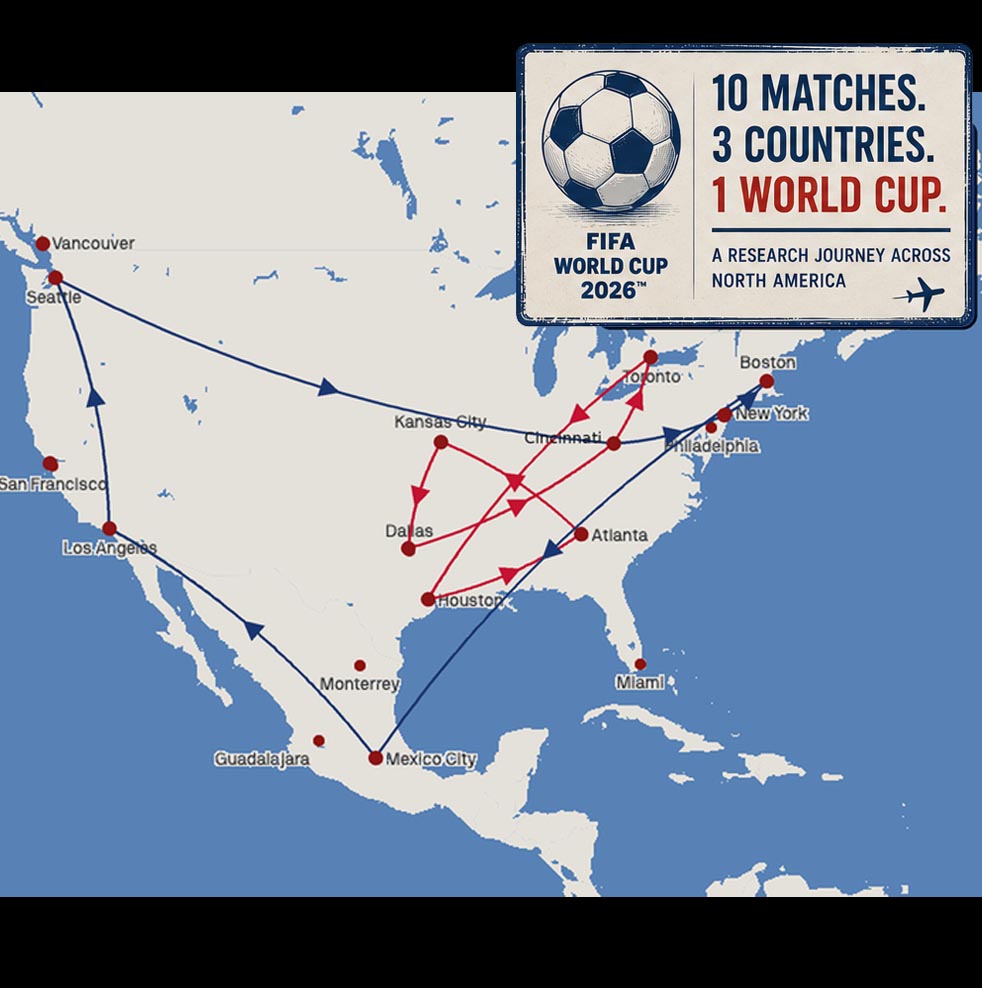
10 matches. Three countries. One World Cup. Traveling across North America, Adam Beissel turns firsthand observations into research on fan culture, host cities, and the future of global sporting events
•
Published
•
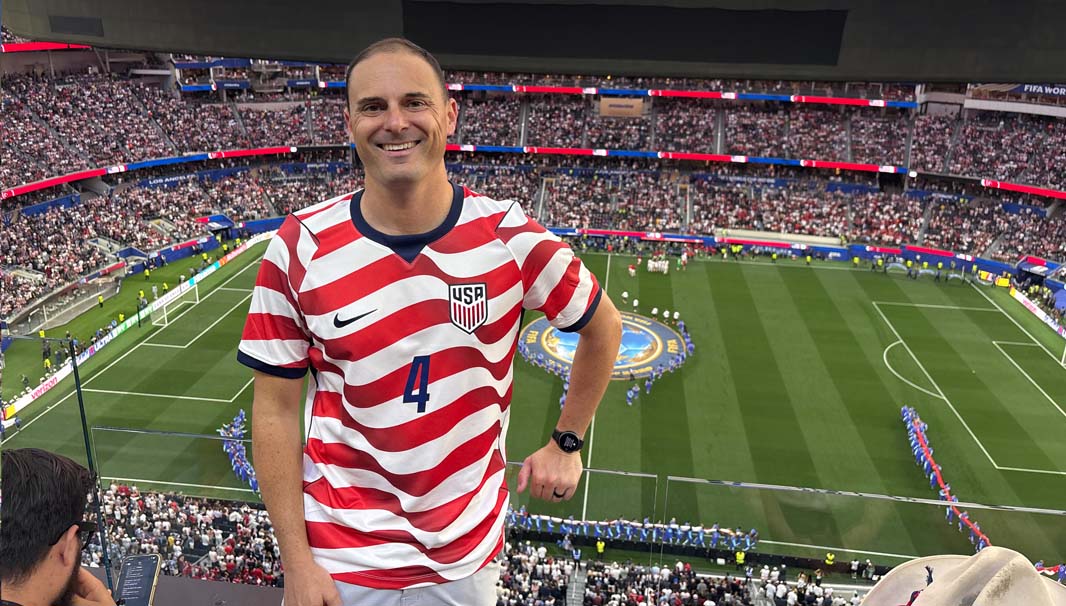
Adam Beissel attends 10 matches across North America during the 2026 World Cup
Inside the world's largest World Cup: What could only be learned by being there
10 matches. Three countries. One World Cup. Traveling across North America, Adam Beissel turns firsthand observations into research on fan culture, host cities, and the future of global sporting events
•
Published
•
While millions of fans descended on North America for the largest World Cup in history, one Miami University professor traveled across three countries to study how cities, fans, and FIFA experienced the world’s biggest sporting event from the ground up.
Across two separate trips to 10 different games in Canada, the U.S., and Mexico, Adam Beissel, associate professor of Sport Leadership and Management, studied economics, fan culture, and host-city logistics. What he found was a sprawling event that revealed how global sport collides with infrastructure, national identity, and the joys of fandom.
What could only be learned by being there
“The benefit of doing 10 matches is you can create those comparison points,” Beissel said. “When you notice those differences, they point to the good and bad things that need to be teased out. By going to so many different matches and seeing how each city was different in its own way, we learned a lot about how the World Cup was organized, managed, and delivered. Then you can speak from authority. You’ve been there. You understand how it comes together.”
Those differences included the quality of stadiums, transportation systems, the atmosphere surrounding fans, and how connected or disconnected each city felt to the tournament itself.
“Those differences were probably the most important thing that you can’t quite get if you’re just sitting in your office,” Beissel said.
With a continent-wide tournament such as this – the first in World Cup history – it’s easy to imagine stark contrasts emerging among the three host countries. But such differences were immediately clear within the U.S. as well.
In Atlanta, for example, Beissel found one of the tournament's strongest examples of successful planning. A fan festival next to the stadium created an energetic atmosphere as thousands of supporters gathered before kickoff, even on a weekday, for the afternoon’s matches.
While a different lesson emerged in Kansas City, where everything worked every Sunday for Chiefs games … until FIFA arrived.
Across two separate trips to 10 different games in Canada, the U.S., and Mexico, Adam Beissel, associate professor of Sport Leadership and Management, studied economics, fan culture, and host-city logistics. What he found was a sprawling event that revealed how global sport collides with infrastructure, national identity, and the joys of fandom.
What could only be learned by being there
“The benefit of doing 10 matches is you can create those comparison points,” Beissel said. “When you notice those differences, they point to the good and bad things that need to be teased out. By going to so many different matches and seeing how each city was different in its own way, we learned a lot about how the World Cup was organized, managed, and delivered. Then you can speak from authority. You’ve been there. You understand how it comes together.”
Those differences included the quality of stadiums, transportation systems, the atmosphere surrounding fans, and how connected or disconnected each city felt to the tournament itself.
“Those differences were probably the most important thing that you can’t quite get if you’re just sitting in your office,” Beissel said.
With a continent-wide tournament such as this – the first in World Cup history – it’s easy to imagine stark contrasts emerging among the three host countries. But such differences were immediately clear within the U.S. as well.
In Atlanta, for example, Beissel found one of the tournament's strongest examples of successful planning. A fan festival next to the stadium created an energetic atmosphere as thousands of supporters gathered before kickoff, even on a weekday, for the afternoon’s matches.
While a different lesson emerged in Kansas City, where everything worked every Sunday for Chiefs games … until FIFA arrived.
For Beissel, watching local officials adapt in real time underscored how difficult it can be to apply a one-size-fits-all approach across dozens of host cities.
“One of the biggest challenges I saw was that these stadiums were built for the American suburban lifestyle,” Beissel said. “You get in your car, you park, you tailgate. FIFA wanted people to take buses and trains, but the city’s infrastructure simply wasn’t designed that way.”
While fans waited in line to enter the stadium, local security staff decided to abandon FIFA's mandates and reverted to the procedures they routinely use for Chiefs games.
“The stadium workers were like, ‘This is outrageous. We do this every Sunday,’” Beissel said. “They told me, ‘We’re resorting to the Chiefs’ security plan, and we’re just going to get people into the stadium.’ So I'll be doing a case study on Kansas City, which, ironically, I thought had the best fan fest and the best downtown but arguably the worst stadium and transportation experience.”
Transportation and operations were only part of Beissel's research. Traveling across three host nations also allowed him to compare how each country experienced a shared tournament in remarkably different ways.
Outside the U.S., fans in co-host countries Canada and Mexico experienced the tournament through very different cultural lenses. In Canada, the World Cup largely felt like an intriguing curiosity. In Mexico, where soccer is already deeply woven into the country's national identity, the tournament carried a vastly different energy.
“It’s in the periphery in Canada,” Beissel said. “For people there it was more of a, ‘Hey, this thing's happening. We might as well get a ticket.’ There was a very novel kind of fandom around it. Obviously, the opposite was true in Mexico because soccer is such a national sport. When you put the Mexican national team in Estadio Azteca in Mexico City in front of 85,000 fans, you better believe that it did very much feel like they were indeed hosts of the World Cup.”
From fieldwork to future findings
Although the matches have all but ended, Beissel says the trip around the tournament actually marks the beginning of a much larger project.
Now comes the work of turning everything into evidence. Beissel's observations, interviews, and field notes from across North America will become the foundation for multiple studies examining affordability, host-city operations, fan experiences, and the future of global sport mega events such as the World Cup and the Olympics.
“I think the impact is going to be significant,” he said. “Everything that we find – all the data, all the impact, the affordability issues, the travel issues, the successes, and all the ways that cities did it well – can help shape how future tournaments are planned and delivered. It's very likely that many of these cities are going to be hosting the World Cup yet again a little over a decade from now.”
He and his colleagues also surveyed hundreds of fans attending matches with the goal of determining a Fan Cost Index that estimates how expensive it is for a family of four to attend the 2026 World Cup.
To recruit participants, they designed commemorative matchday stickers with QR codes that linked to a survey, which was distributed outside of select World Cup matches in each of the three host nations.
“We already know this is the most expensive World Cup in history,” Beissel said. “FIFA’s use of dynamic ticket pricing and ticket resale market meant that fans are spending thousands of dollars to attend just one match.”
The goal is not only to determine the ”get in price” but to hopefully effect change to the costs of attending future matches. But even after studying the tournament's economics, operations, and cultural dynamics across three countries, Beissel says the World Cup's enduring appeal remains remarkably simple.
“Part of this is economic. Part of it is political. Part of it is cultural,” he said. “But part of it is still the essence of sport, and oftentimes once that first ball is kicked off, it does generally become about the soccer.”
Established in 1809, Miami University is located in Oxford, Ohio, with regional campuses in Hamilton and Middletown, a learning center in West Chester, and a European study center in Luxembourg. Interested in learning more about the Department of Sport Leadership and Management? Visit their website for more information.