
Miami University Polytechnic to launch in fall 2027 with three programs
Board of Trustees approved creation of polytechnic education model on Hamilton campus during June meeting
Miami University Polytechnic to launch in fall 2027 with three programs
Board of Trustees approved creation of polytechnic education model on Hamilton campus during June meeting
Miami University Polytechnic continues the mission of Miami Regionals to provide a high-quality, affordable education while preparing graduates to meet evolving workforce demands and strengthen communities.
Unanimously approved by the Miami University Board of Trustees on June 26, the creation of Miami University Polytechnic on the Hamilton campus enables students to benefit from the polytechnic education model with more pathways for students and a faster timeline toward a degree or credentials.
As a key component of MiamiTHRIVE, the university’s strategic plan, Miami University Polytechnic programs are hands-on, work-based learning designed for students to develop in-demand skills through industry-informed curriculum.
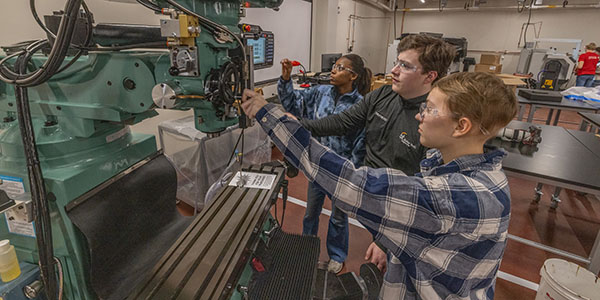
Based at the Advanced Manufacturing Workforce and Innovation Hub (AM Hub) on the Hamilton campus, Miami University Polytechnic will recruit its first cohort for fall 2027. Three polytechnic programs are available at launch: Engineering Technology, Information Technology, and Applied Biology.
“Miami University Polytechnic is about students and about providing more opportunities for all kinds of learners,” Miami University President Gregory Crawford said. “Through this innovative education model, Miami is empowering our students to solve real-world challenges, connect with in-demand careers, and be ready on day one to make an immediate impact.”
Miami’s versatile Hamilton campus is well-suited for the launch of Miami University Polytechnic. The recent addition of the AM Hub – a $31 million collaboration between Miami, Butler Tech, OhioMeansJobs Butler County, and Butler County – provides a home for advanced manufacturing education, training, and industry partnerships, with room to grow in the facility. AM Hub was originally purchased in 2024 for $11.7 million, a joint venture between Butler County, the city of Hamilton, Butler Tech, and Miami, for a total of $42.5 million invested in the property.
The 375,000-square-foot-facility offers space for joint programming between Miami, Butler Tech, and OhioMeansJobs Butler County and serves as the foundation for workforce readiness and advanced manufacturing. Miami and Butler Tech invested a combined $19.1 million to renovate the property.
“Miami University Polytechnic is among the highest priorities of the university’s MiamiTHRIVE strategic plan, and we are grateful for collaboration and investment across the region as we develop this new educational model,” said Melissa Thomasson, interim vice president and dean of the College of Liberal Arts and Applied Science. “We are committed to working alongside our community, industry, and economic development partners to create an ecosystem where students can gain the skills employers need and businesses can find the talent they depend on.”
Also housed inside AM Hub is the Makino Subtractive Lab, which immerses students in Makino CNC precision machining. Students develop hands-on expertise in high-accuracy milling, advanced machine controls, and production-level manufacturing practices.
Makino, a global leader in high-performance computer numerical control machining centers and electrical control machining, pledged two machining centers to support precision manufacturing, CNC programming, and industry 4.0 training.
ABB, a leading supplier of industrial robots, and Covariant, an AI and robotics technology company, donated four industrial robots to enhance AM Hub’s robotics and automation labs. Modula Inc., a manufacturer of automated storage solutions, also contributed a vertical lift module to strengthen logistics and material-handling training.
Partnerships are vital to the development of Miami University Polytechnic, said Randi Thomas, vice president of Miami’s Office of ASPIRE.
“Miami University Polytechnic is designed to meet the evolving needs of industry by aligning education with workforce demand,” Thomas said. “Together with our community and industry partners, Miami is creating a new model for applied learning that strengthens Ohio’s talent pipeline, supports business and economic growth, and ensures employers have access to the skilled workforce needed to compete in the future.”
Miami Regionals’ Career Services and Professional Development is helping move Miami University Polytechnic forward by building a career ecosystem for students from the beginning of their educational journey. Miami Regionals has been accepted into the Curriculum to Career Innovations Institute, which equips organizations to collaboratively design strategic, outcomes-driven career ecosystems to embed career readiness across student experiences and improve long-term career outcomes at scale.
While Miami University Polytechnic will launch with three programs in fall 2027, it is intentionally designed to scale up and grow. University leaders are actively engaging employers and industry partners to identify future academic programs that would benefit from the polytechnic education model. Existing programs will also be evaluated for opportunities to incorporate more applied learning, strengthen employer partnerships, and modernize classrooms and laboratories to meet emerging workforce needs.
Thomasson said Miami Regionals will continue to offer a broad range of classes, in addition to the polytechnic programs.
“Miami University is well known for academic excellence and its dedication to curriculum and an environment that empowers critical thinking and durable skills,” Thomasson said. “These are the skills employers want from their new hires – communication, critical thinking, and adaptability. Those skills will continue to position our graduates well for success.”
It was announced in late May that Thomasson would assume the role of interim VP of Miami Regionals. A national search for the position will begin in the fall.
Thomasson stressed that the polytechnic educational model will help drive local and regional economies by working closely with partners and employers to identify shifting needs in regards to credentials, skills, and disciplines.
“Like the industries our students will shape and build, Miami University Polytechnic will continually evolve,” Thomasson said. “That adaptability is one of the defining characteristics of a polytechnic education. It is responsive to the needs of the communities it serves. Working closely with our community, education, and industry partners, we will continually refine our programs to prepare students for the future.”