Transformation of College of Creative Arts helps meet evolving needs of students, workforce
New institutes, reimagined degrees in CCA build groundwork for successful future

Transformation of College of Creative Arts helps meet evolving needs of students, workforce
New institutes, reimagined degrees in CCA build groundwork for successful future
Artistic excellence.
Mentorship.
Personal attention to students.
These have been, and will continue to be, hallmarks of Miami University’s College of Creative Arts (CCA). As CCA embraces its rich traditions, the college also is forging a path to a prosperous future.
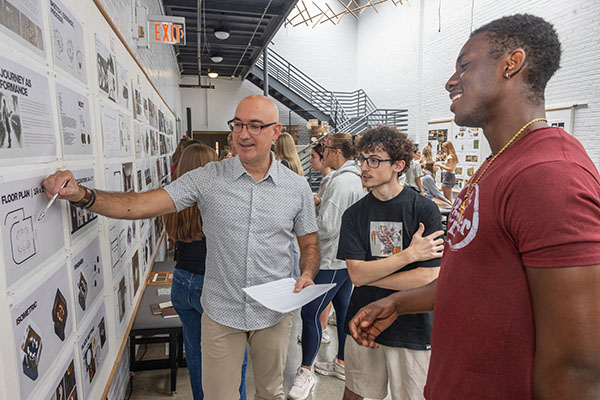
For the past year, CCA has introduced institutes, revamped degree programs, and reinvigorated departments and majors. It’s part of the college’s new strategic plan that is transforming CCA to better reflect the creative landscape.
Ryan Fisher, dean of CCA, sees the evolution of the college as “essential.”
“Higher education must continuously adapt to changing student interests, workforce needs, and societal challenges,” Fisher said. “Our responsibility is to preserve what is most valuable about a Miami education while ensuring that our programs remain relevant and responsive.”

With its new strategic plan, CCA’s goal is to successfully connect creativity, technology, innovation, entrepreneurship, and human-centered thinking.
The college’s blueprint for the future includes:
- The development of the Fashion Institute at Miami University
- The growth of the Institute for Innovation in Arts and Design, which oversees CCA’s Arts Management and Arts Entrepreneurship programs
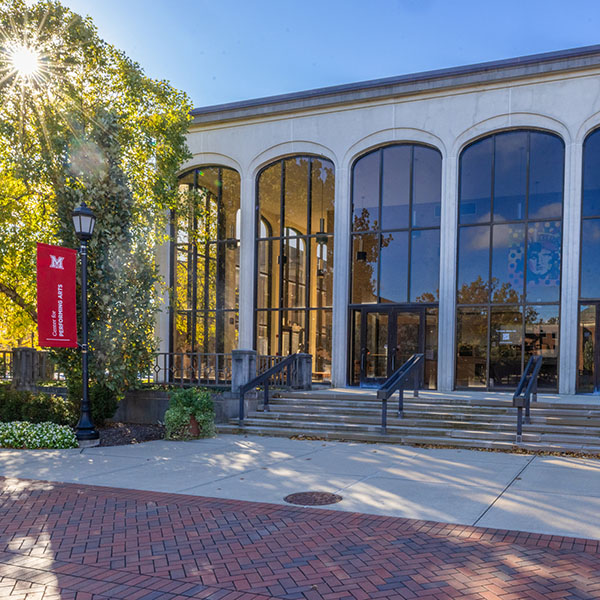
- Plans to renovate the Center for Performing Arts
- Launching several new and revised academic programs, including the flexible BA in Art with concentrations in Studio Art, Art History, and Fashion Design, which builds off the successful Fashion co-major
- The unification of the BFA in Studio Art and BS in Art Education into a single BFA structure for greater flexibility and innovative approaches to teaching studio art
- Aligning the Music department’s Performance and Music Education programs, while also redesigning the Music BA to include tracks in Music Production and Music Business
- Renaming the BA in Emerging Technology and Business Design to the BA in Interactive Media and Design to better reflect the skills students develop, as well as renaming the BFA in Communication Design to the BFA in Graphic and Experience Design
- Changing the BA in Theatre to the BA in Performing Arts with concentrations in Theatre, Dance, and Entertainment Design and Technology
- Expanding the BA in Arts Management and Arts Entrepreneurship to include a new Entertainment Management track
- Launching a new Construction Management minor, in collaboration with the College of Engineering and Computing and Department of Architecture and Interior Design

These changes illustrate CCA’s commitment to cross traditional disciplinary boundaries for the benefit of students.
“Today's architect must understand project delivery and construction management,” Fisher said. “Today's musician may need expertise in production, entrepreneurship, and digital distribution. Today's designer must navigate user experience, emerging technologies, and data-informed decision-making. Today's performing artist may work in live entertainment, immersive experiences, themed attractions, gaming, or digital content creation. Our revised programs recognize these realities and prepare students to lead in an increasingly interconnected creative economy.”
They also help create more pathways into high-growth sectors, as well as generate more opportunities for students to build professional networks before they graduate.
By providing access to emerging fields, interdisciplinary collaborations, internships, entrepreneurial experiences, and industry-connected learning, CCA is helping accelerate career success for its students.
The college is also strengthening its ability to attract talented students, recruit outstanding faculty, develop external partnerships, and secure philanthropic and grant support.
Miami is a destination for students who seek an education combining creativity, innovation, and career readiness, according to Fisher.
“For Miami University, these changes reinforce our position as a place where innovation is grounded in a strong liberal arts foundation,” Fisher said. “The challenges facing society today require both technical expertise and creative thinking. The College of Creative Arts plays a critical role in developing graduates who can bring those qualities together.”
Ultimately, Fisher aims for CCA to be home to creative students who want to combine artistic excellence with innovation, entrepreneurship, technology, and real-world impact. “We want Miami to be known not only for producing exceptional artists, designers, musicians, architects, performers and creative professionals, but also for producing the next generation of leaders who will shape the future of the creative economy,” he said.
Positioning creativity as one of the future’s most valuable skills is also paramount. With artificial intelligence, immersive technologies, and rapid technological change reshaping industries around the globe, many jobs will evolve.
With that comes the increased need for a workforce able to imagine, create, communicate, collaborate, and solve complex problems. That’s where CCA comes in.
“Those are precisely the strengths that creative disciplines cultivate,” Fisher said.
“I am excited about building a college where artists, designers, musicians, architects, technologists, entrepreneurs, and storytellers work alongside one another to create new ideas, products, experiences, and solutions. We have an opportunity to become a national model for how a college of creative arts can prepare students not only for traditional careers in the arts, but also for leadership roles across the broader creative industries.”