
Undergraduate research explores the psychology behind ghosting
Hannah Alvarez’s study examines who ghosts, and why, across gender and sexual orientation
Undergraduate research explores the psychology behind ghosting
Hannah Alvarez’s study examines who ghosts, and why, across gender and sexual orientation
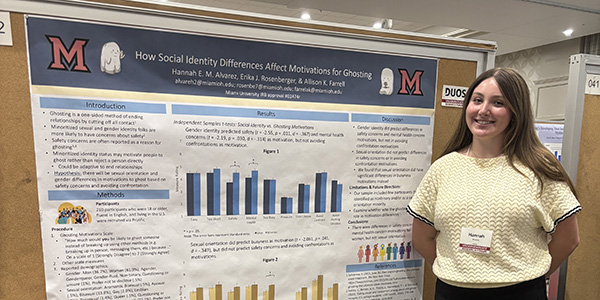
In a survey of 210 English-speaking U.S. adults aged 18 and older, Hannah Alvarez, a rising junior Psychology major and Neuroscience co-major and Honors College student, studied “ghosting” — the act of abruptly cutting off all contact in a relationship without explanation. She found that women and those with minority identities were more likely than men to ghost due to safety, mental health concerns, or a busy schedule — a finding that could help expand social psychology literature.
For many current or former dating app users, being ghosted leaves unanswered questions about what went wrong and why. Alvarez’s research sets out to answer that question by examining the identities of those who ghost and their motivations.
“It’s a little unfortunate that it’s so normalized, especially within my generation,” Alvarez said.
Alvarez’s survey found that women were more likely than men to ghost due to safety and mental health concerns, but not necessarily to avoid confrontation. When it came to sexual identity differences, those of a minority sexual orientation were more likely to ghost due to busyness and were just as likely to ghost due to mental health concerns compared to their heterosexual counterparts. However, Alvarez noted that a limitation of the study was that its sample included fewer participants with a minority gender identity or sexual orientation.
Of the study’s 210 participants, 36.7% identified as men, 61.9% as women, 1% as a minority gender identity such as genderqueer, genderfluid, or nonbinary. 77.1% identified as heterosexual, 13.8% as bisexual, and a combined 8.4% as another minority sexual orientation such as gay, lesbian, pansexual, queer, or asexual.
Participants were asked how likely they'd be to ghost someone rather than use other breakup methods. They also rated a list of possible motivations on a scale of one to seven. These motivations include ease, relationship brevity, safety, mental health, busyness, pressure, avoid confrontation, avoid hurting the ghostee, or not knowing why.
Ghosting is a newer concept in social psychology with little existing research on it. Alvarez’s mentor, associate professor of Psychology Allison Farrell, is aiming to validate the ghosting motivations scale for use in future studies.
“If we can get a validated scale for ghosting and motivations, that can really further the research and influence more people to also look into ghosting research if there’s a scale that can be used to measure certain variables,” Alvarez said.