
Undergraduate researcher charts the evolution of public libraries since the 1800s
Julia Moser ’26 researched the history and purpose of public libraries across the U.S.
Undergraduate researcher charts the evolution of public libraries since the 1800s
Julia Moser ’26 researched the history and purpose of public libraries across the U.S.
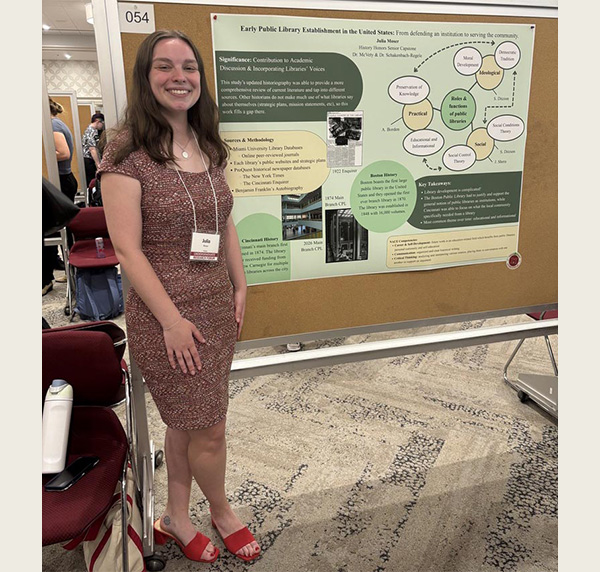
Sport Management and Psychology double major and Honors College student Julia Moser ’26 found that public libraries justify their existence through three key roles: the practical (preserving and providing knowledge and information), the ideological (upholding the democratic tradition of free access to information and fostering good citizenship), and the social (benefiting and supporting the local community). Her research, which traced the history of early public library establishment in the United States, showed these three justifications have anchored libraries since their earliest days — and still appear in library mission statements and strategic plans today.
Moser’s comparative analysis of the Cincinnati Public Library and the Boston Public Library revealed that each institution had to justify itself in different ways. As one of the first public libraries in the country, Boston had to defend and justify the very institution of public libraries as a whole, Moser found. Cincinnati, by contrast, didn’t need to advocate for the concept of a public library, but did need to prove its purpose to the local community funding it, remaining responsive to residents’ needs over time. Community members wrote to local newspapers on the library’s behalf. Local support like this is critical, Moser said, as without it many libraries throughout the country would not have received government funding.
Both Cincinnati and Boston’s current strategic priorities reflect these same practical and social justifications, emphasizing lifelong learning, resource access, and inclusive community engagement.
Moser, who minored in History, was mentored by professors of History Amanda McVety and Lindsay Schakenbach Regele. She focused her research on the Cincinnati Public Library — a system she grew up visiting — and the Boston Public Library, using historical newspapers to build an updated historiography spanning the late 1800s to the present.
“Looking at the specific mission statements and strategic plans of these libraries is not something that other historians have done, so that helps fill a research gap,” Moser said. “Creating a more comprehensive literature review of what other historians have said has also not been done. The historians who research libraries and look at this question of why they exist, what their role is, all reference each other, but no one has put that into a more organized format.”
The Boston Public Library was established in 1848 and is considered a pioneer in library development. Its website states they are the first large free municipal library in the United States, the first to lend books, the first to have a branch library (1870), and the first to have a children’s room. Cincinnati’s main branch opened in 1874 and received funding from philanthropist Andrew Carnegie to develop other branches across the city.
“At their heart, libraries provide books, they provide resources, both digital and physical, and that has been the most consistent, going all the way back to when libraries were only accessible to kings and upperclassmen,” Moser said.
Moser’s love for books inspired her to pursue this historical research.
“We never really hear about public libraries. We all know they exist. We see them in our communities, but in school, we don’t learn why they exist and how they came to exist. It’s really not talked about. This was my opportunity to dig into this question,” Moser said.