
Student's senior honors thesis explores how inside the gay community, some spaces may fuel anxiety more than others
Dylan Siebenaler ’26 studied the relationship between gay community involvement and mental health
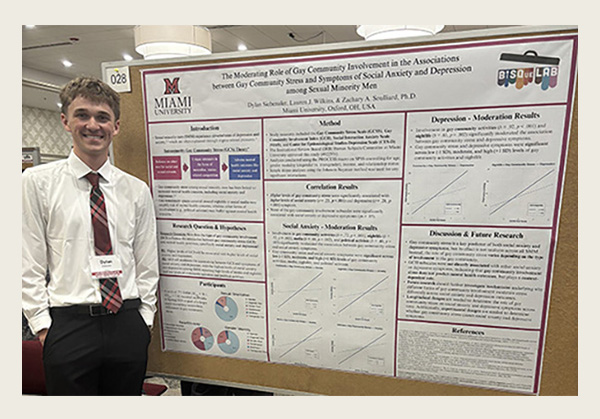
Student's senior honors thesis explores how inside the gay community, some spaces may fuel anxiety more than others
Dylan Siebenaler ’26 studied the relationship between gay community involvement and mental health
As part of his senior honors thesis, Psychology major Dylan Siebenaler ’26 — currently a student in Miami’s Master’s of Social Work program — found that all types of gay community involvement were linked to social anxiety, but only nightlife and community activities were linked to depression. The findings, based on a survey of 771 sexual minority men, could help expand literature on the intraminority stress theory as well as research on segments of the queer population.
The survey was conducted as part of a larger study examining racial/ethnic differences in gay community stress for assistant professor of Psychology and 2026 Miami University Junior Faculty Scholar Zachary Soulliard’s Body Image and Stigma Among Queer Populations (BISQue) Lab.
A 2021 study from the National Institutes of Health found that suicide risk was three to six times greater for LGBTQ+ individuals compared to heterosexual adults across race and age. The same study found that 12 to 17% of gay and bisexual men had experienced suicidal ideation in the past year. Those types of statistics are what encouraged Siebenaler to study what might be contributing to this, including stressors caused within the gay community.
Siebenaler used the Gay Community Involvement Index (GCII) for the study, which categorizes a person’s participation in the gay community into four domains — community activities (volunteering, pride events, social or support groups, LGBTQ centers), nightlife (bars and clubs), media consumption, and political activism (advocacy, protests, and organizing) — to understand how community engagement affects mental health, psychological well-being, and social support. Siebenaler wanted to study how one’s involvement with those activities can either be a buffer or a protective factor against social anxiety and depression.
He found that all of the individual domains of the GCII were correlated with social anxiety, whereas only gay community activities and nightlife were associated with depression.
The gay community stress theory, an extension of the intraminority stress theory, posits that sexual minority individuals face unique mental health challenges caused by pressures, prejudice, and exclusion originating within their own marginalized communities. The hyper-focus on sex, appearance and body standards, social status, and exclusion of diversity can cause depression, anxiety, body image issues, and reduced self-esteem.
Siebenaler said the interpretation of the survey data was that “if there’s already a negative evaluation of the gay community that impacts you mentally through internalizing symptoms, like increased appearance norms or masculinity traits that you ‘need to have’ to engage in certain types of behaviors or people, that might be correlated with significant social anxiety symptoms compared to depression.”
However, Siebenaler emphasized that because the data is from one time point, he wasn’t able to test for causality or directionality. More longitudinal research would be needed to track whether involvement leads to more or less anxiety/depression, or whether anxiety and depression influences the types of community involvement people choose. Someone might already have social anxiety and therefore choose specific domains of community involvement, or their involvement might increase their anxiety.
Siebenaler said he personally felt connected to the research as he grew up living in a rural area and didn’t have access to gay community activities until attending a university.
“I really wanted to figure out how that intervention or even what you’re involved in can influence your mental health,” Siebenaler said. “Doing this research, it has helped me connect the dots in my brain to why I am the way that I am, made me more secure in my identity, and helped me be more intentional in the ways that I engage with the gay community.”
Siebenaler presented his research at Miami’s 2026 Undergraduate Research Forum (URF) in April. Read more about it on the URF website at “Gay community stress and mental health among sexual minority men: The moderating role of community involvement."