
Independent study offers valuable experiences for RedHawks
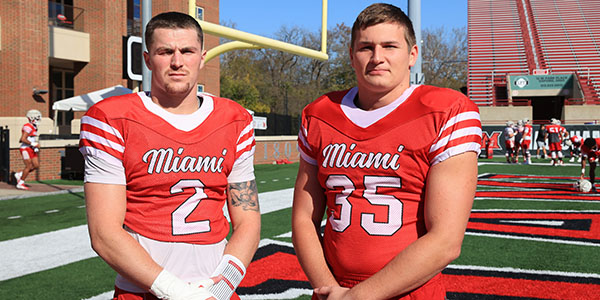
Two members of Miami’s football team gained strong insight into potential future careers
Independent study offers valuable experiences for RedHawks
Two members of Miami’s football team gained strong insight into potential future careers
After missing the 2025 season with an injury, Jackson Pons gained a different perspective on Miami University’s football team.
A spring semester of independent study gave Tyler Dikos a look at the similarities between working in a lab and succeeding on the football field.
Pons and Dikos, both members of the RedHawks football team, took separate independent study courses that gave them hands-on research opportunities.
Digging through the data
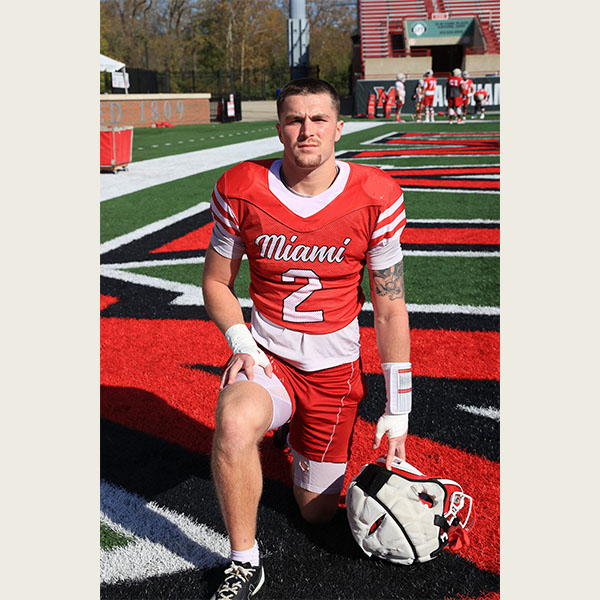
Pons, a redshirt sophomore Human Capital Management and Leadership major from North Huntington, Pennsylvania, kept his focus on football.
A torn ACL prevented Pons from participating in 2025, but the defensive back was inspired to still contribute. Working with Adam Beissel, associate professor of Sport Leadership and Management, provided the opportunity.
Recognizing Miami’s reputation as the Cradle of Coaches, Pons opted to concentrate his independent study on data analysis on the RedHawks’ Mid-American Conference opponents.
“He plays a position on the football field that is quite conducive to understanding the game at a high level, a level that a coach might understand it,” Beissel said. “He takes in the totality of what is happening on defense to be the eyes and ears for every player out there.”
Digging through data from the previous year’s season, Pons looked at critical statistics such as key plays, average time per throw, and average distance in the air per throw. If a team had a new coach, he looked at what they had done with their previous program.
Applying these findings could help a coaching staff develop a 10,000-foot view of their opponents, Beissel said.
One of the most surprising finds for Pons was just how much data was out there, particularly for lesser-known statistics.
“Being a player, you look at tackles, fumbles, interceptions, catches. But they have so much data and so many tools,” Pons said. “I found a lot of similarities with MAC teams, especially with the run game. I noticed that there were a lot of similarities between run concepts and pass concepts among the league.”
Pons shared his findings with members of the Miami coaching staff, too. “They were asking me questions, so it was kind of cool to be able to give some of the answers,” he said.
Sticking with statistics and the business part of football may be in Pons’ future, and he encourages other student-athletes to consider research and independent study opportunities.
“It was cool to look at football from a different perspective, and it brings you new connections, too,” Pons said.
Pons has just scratched the surface with his research, according to Beissel, who noted many projects can start “a mile wide and an inch deep.” Gradually, Beissel tries to adjust that so students instead take the view of “an inch wide and a mile deep” with a particular subject.
“Jackson is well on his way,” Beissel said. “Some folks just stand out. You can do sports analytics and those things in the classroom, and that’s all well and good. But it always helps when you can take those skills and teach them to someone who lives the game. He has the ability to do objective data analysis. That’s the future of all coaching.”
Working toward a common goal
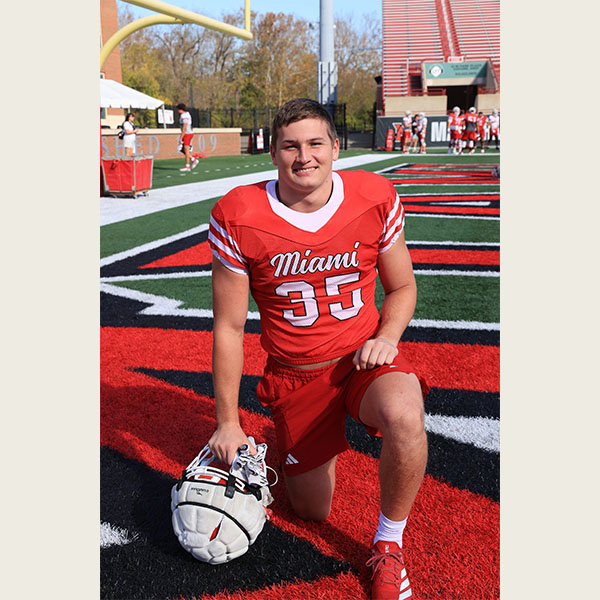
Dikos, a Biomedical Engineering major with a Premedical and Prehealth Studies co-major, spent last spring working in the lab of Amy Yousefi, professor of Chemical, Paper, and Biomedical Engineering.
Like Pons, Dikos is also a part of the RedHawks’ defensive unit as a defensive lineman. Yousefi’s lab included both undergraduate and graduate students. While Dikos was the lone student-athlete in the group, he very much felt like part of a team.
“Everyone came from different backgrounds. It was a lot of different people coming together for a common goal,” said Dikos, a redshirt junior from Westfield, Indiana. “It was a lot of fun.”
As part of Chemical, Paper, and Biomedical Engineering’s 377 course, Yousefi said Dikos gained hands-on experience using a Carver hot press for polymer compression molding and he “contributed to the characterization of biomaterials with potential use as implant materials.”
“Working effectively as part of a team of undergraduate and graduate students, he performed argon plasma surface treatments on compression-molded polylactic acid (PLA) and evaluated the wettability of the treated surfaces by measuring water contact angles with an optical tensiometer before and after treatment,” Yousefi said.
The different plastic materials could be used in sutures, which aligned with Dikos’ career interest of going into medicine in either orthopedics or dentistry.
“You’re seeing how some of the technology I’ll be using in a surgical situation is developed,” Dikos said. “A lot of time and energy goes into developing these technologies, so to get an idea of that was really cool.”
Dikos’ independent study was in the spring. Football is a fall sport, so the timing was beneficial in managing his workload both in the classroom and on the field.
With so many classroom-based courses, spending a semester in the lab was definitely different — but also extremely valuable and rewarding.
“To really get a hands-on experience on what an engineer does on a daily basis was my favorite part,” Dikos said. “If you have the opportunity, I recommend doing it. It was hard, but it was eye-opening and a lot of fun. Working with Dr. Yousefi was a blast.”
Independent study and undergraduate research, along with opportunities such as internships and study abroad, are important facets of what Miami has to offer, Beissel said.
“We do a really good job of getting students outside the classroom to hone those skills,” he said.