
Michelle Putnam ’93 receives 2026 Cottrell Distinguished Alumni Award
Her work honors scholarship, leadership, and mentorship in the field of aging.
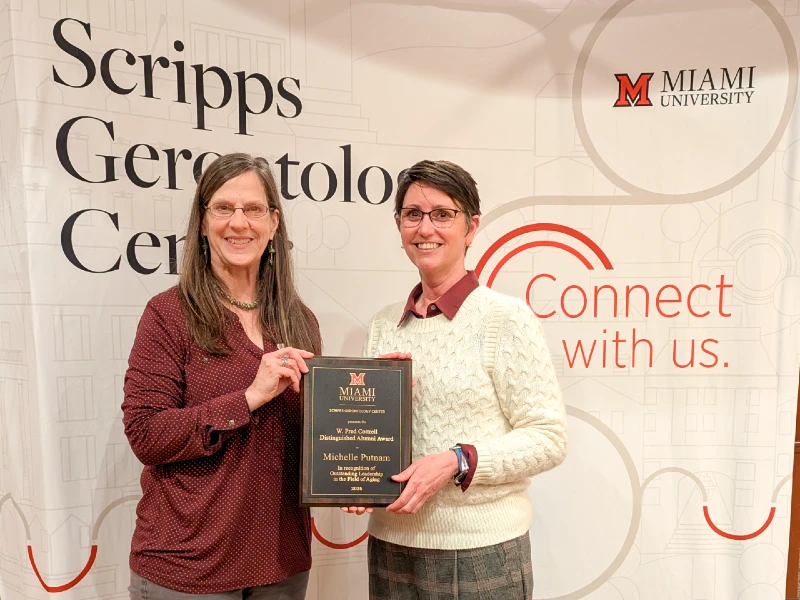
Michelle Putnam ’93 receives 2026 Cottrell Distinguished Alumni Award
Her work honors scholarship, leadership, and mentorship in the field of aging.
The Scripps Gerontology Center named Michelle Putnam ’93, as the recipient of this year’s Cottrell Distinguished Alumni Award.
Named after W. Fred Cottrell, the award recognizes Miami University alumni who demonstrate outstanding scholarship, leadership, and mentorship in the field of aging. Cottrell, a pioneer in aging policy and the first director of Scripps Gerontology Center in 1972, helped shape national conversations around aging and public policy, a legacy that Putnam’s work continues to advance.
Choosing Gerontology Before It Was Popular
Putnam began the Master of Gerontological Studies program in the winter of 1992, drawn by Miami’s reputation and the opportunity to pursue a dedicated degree in gerontology at a time when such programs were rare.
“There were only a few gerontology programs then,” she recalled. “There was a belief it was going to be a huge and growing field.”
Encouraged by her undergraduate advisor at the University of Michigan who connected her to faculty at Miami, she chose the MGS program for its focused training and strong mentorship. A scholarship also helped make the decision possible.
Oxford in the early 1990s, she noted, was a quieter place, long before smartphones and constant connectivity.
“You just had time,” she said. “There was space to think. You weren’t constantly bombarded with information. That slower pace mattered.”
Rather than a single defining moment, Putnam describes her time at Scripps as formative in cumulative ways: close relationships with faculty, intellectual freedom, and the experience of studying aging as a young graduate student.
“It gave me time to reflect not just on what I wanted to do, but what I thought about the topic,” she said.
A Career Bridging Aging and Disability
Over the course of her career, Putnam has become a nationally recognized scholar in aging and disability, working to connect the two fields.
“When I started, bridging aging and disability wasn’t a common conversation,” she explained. “Now I see it much more often.”
Though she is quick to note that academic impact is difficult to measure, she has observed a growing integration of aging and disability perspectives in research, policy discussions, and program development. Her work has contributed to shaping how professionals think about inclusive community living and cross-sector collaboration.
Throughout her academic career, Putnam has balanced research, teaching, editorial leadership, and administrative responsibilities. Grounded in applied scholarship, she emphasizes ensuring that research informs real-world policy and practice.
“There’s always been an anchor to what’s happening in the real world,” she said. “Research should feed into teaching and policy, and that loop should keep moving.”
Aging Policy in a Shifting Landscape
When asked about the most urgent issues in aging policy today, Putnam describes the current moment as uncertain and challenging.
“For years, progress in aging policy may have been incremental, but it was moving forward,” she said. “Now, it feels much less certain.”
She points to the long-standing sustainability concerns surrounding Social Security and the persistent risk of poverty among older adults as particularly pressing issues.
“We’ve known the solutions for a long time,” she noted. “But policy requires political courage.”
Her reflections highlight the importance of continued advocacy and thoughtful policymaking in the face of demographic change.
Mentorship and Creative Pathways
Beyond her scholarship, mentorship has been a defining feature of Putnam’s career.
She recalls supporting students who pursued unconventional or initially discouraged professional paths. In one instance, she worked creatively to help a social work student secure a nontraditional practicum placement at an Area Agency on Aging despite administrative resistance. That student now serves as the director of the same agency.
“Even when there are a lot of ‘no’s,’ you can usually find a ‘yes,’” she said. “You just have to be creative.”
She credits her students with teaching her the value of stepping outside established norms and trusting innovative ideas.
Becoming an Effective Professional in Aging
Putnam believes humility and emphathy is essential in her field.
“You’re studying and working with older adults, but you’re not old,” she explained. “There’s no way to fully understand that experience. You have to approach the work with humility and deep listening.”
She also emphasizes critical thinking — making space to reflect, synthesize, and connect ideas in a world increasingly saturated with information.
“You need time to think,” she said. “That’s how you put the puzzle pieces together.”

Aging as a Lifelong Process
For current Miami students considering careers in aging, Putnam encourages curiosity and breadth.
“Keep learning,” she advised. “Read widely. Think broadly.”
She urges students to view aging not as a narrow specialty but as a lifelong process that intersects with every discipline.
“Aging isn’t just about older adults,” she said. “It’s happening all the time. It’s not a noun — it’s a verb.”
Framing aging as an inclusive, ongoing journey reinforces the importance of integrating older adults into communities rather than isolating them as a separate category.
Continuing the Cottrell Legacy
Like Cottrell, whose scholarship elevated aging policy to national prominence, Putnam’s work advances critical conversations around disability integration, community living, and inclusive policy design.
“It’s hard to know what impact you’ve had,” she said. “You mentor students, you write papers, and you send them into the world. You don’t always see where it lands.”
Still, the growing visibility of aging and disability integration suggests that those early efforts have contributed meaningfully to the field.
As she returns to campus to accept the 2026 Cottrell Distinguished Alumni Award, Putnam’s career stands as a testament to scholarship grounded in humility, mentorship, and a commitment to advancing equity in aging policy.