
Free tool being developed by Miami researchers aims to expand treatment for bone damage
Free tool to design artificial bone structures could expand treatment options
•
Published
•
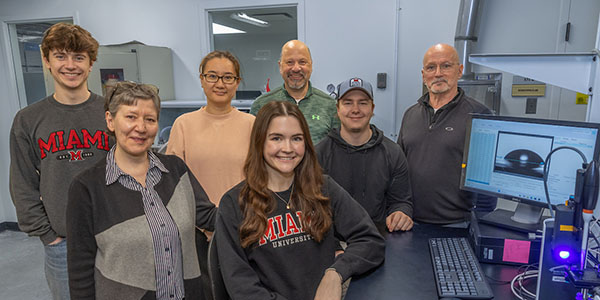
Front row: Amy Yousefi, Brooklyn Sims. Back row: Ryan Duffey, Jing Zhang, Jens Mueller, Brendan Williamson, and Paul James. Together, they're working to develop a free tool that could expand treatment options for bone grafts.
Free tool being developed by Miami researchers aims to expand treatment for bone damage
Free tool to design artificial bone structures could expand treatment options
•
Published
•
Miami University researchers are developing a design tool that will be made freely available to scientists, educators, and students from software that normally costs thousands of dollars to use. The tool will help them to design 3D scaffolds — artificial structures that support new bone growth — and could help expand treatment options for bone damage, a growing problem as populations age.
“Older adults are vulnerable to bone damage and related issues such as osteoporosis, falls, and fractures, which can lead to significant disability and reduced quality of life,” said Amy Yousefi, professor of Chemical, Paper, and Biomedical Engineering.
According to the National Institutes of Health, an estimated 1.5 million Americans annually will experience a bone fracture due to bone disease.
“Aging is a global demographic trend that is fundamentally reshaping societies, creating both opportunities and significant social and scientific problems,” Yousefi added.
The study, “A Stand-Alone Simulation Platform for Designing Tissue Engineering Scaffolds to Serve as Bone Graft Substitutes,” builds upon 15 years of research by Yousefi along with Paul James, professor of Biology; Jing Zhang, professor of Statistics; and Jens Mueller, director of High Performance Computing Services.
James and Yousefi have been collaborating on research studies for many years, with James bringing more than 35 years of experience in cell biology to help the team understand how bone cells interact with the synthetic bone scaffolds. Zhang has been working on applied statistics in environmental, biological, and health sciences since 2005.
The design tool addresses a critical healthcare challenge. Bone defects — areas where bone has been damaged by disease or trauma — often cannot heal naturally. When a defect is too large for the body’s natural repair system, the space fills with fibrous scar tissue instead of new bone. Bone grafts can fill those gaps and stimulate healing, but existing treatments face significant constraints.
Only a limited amount of healthy tissue, either directly from the patient or from a donor, can be safely used for bone grafts. Commercial bone graft substitutes rely on donated human bone or laboratory-created materials and may not integrate fully with natural bone. Postoperative complications add further risk.
In a previous study, the team created 3D scaffolds to test what materials support cell growth. Using modeling and simulation software, they are developing a design tool that will allow scientists with limited modeling experience to design 3D scaffolds with improved configuration and material composition. Researchers will be able to rapidly test virtual designs, potentially accelerating the development of better bone graft substitutes. The design tool will be available on Windows, macOS, and Linux. The licensing fee to obtain distribution rights for the tool will be covered by Miami, ensuring no cost to users.
As part of the study, the team is prototyping 3D scaffolds made of biodegradable polymers (materials that safely dissolve as new bone grows) approved for use in medical devices. While the scaffolds will require years of testing before clinical trials, the design tool could accelerate research timelines. The researchers plan to showcase the application through LinkedIn, webinars, conferences, and the Ohio Life Sciences Network.
The study seeks to advance the field of tissue engineering and expand the available treatment options for bone defects. Tissue engineering combines cells and scaffolds to repair and regenerate damaged tissue like skin, cartilage, and bone. Scaffolds are structures with small, connected spaces that allow cells to grow and receive oxygen and nutrients. However, they must also be able to safely break down over time as new tissue forms.
“Improving the quality of life for the aged population through development of bone grafting materials has become an important research direction for biomedical engineering. It is crucial that we develop reliable and effective materials,” Yousefi said. “This study will enable controlled randomization of bone graft designs for optimization, a level of experimental flexibility that cannot be achieved with natural human bone.”
“Older adults are vulnerable to bone damage and related issues such as osteoporosis, falls, and fractures, which can lead to significant disability and reduced quality of life,” said Amy Yousefi, professor of Chemical, Paper, and Biomedical Engineering.
According to the National Institutes of Health, an estimated 1.5 million Americans annually will experience a bone fracture due to bone disease.
“Aging is a global demographic trend that is fundamentally reshaping societies, creating both opportunities and significant social and scientific problems,” Yousefi added.
The study, “A Stand-Alone Simulation Platform for Designing Tissue Engineering Scaffolds to Serve as Bone Graft Substitutes,” builds upon 15 years of research by Yousefi along with Paul James, professor of Biology; Jing Zhang, professor of Statistics; and Jens Mueller, director of High Performance Computing Services.
James and Yousefi have been collaborating on research studies for many years, with James bringing more than 35 years of experience in cell biology to help the team understand how bone cells interact with the synthetic bone scaffolds. Zhang has been working on applied statistics in environmental, biological, and health sciences since 2005.
The design tool addresses a critical healthcare challenge. Bone defects — areas where bone has been damaged by disease or trauma — often cannot heal naturally. When a defect is too large for the body’s natural repair system, the space fills with fibrous scar tissue instead of new bone. Bone grafts can fill those gaps and stimulate healing, but existing treatments face significant constraints.
Only a limited amount of healthy tissue, either directly from the patient or from a donor, can be safely used for bone grafts. Commercial bone graft substitutes rely on donated human bone or laboratory-created materials and may not integrate fully with natural bone. Postoperative complications add further risk.
In a previous study, the team created 3D scaffolds to test what materials support cell growth. Using modeling and simulation software, they are developing a design tool that will allow scientists with limited modeling experience to design 3D scaffolds with improved configuration and material composition. Researchers will be able to rapidly test virtual designs, potentially accelerating the development of better bone graft substitutes. The design tool will be available on Windows, macOS, and Linux. The licensing fee to obtain distribution rights for the tool will be covered by Miami, ensuring no cost to users.
As part of the study, the team is prototyping 3D scaffolds made of biodegradable polymers (materials that safely dissolve as new bone grows) approved for use in medical devices. While the scaffolds will require years of testing before clinical trials, the design tool could accelerate research timelines. The researchers plan to showcase the application through LinkedIn, webinars, conferences, and the Ohio Life Sciences Network.
The study seeks to advance the field of tissue engineering and expand the available treatment options for bone defects. Tissue engineering combines cells and scaffolds to repair and regenerate damaged tissue like skin, cartilage, and bone. Scaffolds are structures with small, connected spaces that allow cells to grow and receive oxygen and nutrients. However, they must also be able to safely break down over time as new tissue forms.
“Improving the quality of life for the aged population through development of bone grafting materials has become an important research direction for biomedical engineering. It is crucial that we develop reliable and effective materials,” Yousefi said. “This study will enable controlled randomization of bone graft designs for optimization, a level of experimental flexibility that cannot be achieved with natural human bone.”
Established in 1809, Miami University is located in Oxford, Ohio, with regional campuses in Hamilton and Middletown, a learning center in West Chester, and a European study center in Luxembourg. Interested in learning more about the College of Engineering and Computing? Visit the website for more information.