
Miami ranked in top 25 for Game Design by Princeton Review
University is No. 24 overall on international list, fifth for Midwest
Published
•
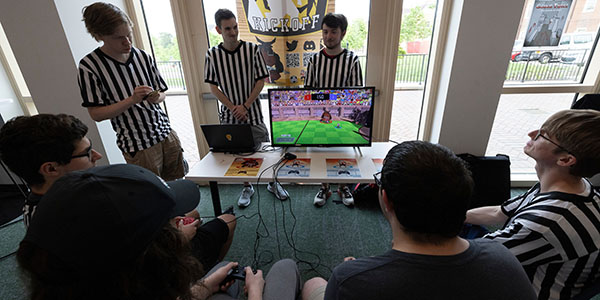
Miami University was recently ranked No. 24 on the Princeton Review’s Top 50 Undergraduate Schools for Game Design for 2026.
Miami ranked in top 25 for Game Design by Princeton Review
University is No. 24 overall on international list, fifth for Midwest
Published
•
Video games represent a uniquely 21st century art form — combining technology, storytelling, music, experience design, and more.
Miami University is at the forefront of what makes the medium so compelling. Miami is No. 24 on the Princeton Review’s recently released Top 50 Undergraduate Schools for Game Design for 2026.
This continues the long-running recognition for the university’s Games and Simulation program. The university was first selected for the inaugural 2010 rankings and has been on the international list nearly every year since. Miami moved up five spots from last year’s ranking, and the university is the No. 5 school on the Princeton Review’s undergraduate Midwest list.
Geoffrey Long, director of the program and assistant professor of Emerging Technology in Business and Design, said it is an honor to be included on the list, especially with the increase of game programs globally.
“For us to be ranked higher this year is a real feather in our cap,” Long said. “One of our goals is to always prepare our students for the next ‘next,’ while helping to continually foster the games and interactive media landscape here in Ohio. We are advancing the idea of Ohio as a state where students can build their own careers in games.”
The rankings are based on a survey of more than 150 schools offering game design coursework, as well as degrees, with criteria that covers faculty, facilities, technology, and more.
Part of Miami’s appeal revolves around opportunities. In addition to game design, art, and programming, students can take courses from Garrison LeMasters and Adam Strantz in game studies and rhetoric, from Eric Hodgson in virtual and mixed reality, from Tim DeMarks in the fundamentals of running their own successful businesses, and from Long in worldbuilding and narrative design.
Students then spend three semesters, beginning junior year, working in capstone teams to develop and publish a game by the time they graduate. Long likens this to a “micro-studio” concept that gives students a type of real-world experience.
That effort culminates in a spring semester showcase where students present their work to the community. This year’s event will be held on May 6 in the McVey Data Science building and is open to the public.
Miami students also showcase their work at GDEX, one of the top gaming conferences in the Midwest, held annually in Columbus. A number of students also attend the Game Developers Conference in San Francisco each year, where they have the opportunity to meet and share their work with leading industry professionals.
“A lot of our students come in already fascinated by the gameplay, art, and storytelling aspects of games, but once they get into our program, they’re exposed to a broader range of experiences, like what games can do, what games have historically been, and what they might become in the future,” Long said. “We blur the lines between games and other media while really leaning into what makes games special, such as immersion, interactivity, and making choices that other forms of media don’t offer in the same way.”
Long noted that approximately 50 students come into the program each year. He also invites notable alumni to speak to current students and share their experiences.
Recent visitors to campus include Jeff Ketcham ’03, a senior franchise producer at Sony Santa Monica Studios, publisher of the popular “God of War” franchise; and Brian Beebe ’15, a game production supervisor at Riot, publisher of the blockbuster e-sports title “VALORANT.”
Other alumni providing guidance include AJ Fulco ’22, who took his capstone game “Mole Maiden” to a full launch on Steam in 2025; Roberto Ritger ’18, an area design manager and region director at Obsidian Entertainment working on the blockbuster game “Avowed,” and Jessica Lindl ’95, SVP and interim CMO of Unity, a leading video game software development company.
Partnering with fellow ETBD faculty members Artie Kuhn and his theme park design courses and Ben Nicholson and his work on the university’s XR stage has also yielded positive outcomes for the program, allowing students to mix games with experience design.
“We’re not just teaching students how to use the tools,” Long said. “We teach a mix of theory and practice, liberal arts and programming, and how to think about the future of games and media in a much larger capacity.
“All of these aspects of games provide a kind of allure to a whole generation of students, the same way previous generations were fascinated by Hollywood movies. What we’re doing is teaching them a lot of 21st century skills with a strong dose of entrepreneurialism so they can succeed working for a large studio, starting up their own studios, or applying those creative design and problem-solving skills to whatever career they choose to pursue – and have fun doing it.”
Miami University is at the forefront of what makes the medium so compelling. Miami is No. 24 on the Princeton Review’s recently released Top 50 Undergraduate Schools for Game Design for 2026.
This continues the long-running recognition for the university’s Games and Simulation program. The university was first selected for the inaugural 2010 rankings and has been on the international list nearly every year since. Miami moved up five spots from last year’s ranking, and the university is the No. 5 school on the Princeton Review’s undergraduate Midwest list.
Geoffrey Long, director of the program and assistant professor of Emerging Technology in Business and Design, said it is an honor to be included on the list, especially with the increase of game programs globally.
“For us to be ranked higher this year is a real feather in our cap,” Long said. “One of our goals is to always prepare our students for the next ‘next,’ while helping to continually foster the games and interactive media landscape here in Ohio. We are advancing the idea of Ohio as a state where students can build their own careers in games.”
The rankings are based on a survey of more than 150 schools offering game design coursework, as well as degrees, with criteria that covers faculty, facilities, technology, and more.
Part of Miami’s appeal revolves around opportunities. In addition to game design, art, and programming, students can take courses from Garrison LeMasters and Adam Strantz in game studies and rhetoric, from Eric Hodgson in virtual and mixed reality, from Tim DeMarks in the fundamentals of running their own successful businesses, and from Long in worldbuilding and narrative design.
Students then spend three semesters, beginning junior year, working in capstone teams to develop and publish a game by the time they graduate. Long likens this to a “micro-studio” concept that gives students a type of real-world experience.
That effort culminates in a spring semester showcase where students present their work to the community. This year’s event will be held on May 6 in the McVey Data Science building and is open to the public.
Miami students also showcase their work at GDEX, one of the top gaming conferences in the Midwest, held annually in Columbus. A number of students also attend the Game Developers Conference in San Francisco each year, where they have the opportunity to meet and share their work with leading industry professionals.
“A lot of our students come in already fascinated by the gameplay, art, and storytelling aspects of games, but once they get into our program, they’re exposed to a broader range of experiences, like what games can do, what games have historically been, and what they might become in the future,” Long said. “We blur the lines between games and other media while really leaning into what makes games special, such as immersion, interactivity, and making choices that other forms of media don’t offer in the same way.”
Long noted that approximately 50 students come into the program each year. He also invites notable alumni to speak to current students and share their experiences.
Recent visitors to campus include Jeff Ketcham ’03, a senior franchise producer at Sony Santa Monica Studios, publisher of the popular “God of War” franchise; and Brian Beebe ’15, a game production supervisor at Riot, publisher of the blockbuster e-sports title “VALORANT.”
Other alumni providing guidance include AJ Fulco ’22, who took his capstone game “Mole Maiden” to a full launch on Steam in 2025; Roberto Ritger ’18, an area design manager and region director at Obsidian Entertainment working on the blockbuster game “Avowed,” and Jessica Lindl ’95, SVP and interim CMO of Unity, a leading video game software development company.
Partnering with fellow ETBD faculty members Artie Kuhn and his theme park design courses and Ben Nicholson and his work on the university’s XR stage has also yielded positive outcomes for the program, allowing students to mix games with experience design.
“We’re not just teaching students how to use the tools,” Long said. “We teach a mix of theory and practice, liberal arts and programming, and how to think about the future of games and media in a much larger capacity.
“All of these aspects of games provide a kind of allure to a whole generation of students, the same way previous generations were fascinated by Hollywood movies. What we’re doing is teaching them a lot of 21st century skills with a strong dose of entrepreneurialism so they can succeed working for a large studio, starting up their own studios, or applying those creative design and problem-solving skills to whatever career they choose to pursue – and have fun doing it.”
Established in 1809, Miami University is located in Oxford, Ohio, with regional campuses in Hamilton and Middletown, a learning center in West Chester, and a European study center in Luxembourg. Interested in learning more about the College of Creative Arts? Visit the website for more information.