
Diplomacy Lab trip to D.C. brings students inside the world of foreign policy
Students enter spaces they could normally never access, meet people they might otherwise never meet, and now dream of careers they never knew existed
Diplomacy Lab trip to D.C. brings students inside the world of foreign policy
Students enter spaces they could normally never access, meet people they might otherwise never meet, and now dream of careers they never knew existed
Imagine going to Washington, D.C., as a first-year college student.
But instead of just any typical class trip, you’re visiting normally restricted diplomatic spaces, where foreign ambassadors and senior State Department officials are ready to open doors to careers that could change the course of your entire life.
This was a dream turned reality for Scott Coopman, a first-year International Studies and Public Health double major, who – along with 11 other Miami University students – engaged with high-level D.C. professionals and alumni to explore international policy and global affairs.
The experience was part of Miami University’s Diplomacy Lab, a program that connects students with real policy research projects proposed by the U.S. State Department and immerses them in hands-on foreign policy work. Through a partnership with the State Department, students get experiential learning by conducting research on pressing issues that can help inform global U.S. diplomatic decision-making.
“I was able to immerse myself in the diplomatic world,” said Brooke Smith, a Diplomacy and Public Administration major. “We got to meet with a ton of alumni at an event, and they invited some ambassadors. There was a public diplomacy officer in the Foreign Service who I really connected with. It was a great networking opportunity, and a moment when I thought, ‘Oh my goodness, I'm in a place with all these high-level individuals.’”
Smith aspires to one day serve as a U.S. ambassador to Latin America, and meeting with ambassadors during an alumni networking event was just one stop during the group's whirlwind week in Washington.
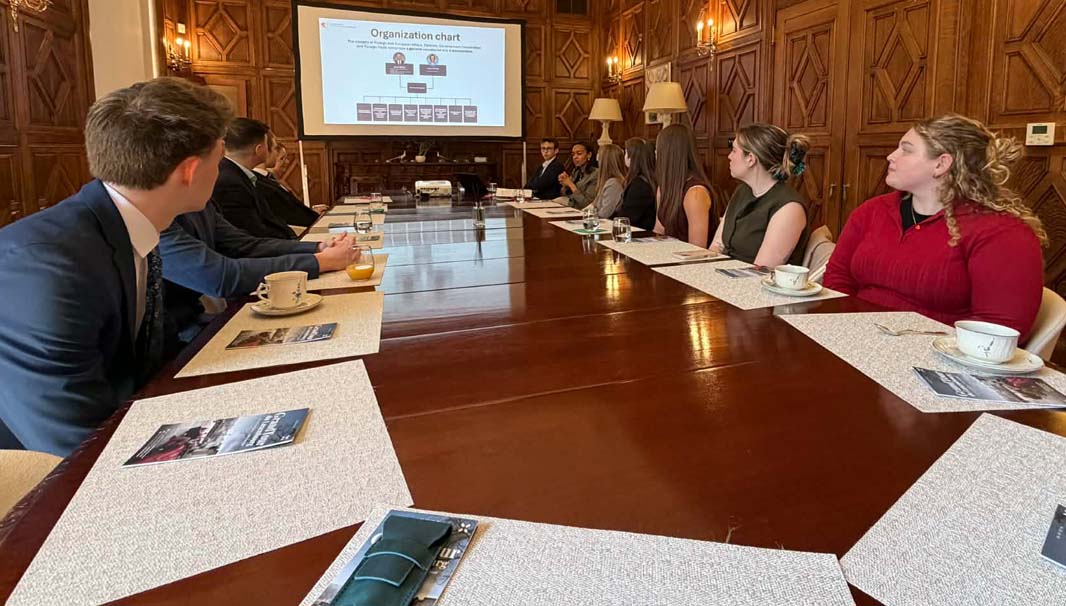
Throughout the week, students visited the State Department, met with diplomats at the embassies of Luxembourg and Serbia, toured prominent think tanks, and connected with policymakers and military officials working all across the capital.
Stops also included the Carnegie Endowment for International Peace, the American Security Project, the Defense Security Cooperation Agency, the Congressional Office on International Leadership, a U.S. Senate office, and meetings with both foreign diplomats and an international delegation from Armenia.
“It’s a totally different environment to actually walk into these spaces,” said Phillip Arceneaux, assistant professor of Media, Journalism, and Film and Diplomacy Lab director. “You can’t just walk into the State Department building. We needed security escorts to enter, and that really ups the ante for the students, that what they did was real. It has meaning, and it has impact.”
For Arceneaux, the goal of the trip was about far more than just introducing students to Washington. It was an opportunity to immerse them in a world most have never seen. By exposing them to career paths across diplomacy, foreign policy, and national security, it also helps them understand how to build the connections and experiences needed to pursue these types of career opportunities.
But the trip was also about more than career exploration as well. The research component was also key.
Prior to the trip, several students had completed Diplomacy Lab projects during the previous semester by examining various international challenges identified by State Department offices. And while in Washington, some presented their findings directly to State Department officials and foreign policy professionals, and they received feedback from the very people that work on these global issues every day.
Among them was Abby Echtenacher, a Sport Leadership and Management major, who examined the social and economic impact of the 2026 FIFA World Cup on communities in Mexico City. Coopman, meanwhile, was part of a team that analyzed the growing influence of the Russian Orthodox Church in Africa and how it has become a tool for expanding Russian influence across the region.
“You can’t toss a rock in D.C. and not hit a think tank,” Arceneaux said. “And many of the students had never even heard of a think tank, and there’s so much more. But until you’re in this world, you don’t really know about it. So it’s exposing them to what you can do, and opening their eyes to the opportunities that are available. And that could be research. It doesn’t have to be in the government.”
In the end, what emerged from this experience was not just a list of meetings or destinations, but an illuminating sense of possibilities. By placing them in rooms they had only ever read about and exposing them to careers they had never fully considered, it blurred the line between classroom learning and real-world policy work in significant ways.
For Smith, that impact was both in who she met, as well as how the entire experience expanded what her future could look like.
“I'm super excited to see everything that comes out about the Diplomacy Lab, because it was such a valuable experience,” she said. “It definitely solidified that I want to go into a diplomatic role. Seeing all these people, especially women in high-level diplomatic positions, showed me that this is something I can do.”