

Research

Active areas of research in the Department of Physics include astrophysics, atomic/molecular/optical physics, biophysics and soft condensed matter physics, computational physics, condensed matter physics, physics education, and quantum information science and technology. Research laboratories are open to undergraduates. Many begin their hands-on involvement in their first year, with three-quarters of students engaging in research before graduation.
Student Spotlight
Molecular spectroscopy physics - Hannah Stevens '27, Prof. Burcin Bayram.
Research Areas


Computational physics
Scientific visualization, image processing and analysis, computer graphics and animation (Mirza).

Biophysics and soft condensed matter physics
Techniques to model and understand complex materials such as living biological systems and nano-materials (Urayama, Vishwanath).


Astrophysics
Numerical simulations with gravitational N-body codes (Alexander)

Physics education
Strategies for teaching scientific reasoning and problem-solving skills (Blue)
Student Spotlight - Quantum Physics
Quantum computing - Glenn Ochsner '26, Prof. Imran Mirza
Quantum optics - Caden McCollum '27, Prof. Samir Bali
Quantum materials - Sara McGinnis '27, Prof. Perry Corbett
Macklin Quantum Information Sciences (MQuIS) Group
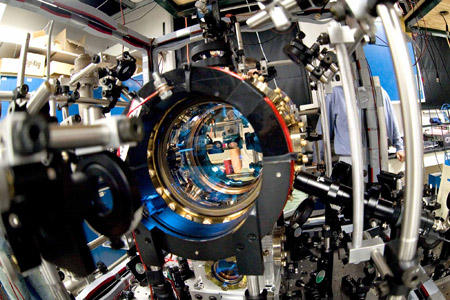
The Macklin Quantum Information Sciences (MQuIS) Group consists of the research laboratories of Profs. Bali, Bayram, Corbett, and Mirza. The group is affiliated with the Southwestern Quantum Information and Technology (SQuInT) network, an internationally renowned network of universities, national laboratories, and industry in quantum information science and technology.
The Macklin Quantum Information Sciences Group traces its scientific genealogy back to the pioneering experiments of quantum information science.
Philip A. Macklin (Miami University professor of physics between 1954-1993, department chair between 1972-1985) had a long history of being interested in quantum fundamentals. Even after retiring, Phil worked closely with Professor Perry Rice (now emeritus), staying engaged in quantum information science (QIS) research performed by Professor Rice and his students. Around 2006, Miami's QIS group (Professors Perry Rice, Samir Bali, and James Clemens) was invited to join the Southwest Quantum Information and Technology network based on the reputation of Miami faculty and graduates who had gone on to get PhD's with prominent QIS groups as well as positions in industry. Upon Phil's passing, Miami's QIS group was named in his honor.
Phil earned his master's and PhD in physics at Columbia University, working under Professor Chien-Shiung Wu between 1949-1951. Madame Wu is best known for her experiments showing that parity was not a conserved quantity in weak force interactions. Recent re-analysis of her work shows that she and her group made the first measurements demonstrating entanglement between quantum systems, now a cornerstone of quantum information, quantum computation, and quantum technology.
References:
- Glenn M. Julian. "Obituary of Philip A. Macklin," Physics Today, July 14, 2008. https://doi.org/10.1063/PT.4.
2255
- Chon-Fai Kam, Cheng-Ning Zhang, and Da Hsuan Feng. "Chien-Shiung Wu’s trailblazing experiments in particle physics," Physics Today, vol. 77, no. 12, December 01, 2024. https://doi.org/10.1063/pt.
oufp.zwkj