
The Attention Revolution: Deliberation, Sanctuary, and the Liberal Arts
“Attention in the Age of Distraction” is a nine-part lecture series hosted by the Altman Institute through April
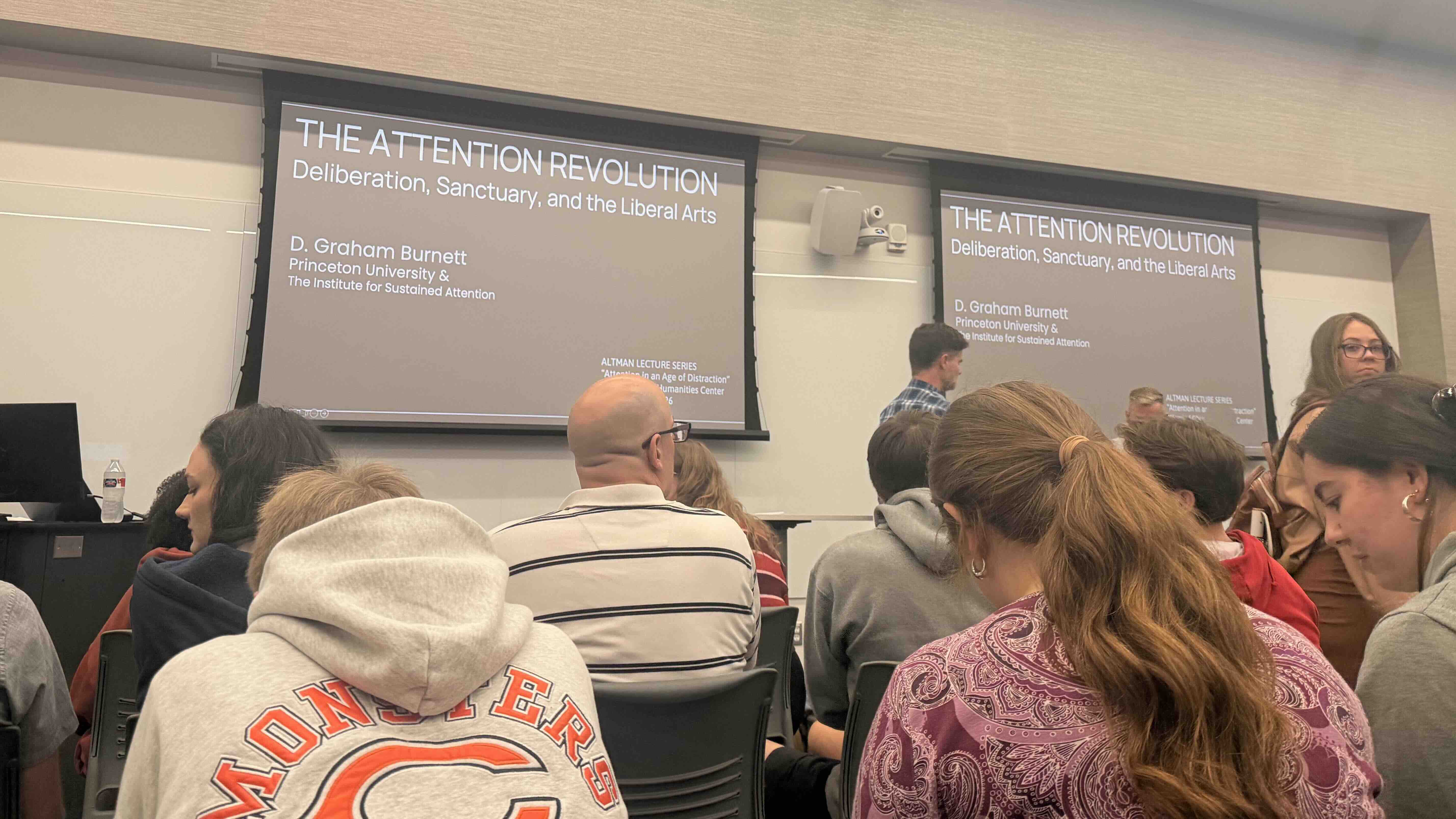
The Attention Revolution: Deliberation, Sanctuary, and the Liberal Arts
“Attention in the Age of Distraction” is a nine-part lecture series hosted by the Altman Institute through April
The first event of the Altman Lecture Series in the newly-updated Bachelor Hall brought D. Graham Burnett of Princeton University and The Institute for Sustained Attention to campus to explore a topic that affects every one of us: how we pay attention.
Burnett’s lecture, “The Attention Revolution: Deliberation, Sanctuary, and the Liberal Arts,” looked at how human attention has changed and why protecting it matters.
Burnett began by tracing the history of attention research, including government-funded studies throughout the 20th century. He discussed experiments that examined how long people could maintain focus, including research on pilots in training and single-screened focus-duration studies.
From there, Burnett connected those historical details to what he called “human fracking,” referring to the ways technology companies use human attention as a resource to monetize. He emphasized that the issue goes beyond simply spending too much time on phones or social media apps, saying, “The problem is not the phones, and it's not the social media either.”
One major theme throughout the lecture was that attention is more than an individual experience; it comes from being around people and objects.
“Human attention is social,” Burnett explained.
He noted that large entities, corporate or otherwise, compete and profit off our attention, but urged the audience to work together to challenge them. In his own words, “Powerful forces are fracking our attention. We can fight back. We need to fight back.”
Burnett introduced the idea of “Attention Activism,” which he described through three main ideas: study, organizing, and sanctuary. Rather than focusing only on reducing individual screen time, he encouraged people to think about how communities can create spaces that support focus, learning, and meaningful engagement.
“It takes an actual movement, like the environmental movements,” he said.
Additionally, the lecture connected attention to the university setting, education, and the liberal arts, emphasizing the importance of taking time to study and engage deeply with ideas, saying, “Study is the way you take shape as a person.”
Ultimately, “The Attention Revolution” invited attendees to think differently about our ordinary, but often taken-for-granted, ability: our attention.