Virtual Open Houses
Virtual open house sessions last approximately one hour. You’ll learn about the program, thesis process, and studio culture, and have opportunities to ask questions about admissions, assistantships, internships and more.




The Master of Architecture (M.Arch) is a graduate degree that is accredited by the National Architectural Accrediting Board (NAAB). In addition to a period of professional internship, the M.Arch degree qualifies individuals for the Architectural Registration Examination (ARE) and licensure in architecture. There are two pathways available: The M.Arch II program for students from pre-professional undergraduate architecture programs; the M.Arch III program for students with undergraduate degrees in fields other than architecture. Both programs sit within the Department of Architecture and Interior Design at Miami.
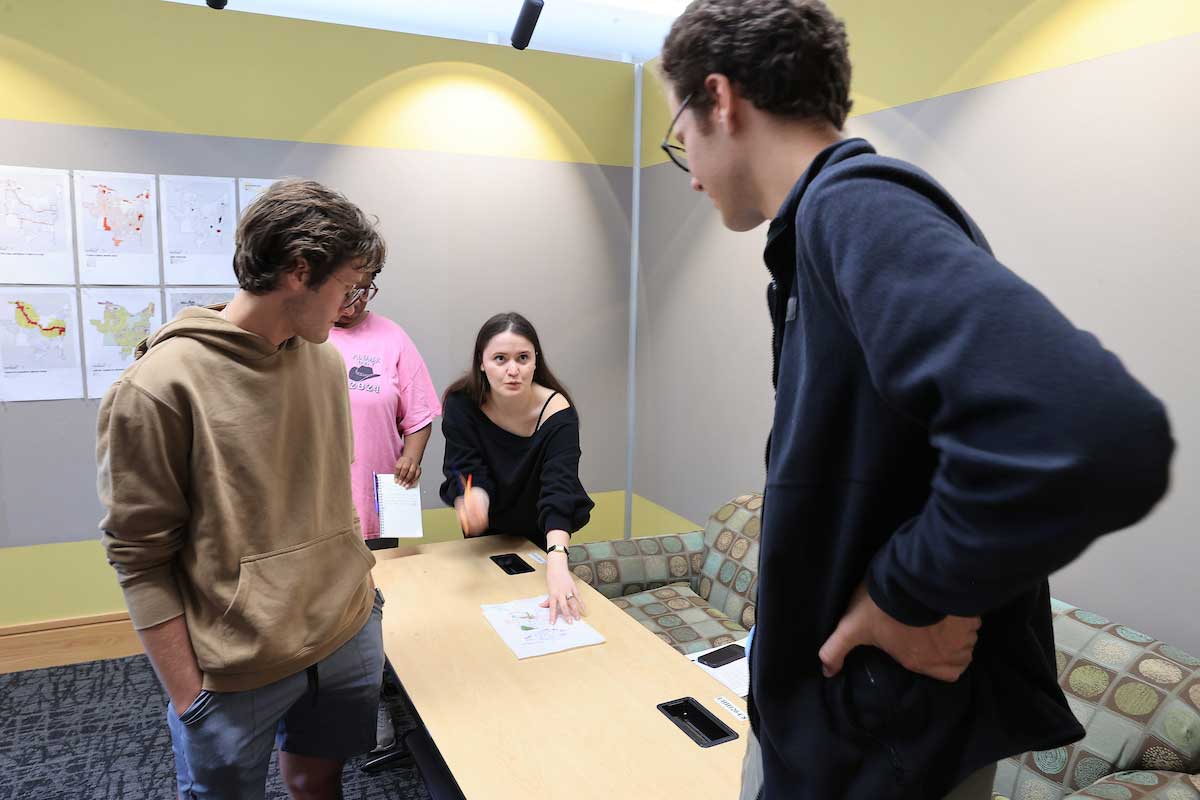 We welcome you to take a tour of Miami University’s Master of Architecture program – whether it is virtually or in person.
Take a look at the following opportunities to connect with our program.
Virtual open house sessions last approximately one hour. You’ll learn about the program, thesis process, and studio culture, and have opportunities to ask questions about admissions, assistantships, internships and more.
Check out architecture graduate student thesis project presentations. A Q&A with members of the admissions committee will be held 12-1 p.m. Lunch will be provided.
Nov. 18, 10 a.m. to 2 p.m.
Alumni Hall, Miami University, Oxford, Ohio
We also offer individual campus visits, with an opportunity to speak with a member of our graduate admissions committee and tour Alumni Hall with a current graduate student. Please contact Kim Wuertemberger at wuerteka@MiamiOH.edu to make arrangements to visit us.
We hope to see you at one of our events.
Graduates of the Master of Architecture degree program will be able to:

(60 credit-hour track)
The two-year professional program is designed for students with a pre-professional degree that is equivalent to a Bachelor of Arts in Architecture. Normally, a Bachelor of Arts or a Bachelor of Science in Architecture is considered an equivalent pre-professional degree. Other undergraduate degree programs, in which the students have completed four years of architectural design studio and requisite course work in architectural history and architectural technology, may also satisfy partial requirements for admission to the M.Arch II program.
The M.Arch II program is typically completed in two academic years. Students in the program must complete both a written and a design thesis.

(88 credit-hour track)
The three-year professional program is designed for students with an undergraduate degree other than architecture. The program was established to bring in students from diverse academic backgrounds, offering a variety of perspectives, different intellectual viewpoints, experience, and maturity that can significantly enrich the teaching and learning culture of the department.
The M.Arch III program is typically completed in three academic years. Students in the program must complete both a written and a design thesis.
In the first year of the three-year program, students learn the fundamentals of architectural design, technology, history, and theory, and also develop visual analysis and graphic communication skills. Design work from this first year will be reviewed by graduate faculty to determine eligibility to continue to the Second Year curriculum.


M. Arch II and M. Arch III students complete both a written and a design thesis, supervised by their graduate faculty committee. The thesis process and guidelines are defined in the Thesis Guidelines.
In Fall Semester of pre-thesis year, Architectural Theory (ARC 634) explores important design philosophies ranging from Aristotle to Robert Venturi. It is an intensive seminar course consisting of student-led discussion of twenty complete works and other smaller selections. Seminar papers provide practice engaging with the theory and criticism necessary for crafting a master’s thesis.
In Spring Semester of pre-thesis year, Design and Research Methods (ARC 636) works to establish a foundation for the written thesis and for site research. Students develop and present a preliminary thesis question in poster format to the graduate faculty. This encourages discussion and allows students to begin forming their thesis committees. Writing and diagramming exercises hone both textual and graphical communication with a focus on academic discourse. Independent research, guided by their instructor and thesis committee, informs individual methodologies and the development of a thesis draft. At the end of the semester, 80% of the written thesis is complete, allowing time for revisions, and site selection.
In Fall Semester of thesis year, Pre-Thesis Design Studio (ARC 701) concludes the written thesis process and prepares for the design thesis in Spring Semester. Students are encouraged to submit to relevant conferences, encouraging participation in academic discourse. Written thesis presentations are also sent to the thesis respondent (a distinguished academic or professional from outside Miami University). At this point, students begin their design thesis, including site selection, site analysis, programming, and schematic design, regularly consulting with their thesis committees.
In Spring Semester of thesis year, Thesis Design Studio (ARC 702) continues the design thesis with further exploration and prepares students to present their completed thesis near the end of spring semester. This course navigates the tension between exploration and completion, working to attain both during this final studio. Students must regularly consult with their committees for feedback and critique throughout this critical period. Near the end of the semester, the thesis respondent attends the thesis presentations to critique each student’s design thesis in light of their written thesis.
This process is supported by internationally recognized Visiting Scholars that work with the students. Our students regularly have their papers accepted at both domestic and international conferences.
(The Director of Graduate Studies will issue specific dates for each item at the beginning of each academic term, subject to revision.)
(Development dates to be embedded within ARC 636 course content/ schedule, subject to revision)
| Week | Activity |
|---|---|
| Week 1 | ARC 636 Written Thesis Development Issue: Framing the Research Question and Understanding And consider for whom one is writing: The Audience |
| Week 2 | ARC 636 Written Thesis Development Issue: Epistemology |
| Week 3 | ARC 636 Written Thesis Development Issue: Ideation and Previous Research on the Topic: Your Position within Current & Relevant Discourses |
| Week 4 |
ARC 636 Written Thesis Development Ideation Presentation (The Soiree). Faculty and Student submit committee configuration Request. Thesis Committees Announced. |
| Week 5 | ARC 636 Written Thesis Development Issue: Thesis Outline and Research Methodologies and Anticipated Outcome + Contribution to Discipline |
| Week 6 | ARC 636 Written Thesis Development Issue: Revise Thesis Outline and The Annotated Bibliography/Sources List and Schedule |
| Week 7 | ARC 636 Written Thesis Development Thesis Writing |
| Week 8 | ARC 636 Written Thesis Development Thesis Manuscript Proposal Draft Due Addressing Items 1-6 of the Manuscript Guidelines Proposal Form |
| Week 9 |
ARC 636 Written Thesis Development Thesis Draft Revision |
| Week 10 | ARC 636 Written Thesis Development Thesis Draft Revision |
| Week 11 | ARC 636 Written Thesis Development Prepare "Short Version" Presentations |
| Week 12 | ARC 636 Written Thesis Development "Short Version" Presentations to Faculty and Guests: Morning Sessions up to 2pm. Presentations of manuscript proposals are 10 Minutes Maximum + 10 Minute Question and Answer Session for a total of 20 minutes. Proposals reviewed by Committee for viability. |
| Week 13 | ARC 636 Written Thesis Development Revise Thesis Draft |
| Week 14 | Revise Thesis Draft. Students meet with all members of their committee to establish their research agenda and dates for additional meetings with their committee prior to the summer break. |
| Week 15 | ARC 636 Written Thesis Development Submit Finished Thesis Draft with bibliography and Abstract. Identify Conference Venues. |
August (end 1st week): Submit substantially completed written thesis document draft, thesis program and site documentation and analysis report to thesis committee chair and reader(s). This a necessary prerequisite for admission into ARC 701. Students are advised on their readiness to proceed; lack of readiness means the student may not proceed into 701.
August (end 2nd week): Faculty submit student thesis progress report to the Director of Graduate Studies to advise as to whether student is prepared to enter ARC 701.
Project Title:
Student Name (Please Print):
Students are required to receive thesis proposal approval in order to be eligible to register for any of the following courses:
( ) ARC 701 Architectural Design Studio Term:
( ) ARC 590.A Independent Stud Term:
(Site Analysis and Program Inquiry)
ARC 636 Instructor:
Names of faculty with whom you have consulted:
The Written Thesis Proposal poses a question to be investigated in the written portion of the thesis. Although the written portion of the thesis follows the form of the scholarly papers common to architecture and related disciplines, students are urged to consider early the possible connections between the written portion of the thesis and the subsequent design investigation.
Use 12 point Times type double space. At least 12 pages and not more than 20.
Articulate the following content incorporating the required subject headings noted below:
Please list the names of students you are willing to serve (specify chair or reader). Note whether or not you have discussed this with the student previously.
Please list the names of students you are not willing to serve as chair or reader.
Please list your first three choices for thesis chair:
1.
2.
3.
Please list your first three choices for thesis reader:
1.
2.
3.
Please note the names of any outside readers you have already engaged:
Date:
Project Title:
Student Name:
Thesis Chair:
Reader:
ARC 701, Fall Semester
Site Analysis, conceptual design, preliminary schematic design, and pre-programming
Miami University Department of Architecture and Interior Design Graduate Program
The guidelines below offer the thesis candidate departmental expectations about the nature and scope of Master of Architecture Design theses. The graduate committee acknowledges that students may pursue a design thesis grounded in personal inquiry with emphases in areas such as theory, landscape, urbanism, digital media, technology, artistic production, history, etc. Regardless of subject, there is an implicit assumption that most theses will be tested in an architectural building project with full technical documentation, and procedures and standards set below are intended to help guide such projects. These guidelines may be subject to change as a result of shifts within the broader context of architecture and the profession.
If a thesis project will not follow the norm of a standard building project, the thesis candidate must develop parallel guidelines at least as rigorous as those set forth below. The student’s thesis committee and the graduate committee before the midterm of the ARC 701 studio must approve any alternative guidelines.
All Architectural Design thesis projects must respond creatively and imaginatively to the thesis questions, challenges, and problems presented in the written thesis. Thesis candidates executing a building project to fulfill the Architectural Design requirement must develop their projects to function and be expressive at multiple scales, ranging from a large site context to smaller articulate details. The presentation of the Design Thesis must account for a sufficiently rich conception of the building at all such scales. The final design presentation should document fully the design investigation, incorporating at least three major areas: site documentation and analysis, and design process and development. The following standards are to serve as guidelines, but are negotiable by the candidate in conjunction with the studio instructor and committee, and as appropriate to the specific project, with the approval of the graduate committee.
A substantial deviation from these standards presumes the development of parallel standards of equal rigor, pre-approved by the thesis committee and the graduate committee.
Date:
Project Title:
Student Name:
Thesis Chair:
Reader:
Site Documentation and Analysis:
Design Process:
Architectural Building Design Presentation:
Miami University Department of Architecture and Interior Design Graduate Program
Graduate Studio Advancement Requirement (from the Graduate Studies in Architecture Guidelines and Policy): To be included in all graduate studio syllabi.
All Graduate students need to maintain the minimum 3.0 GPA Graduate School requirement for good standing designation each semester throughout their period of study in the architecture graduate program.
Any student receiving a grade lower than B- in design studio will, in concert with the graduate studio instructor and the Graduate Committee, undergo a progress review prior to the student's advancement to the next studio level.
Graduate students who receive 2 or more studio grades lower than B- in design studio, or have not met the 3.0 minimum GPA Graduate School requirement for the second semester, will not be eligible to commence or complete the thesis year.

Our Award-winning Alumni Traveling Studio received the prestigious National Council of Architectural Registration Boards NCARB Jury Prize in 2005. Forming part of the NCARB Award program, the Prize Jury recognized that its leader, Craig Hinrichs, had developed a unique pedagogical approach that should be emulated across the US. The Alumni Traveling Studio pairs a studio in our program with a project being carried out in an alumni office. The alumni form part of the teaching team and provide students hands-on experience of the realities of project design, development, and construction.
When a Traveling Studio is held, there are additional fees. Please contact Liz Martin-Malikian, Department Chair and Director of Architecture Graduate Studies, for more information.

The Department has specialists in social justice and community design. We have award-winning faculty in questions of net-zero energy design, have a full range of widely published historians and theorists and several graphic, video, and fine artists who have exhibited across the United States. In addition, we have expertise in digital design and fabrication, as well as urban design and planning and more. The range of our faculty expertise is essential to support our unique design thesis approach through which students get the opportunity to develop their own specific areas of expertise.

Liz Martin-Malikian, Department Chair and Director of Architecture Graduate Studies