Miami students study artificial intelligence in Southern Italy
Students gained a global perspective on artificial intelligence through classroom projects, cultural experiences, and international collaboration.
Miami students study artificial intelligence in Southern Italy
Students gained a global perspective on artificial intelligence through classroom projects, cultural experiences, and international collaboration.
The below translation is auto-generated and may contain mistakes.
Presenter: A trip overseas to learn the secrets of artificial intelligence, not in the direction of Silicon Valley, but toward Southern Italy, precisely the University of Calabria, which welcomes the students of Miami University in the new edition of its Summer School.
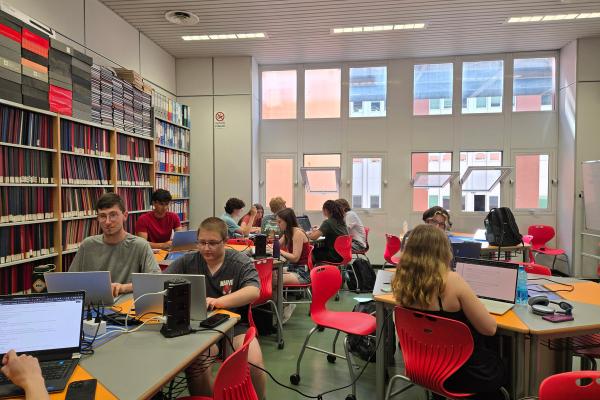
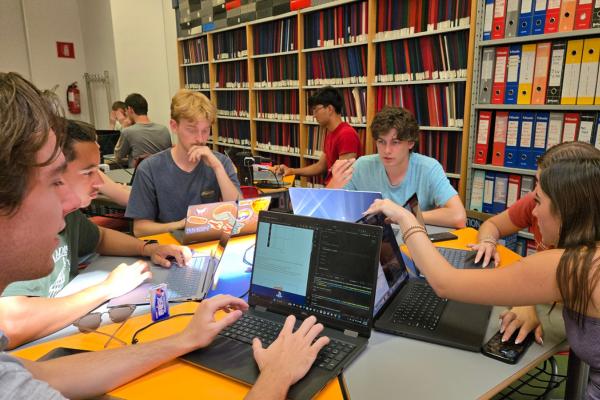
Francesco Ricca: At the moment, the students are following a lesson related to the study of computational logic. It is a branch of artificial intelligence that basically allows complex problems to be solved automatically, simply by specifying the characteristics of the problem to be solved.
Presenter: A flow that reverses: no longer Italian students leaving for Silicon Valley in the United States, but American students crossing the ocean to arrive in Southern Italy to learn the secrets of artificial intelligence.
In fact, a new edition of the Summer School dedicated to 20 university students selected from Miami University in Ohio is underway at the University of Calabria.
Miami Student: “I greatly enjoyed my experience here, and I am grateful to the University of Calabria because it allowed us to participate in this program. I learned a lot about computational logic and programming. This experience will be of great help to me in my research within my university in pursuit of AI and deep learning.”
Faculty Member: American students find here a cutting-edge center where it is possible to learn not only today’s issues of artificial intelligence, but also the direction in which artificial intelligence is moving.
Presenter: Launched in 2014, the initiative has become an annual fixture, confirming the University’s ability to export knowledge to the highest level. The main field of research will be the way to explain why artificial intelligence implements choices.
Nicola Leone: When artificial intelligence makes decisions about a diagnosis or therapy to follow, knowing why is essential.
Presenter: This is a field that is of great interest to the main multinationals in the sector.
Nicola Leone: they are attracted by the possibility of having privileged access to our talented graduates in computer science and computer engineering. At the same time, there is the possibility of collaborating with the departments in Calabria on innovative issues in the future.
Thank you to TGR Leonardo for featuring our students!
[Editor's note: The correct number of Miami University students took part in this study abroad experience was 18, not 20 as stated. For live captions in English on the embedded YouTube video, select "Watch on YouTube" to watch in a new browser window. Then, turn on captions, and set your captioning settings to show the auto-generated English translation.]
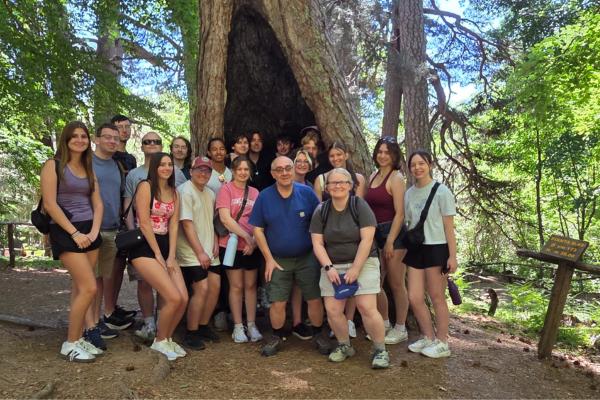
For four weeks this summer, Southern Italy became the classroom for 18 Miami University College of Engineering and Computing (CEC) students studying artificial intelligence at the University of Calabria.
Located in the “toe” of the Italian Peninsula, Calabria was the setting for CEC’s “Knowledge Representation in Italy” faculty-led study abroad experience, where students learned directly from international experts in a subfield of AI focused on rules, logic, and computational reasoning.
Through coursework with faculty in the University of Calabria’s Department of Mathematics and Computer Science, students gained new insight into artificial intelligence and saw how international collaboration can deepen technical learning. Their experience was also featured in Italian news coverage.
At the University of Calabria, Miami students received instruction from leading academic figures in the field, including Professor Georg Gottlob and Professor Nicola Leone, both of whom are Fellows of the European Society for Artificial Intelligence (EurAI). Miami students also attended lectures by Professor Francesco Calimeri and Professors Carmine Dodaro, Marco Maratea, and Francesco Ricca of the University of Calabria's Artificial Intelligence Laboratory.
Throughout the program, CSE faculty members Kaylynn Borror and Alan Ferrenberg helped guide students through the academic and cultural experience, connecting classroom concepts with the broader context of studying, collaborating, and learning abroad.
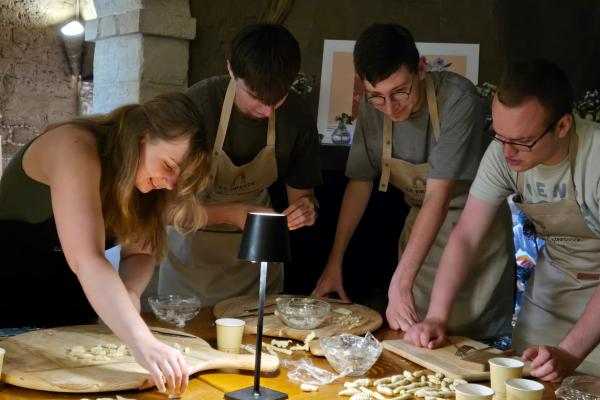
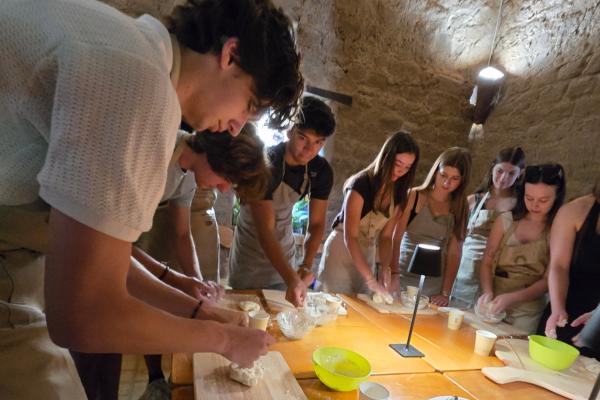
"We've been running this program for 11 years, and I'm proud to have been part of it for the last four," said Kaylynn Borror, assistant lecturer of Computer Science and Software Engineering. "Our students get a chance to explore and learn about not only the Calabria region and its history, but also a different approach to AI than the typical machine learning-based systems." Borror expressed that interfacing directly with thought leaders in Italy offered students a uniquely powerful learning experience. "Our partners at the University of Calabria give our students the opportunity to learn directly from the experts about logic-based AI."
Topics covered
Students who took part in the Knowledge Representation in Italy study abroad trip earned 6 semester credit hours through the completion of two courses: CSE 268, Introduction to Knowledge Representation, and CSE 468, Applied Knowledge Representation. These courses count as upper-level electives for the Computer Science and Cybersecurity majors, as well as electives for the Deep Learning and Artificial Intelligence minor.
Unlike many of the probabilistic methods behind today's AI systems, knowledge representation is a form of AI focused on rules and logic. Classroom topics included computational logic and answer-set programming. Students learned how to use state-of-the-art logic-based languages, techniques, and tools to develop models that capture information about the world to be used for solving complex problems.
They also learned to develop small intelligent systems capable of performing reasoning tasks such as planning, decision making, and problem solving.
Learning through place and culture