
Making 3D-printed carbon fiber reinforced polymer composite parts ready for the real world
NSF-funded research led by Muhammad Jahan, Ph.D., explores more sustainable ways to finish advanced materials used in aerospace and other industries
NSF-funded research led by Muhammad Jahan, Ph.D., is exploring more sustainable ways to finish 3D-printed carbon fiber reinforced polymer composites for use in aerospace, automotive, and other high-performance industries.
Making 3D-printed carbon fiber reinforced polymer composite parts ready for the real world
NSF-funded research led by Muhammad Jahan, Ph.D., is exploring more sustainable ways to finish 3D-printed carbon fiber reinforced polymer composites for use in aerospace, automotive, and other high-performance industries.
Before 3D-printed carbon fiber reinforced polymer (CFRP) composite parts can be used in aircraft, vehicles, or other high-performance systems, they often need one more step: precise, reliable finishing that makes them ready for real-world use.
With support from the National Science Foundation (NSF), Muhammad Jahan, Ph.D., associate professor of Mechanical and Manufacturing Engineering, is studying more sustainable ways to complete that finishing process. The $200,000 grant, awarded in June 2026, will advance that research while creating hands-on opportunities for both graduate and undergraduate students. Through the project, students will gain direct experience solving manufacturing engineering challenges connected to the future of aerospace, defense, automotive, and other industries.
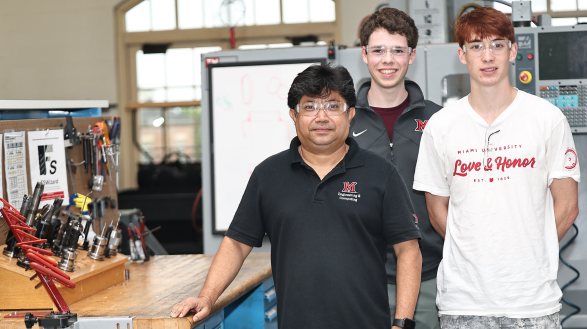
 Muhammad Jahan, Ph.D.
ahan’s research with students will focus on carbon fiber reinforced polymer composites, often shortened to CFRP. These strong, lightweight materials are widely used in aerospace, including commercial aircraft and defense applications, and are also used in automotive and construction industries.
Additive manufacturing, a technical term for 3D printing in manufacturing settings, can create CFRP parts close to their final shape, but those parts may still need additional finishing before they can be used. Jahan’s project will study how sustainable machining processes can improve surface finish and dimensional accuracy without damaging the material’s strength or performance. Precision and material integrity are essential because components may be expected to perform under stress and in demanding operating environments.
In this project, sustainable machining means exploring finishing methods that use less energy, fewer resources, and less cutting fluid than traditional approaches. Jahan will study how options such as dry machining, minimum quantity lubrication, and cryogenic coolant machining affect the quality and performance of 3D-printed CFRP parts.
The grant is also expected to support research positions for both graduate and undergraduate engineering students, creating meaningful opportunities for hands-on research at Miami. In these roles, students will receive training in advanced manufacturing, materials characterization, experiments, and computer simulation. Jahan said undergraduate students can bring unique value to the project with their recent hands-on experience with design, CAD, CNC machines, and project-based learning, while graduate students can help mentor them through the research process. “Undergraduate students can really work very closely with graduate students to form teams and share some of the responsibilities,” Jahan said.
If successful, Jahan’s project could help advance more sustainable approaches to manufacturing strong, lightweight components for high-performance industries. For students, the work offers a chance to help shape new solutions for one of advanced manufacturing’s emerging challenges: finishing 3D-printed composite parts with the precision and reliability real-world applications demand.