
The Albarrán Family's Memorable MUDEC Year
What is it like to live as a family in Luxembourg while teaching for MUDEC during a pandemic? The Albarrán family shares their story.
The Albarrán Family's Memorable MUDEC Year
What is it like to live as a family in Luxembourg while teaching for MUDEC during a pandemic? The Albarrán family shares their story.
Did you work on any other projects?
JCLA: While in Europe most of the projects I worked on were connected with the refugee class I was teaching. I was also teaching my regular class load in Oxford, so I was involved in different activities and projects with the Oxford campus while in Luxembourg.
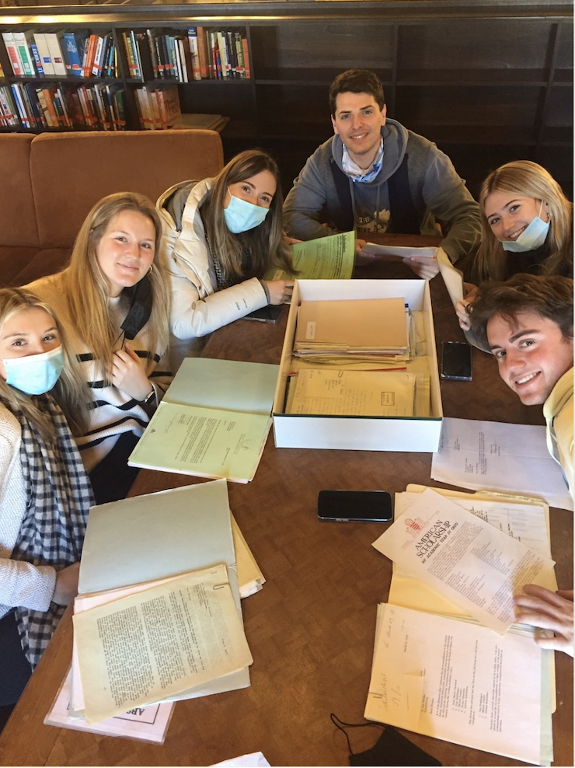
EJA: As part of restoring order to the MUDEC archive, I spent time identifying projects that the archive could be useful for. And since we were relatively confined to the Château for most of the fall and all of the winter, I was able to make progress on some other research projects. I completed a draft manuscript of my second book project (on transnational exchanges between children of the Americas in the early twentieth century), and finished up some articles and a book review.
I am also working on presenting the oral history projects completed by the students in HST 250 as part of a Decolonial and De-Cold War Childhood conference this October. The memories that students collected from their friends and family members will be incorporated into a global memories database that has been part of an ongoing research collective to which I belong.
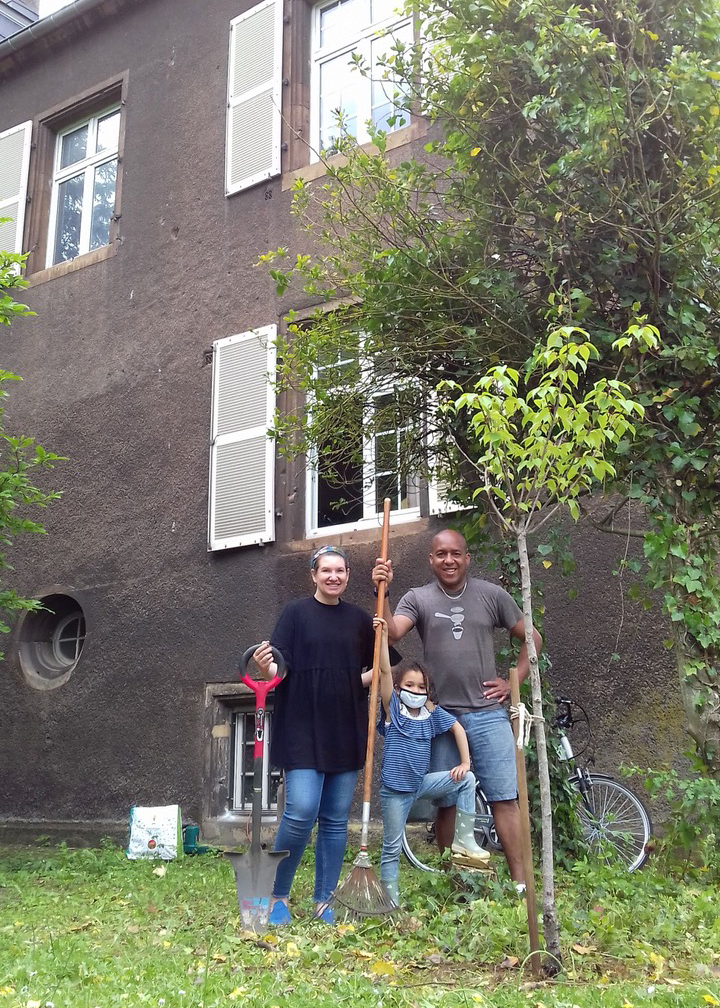 This part of Europe has been experiencing some devastating effects to the forests due to droughts, extra-hot summers, and climate change, and we witnessed the city cut down dozens and dozens of dead or severely unhealthy trees in the immediate environs of theChâteau. We organized a tree planting for the spring semester students to commemorate Earth Day, in a small and symbolic gesture to help reforest this beautiful piece of land, and then we added a family tree of our own to the grounds, in close consultation with the incomparable groundskeeper Guy Graul. Planting a tree is a tradition that we hope future cohorts of MUDEC students will continue, by leaving a lasting mark in exchange for the permanent imprint that Luxembourg will no doubt leave on them.
Tell us about the adjustments your family made to life in Differdange
EJA: The bread and pastries! We will never be the same. Aside from that, we have really enjoyed being car-free for the year, and have taken full advantage of the completely free national transportation network that is wonderfully clean, efficient, and reliable. It helps us to imagine a less carbon-intensive lifestyle back at home, and we hope to bring an aspect of that back with us when we return.
We did not make much progress with Luxembourgish, although we might have done better had we been able to socialize more with other parents or contacts in a non-COVID context. In the late spring and now in the summer, things have begun to improve socially and more people are circulating in the streets, but the social situation for much of the academic year was really limited to just a lot of very intensive family time.
JCLA: There have been many things we needed to adjust to since our arrival. The classes for our children's International School start later than in Oxford (mid-September) and end in mid-July. They study languages as part of their curriculum, and that is different from what we have in our school system in the U.S.
As a country with a very strong welfare system, Luxembourg provides a lot of services that the residents can take advantage of. We were able to take our kids to practice sports like gymnastics and soccer. In Luxembourg, children need to pass a thorough physical exam run by a specialized sports health clinic before they can participate in any matches with their league.
Where did you travel during your time at MUDEC?
EJA: In the fall, I took my students on a study tour to Berlin, which was the perfect place to witness the convergence of the Cold War ideologies and built environments in one city. Highlights included a day spent biking through the city, a riverboat cruise through the city, and a day on the outskirts of the city in an abandoned tuberculosis sanatorium that has been converted into a state park.
In the spring, the entire MUDEC cohort combined all three study tours into one mega-tour of coastal Croatia, one of the only places available for us to travel to in COVID times. As part of former Yugoslavia, which was the headquarters of the Non-Aligned Movement, Croatia ended up being the perfect place to study Cold War geopolitics and culture.
COVID restrictions meant that our personal travel was severely limited. We barely forayed beyond Luxembourgish borders at all, which at first was quite a disappointment given our expectations to explore Europe. However, in exchange, we’ve gotten to know Luxembourg extremely well, and feel like we’ve gotten a privileged view of the country’s diverse landscapes, built environments, and civil structures. I’ve fallen in love with the overgrown post-industrial moonscape of the Minnett region (Luxembourg’s southern region that housed the mining industry.) The UNESCO-protected fortified city of Luxembourg is the most overlooked and underrated European city I’ve ever been to, and reveals new treasures each time we visit.
The Moselle River valley on the border with Germany was absolutely intoxicating, and I can hardly imagine a more peaceful site for a getaway. The bike paths are exquisitely maintained and networked. We easily (and accidentally) biked into France one day, and Belgium another day, and wove in and out of Germany on yet another day. We rented a car and drove through the Valley of the Seven Castles, and rated each one on a scale created by our son. Since we weren’t lured away by the misleading proximity (when looking at a map) of Stockholm or Lisbon, we focused our weekends on Luxembourg and really maximized our time.
JCLA: The COVID pandemic has been a challenge for the European Union in terms of the “Open Borders” policy and trying to control the spread of COVID. I might have to put Croatia as one of my favorite places after visiting that country.
The area of Remich and Remerschen in Luxembourg is really beautiful with some hiking, river walks, wine tasting, etc. making it a very unique area to visit. This is probably one of the areas we enjoyed the most while in Luxembourg. We took a family bike ride along the Moselle River overlooking the vineyards that was breathtaking. We also got to see the biodiversity center and are with some of the preserve lands that not only has a range of birds, plants, and also historical sites like Roman points of trade, making this a great experience.
What was your favorite local shop to visit?
EJA: There is a wonderful stationery store in nearby Esch that has a stunning array of pens. I think that the most expensive one I saw was 1400 Euros. I splurged and purchased one for 20 Euros. One train station away, there is a meat and dairy farm that has a little untended shop where you can buy a litre of fresh cream that you dispense into your own container, and pay in coins by the honor system.
JCLA: I think my favorite place to go was Boulangerie-Patisserie Berto here in Differdange. There is nothing better than getting up in the morning and walk to Boulangerie-Patisserie Berto and get a fresh baguette, a fresh croissant, or an eclair. At one point before the restaurants were closed due to COVID, I would go and have a fresh squeezed orange juice, a cappuccino, and a croissant; nothing beats that. Now, there are others like Fischer, Bartholome, or Paul’s but my favorite was that Berto.
What were some of the most surprising or memorable moments?
EJA: One of the most memorable moments was a field trip that I took with my HST 296 class to Schengen (where the Schengen Treaty was signed to remove border restrictions in the European Union, and where France, Germany, and Luxembourg all meet), and the overnight youth hostel stay nearby. During our trip, I transported them back to 1984 (before the Schengen Treaty was signed), and we had a night of 1984-style hostel socialization. I took away their phones, they made and played a mixtape, and we did arts and crafts, word games, and chess, while we talked politics. It was a refreshing step into past modes of travel and socialization, and took place in one of the classic sites for international exchange and intercultural growth: a youth hostel.
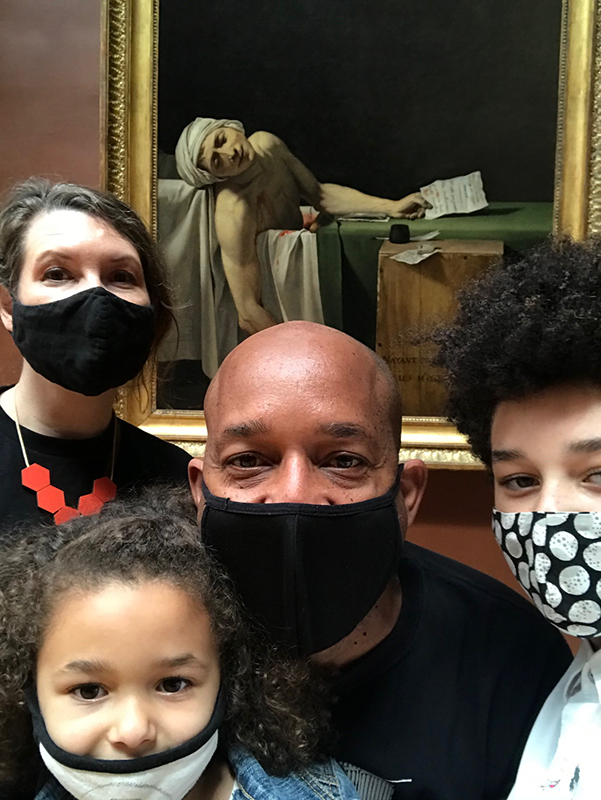
Another very rewarding moment was very recently, when we were finally able to take our first trip to Paris for a weekend. One of the principal motivations for our son (age 11) to come to Europe was to see one of only a handful of extant Vermeer paintings, after he had read a book about Vermeer and unsuccessfully trekked to Detroit and Chicago in hopes that there would be one there. We went to the Louvre, and tracked down the two Vermeers in the collection, which delighted and validated him. We also found The Death of Marat, a painting which we had reenacted as a family in my office bathtub (perks of living in the Château: there is a bathtub in my faculty office!)
JCLA: I have enjoyed all the integration trips coordinated by MUDEC. Those trips helped us ground ourselves with the history of the region from medieval historical landmarks like the Vianden château to the American and Germany WWII cemeteries. There is a lot to see in Luxembourg and we learned that from our first trips.
I enjoyed a lot of the activities organized by MUDEC and SFC too. I enjoyed seeing the Luxembourg Symphonic Orchestra last fall, hearing about dissident art in Russia, and cleaning all the green areas of the Château with the students on Earth Day.
What are some of the ways the pandemic affected your family's life?
JCLA: It was a very challenging time for us personally. I got COVID over Thanksgiving and then our kids got COVID, so we spent most of our winter break in quarantine in the Château.
I think another way that COVID has impacted my life at MUDEC has been the limits it put in how I have to change some of the activities I wanted to do with my students, like visiting the UNHCR in Brussels. It also limited the opportunity to build camaraderie with the MUDEC faculty due to social distancing.
EJA: We had to have a lot of COVID tests, and there was a lot of uncertainty, especially in the fall. The long back-to-back quarantines in the deep, rainy gray winter months were especially emotionally challenging, and it was hard to remain optimistic, creative, and productive.
But sometimes we played hide and seek in the Château. We found a very old Christmas tree in one of the cabinets and decorated it with paper chains that we had colored with splatter paint, all from materials found in the classrooms. We cooked a lot. I suppose that it’s not that different from how most people back home spent the winter COVID months, so we don’t feel too badly that our dreams of wintering in Spain and Portugal were unrealized.
What are your plans as you return to the U.S.?
EJA: I will return service commitments in both of my departments of History and Global and Intercultural Studies. I’m going to be a faculty scholar participating in this year’s Altman series on Race and Racism, and look forward to those conversations with colleagues. I have sorely missed my colleagues and the generative, fun, collaborative things that we always cook up together, so I’ll be looking forward to department life again. I’m especially looking forward to helping to grow the Latin American, Latino/a, and Caribbean Studies program back to healthy numbers, and to teaching courses on Latin America.
JCLA: I think I would like to enjoy my home space a little more once I get back. My immediate future involves a summer project called the Study of the United States Institutes (SUSI) by student leaders. It is a program sponsored by the State Department and the Education and Cultural Affairs (ECA) that allows for students from marginalized regions of Latin America to come to the U.S. to learn about U.S. institutions and bring some of these ideas back home to empower people in their countries.